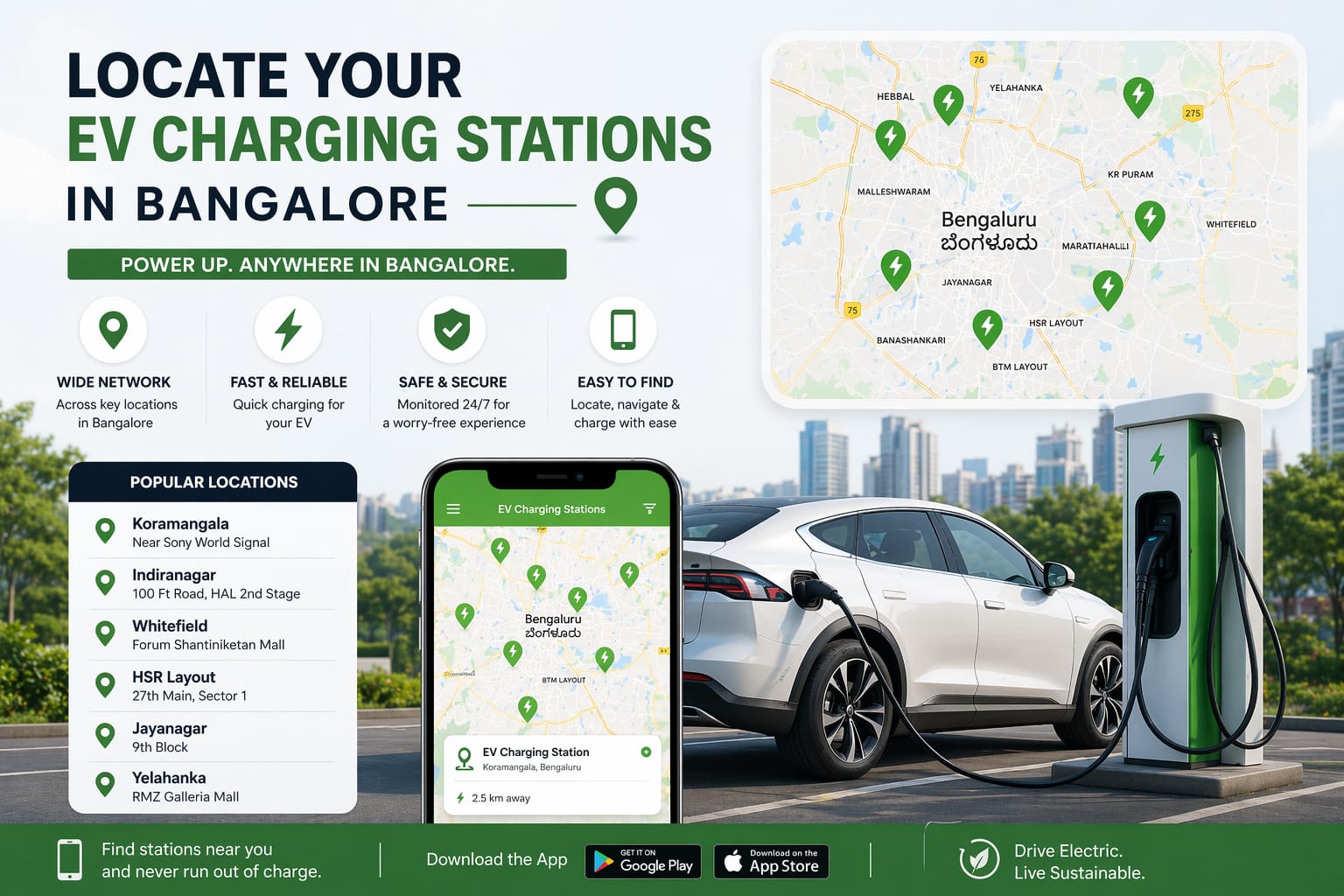
Bangalore, long celebrated as India’s Silicon Valley, is currently undergoing a profound structural shift in its transportation landscape. As of April 2026, the city has firmly established itself as a front-runner in the nation’s electric vehicle (EV) revolution. This transition isn’t just a passing trend; it is a data-driven evolution supported by aggressive policy frameworks and a rapidly densifying charging network that makes “range anxiety” a thing of the past.
The Numbers: Present Infrastructure and Future Projections
The rapid expansion of the EV charging stations in Bangalore is a direct reflection of the city’s commitment to a cleaner future. By analyzing the current metrics and future targets set by the Karnataka Clean Mobility Policy 2025-30, we can see a clear roadmap of how our daily commute is being redefined.
Current Infrastructure (2026): Karnataka is currently the leading state in India’s electric transition, boasting a network of over 5,700 public charging stations. A major portion of this infrastructure is concentrated within the Bangalore Metropolitan area, ensuring that drivers are never far from a power source.
Targeted Growth: The momentum is only increasing. Backed by the PM E-DRIVE scheme and strategic state budget allocations of ₹350 million, Bangalore is on track to integrate 2,500 new public-private partnership (PPP) charging stations by the end of the next fiscal year.
Long-term Vision (2030): The state’s vision for 2030 is ambitious yet structured. In urban areas, the goal is a density of one charging station every 3 km within city limits. For inter-city travelers, high-speed charging corridors are being established with stations every 25-50 km on major routes like the Bengaluru–Pune and Bengaluru–Mysuru highways.
Mapping the Network: Strategic Urban Charging Hubs
The city’s strategy focuses on “high-dwell” areas—locations where you naturally spend time, like depots, malls, and main roads. This integrates charging into your daily routine rather than making it a chore. In 2026, Bangalore’s grid isn’t just about presence; it’s about power density. With the city now maintaining an average of one charging point for every 4 km² in core zones, staying powered up is as easy as grabbing a coffee.
Hennur – Tata Power Charging Hub
The Tata Power station at BMTC Hennur Depot 10 serves as a vital anchor for Northern Bangalore. As of 2026, this hub has expanded to feature 6 high-capacity CCS2 points, capable of delivering up to 60 kW of power. This infrastructure is a lifesaver for long-range electric SUVs, allowing drivers to gain approximately 150 km of range in just 30 minutes while they manage nearby errands.
New Thippasandra – Bharat Petroleum eDrive Station
Located near the Sri Ganesha Temple on the Main Road, this BP station is a high-traffic essential for the Indiranagar-CV Raman Nagar corridor. It features a dual-gun 30 kW DC Fast Charger, specifically designed for “top-up” culture. Research shows that the average user here spends just 22 minutes plugged in—perfect for commuters moving through busy eastern zones who need a quick, reliable energy boost mid-journey.
Indiranagar – EESL Multi-Modal Hub
Situated on the iconic 100 Feet Road, this hub remains a favorite for urban professionals. It is one of the city’s most versatile stations, boasting a mix of CCS2, CHAdeMO, and Type 2 connectors. With a 98.5% uptime record in 2025, it’s the go-to spot for compatibility, ensuring that whether you’re driving a premium import or a local hatchback, you’re never stranded without a matching plug.
Koramangala – Ather Grid Fast-Charging Point
We haven’t forgotten the two-wheeler community that powers Bangalore’s startup heart. The Ather Grid on 80 Feet Road is a dedicated fast-charging powerhouse for scooters. This station utilizes proprietary “Ather Duo” technology, allowing riders to add 15 km of range in just 10 minutes. It’s part of a dense cluster in Koramangala where charging points are now spaced less than 1.5 km apart, catering to the thousands of riders navigating this tech hub daily.
Technical Compatibility: Understanding the Hardware
If you’re new to the EV world, the terminology can feel like a different language. However, understanding your “plug” is essential for a smooth experience.
CCS (Combined Charging System): This is the gold standard for DC Fast Charging. It can typically juice up an EV battery from 10% to 80% in about 45–60 minutes. It’s your go-to for quick stops.
Type 2 (AC Charging): This is better suited for home or workplace charging. It provides a steadier flow that is gentler on your battery’s long-term health, usually taking 6–8 hours for a full charge.
Empowering the User with Real-Time Intelligence
In 2026, finding a “plug” is no longer a matter of luck. Digital ecosystems like EV.sale have become the Best EV marketplace in Bangalore by offering a unified view of the entire city’s grid. These platforms do the heavy lifting for you:
Live Status Tracking: You no longer have to drive to a station only to find a long queue or an “Out of Order” sign. You can now see exactly which plugs are active and available in real-time.
Intelligent Compatibility Filters: Whether you are on an Ather scooter or in a high-end electric SUV, these tools allow you to save your vehicle profile and filter only for the stations that actually fit your car.
Predictive Cost Analysis: Currently, running an EV in Bangalore costs between ₹0.80 and ₹1.50 per km, while petrol alternatives remain high at ₹6–₹8 per km.
Bangalore’s Vision for a Future-Ready City sell ev cars online
Bangalore’s shift toward electric mobility serves as a national blueprint for urban sustainability. The city’s success is a perfect mix of aggressive government targets and private sector innovation.
The Investment Landscape: The state is currently executing the Karnataka Clean Mobility Policy 2025-30, targeting a massive ₹500 billion (approx. $6 billion) in investments.
This isn’t just about sticking chargers in the ground; it’s about a holistic ecosystem. This includes Grid Modernization—using massive Battery Energy Storage Systems (BESS) to ensure the grid handles peak demand—and Policy Incentives, like capital subsidies of up to 25% for fast-charging infrastructure.
How much does it cost to charge an electric vehicle in Bangalore (2026)?
Under current BESCOM guidelines, public fast charging typically costs between ₹8 and ₹10 per unit. This makes EVs incredibly economical, resulting in an average running cost of just ₹0.80 to ₹1.50 per km, compared to over ₹6 per km for petrol-run vehicles.
Which are the best apps to locate EV charging stations in Bangalore?
For the most reliable real-time data, Static and Zeon are highly rated for their “plug-and-charge” features, while Tata Power EZ Charge offers the widest network. Aggregators like ev.sale are also essential for viewing multiple provider networks on a single, unified map.
What is the current status of EV charging infrastructure in Bangalore?
As of April 2026, Bangalore is the hub of Karnataka’s 5,700+ public charging points, the highest in India. The city is currently adding 2,500 new PPP stations under the PM E-DRIVE scheme to ensure every resident is within 3 km of a reliable charger.
Can I get a subsidy for installing a private EV charging station?
Yes, the Karnataka Clean Mobility Policy 2025-30 provides a GST reduction to 5% on all charging equipment. Furthermore, housing societies and private entities can avail of a 25% capital subsidy to help offset the initial costs of installing fast-charging infrastructure.
How long does it take to charge an EV at a public station?
Charging times vary by hardware: DC Fast Chargers (CCS) can power your battery from 10% to 80% in 45–60 minutes, making them ideal for quick stops. Type 2 AC chargers are slower, taking 6–8 hours for a full charge, which is perfect for office parking or overnight stays.
Leave a Reply