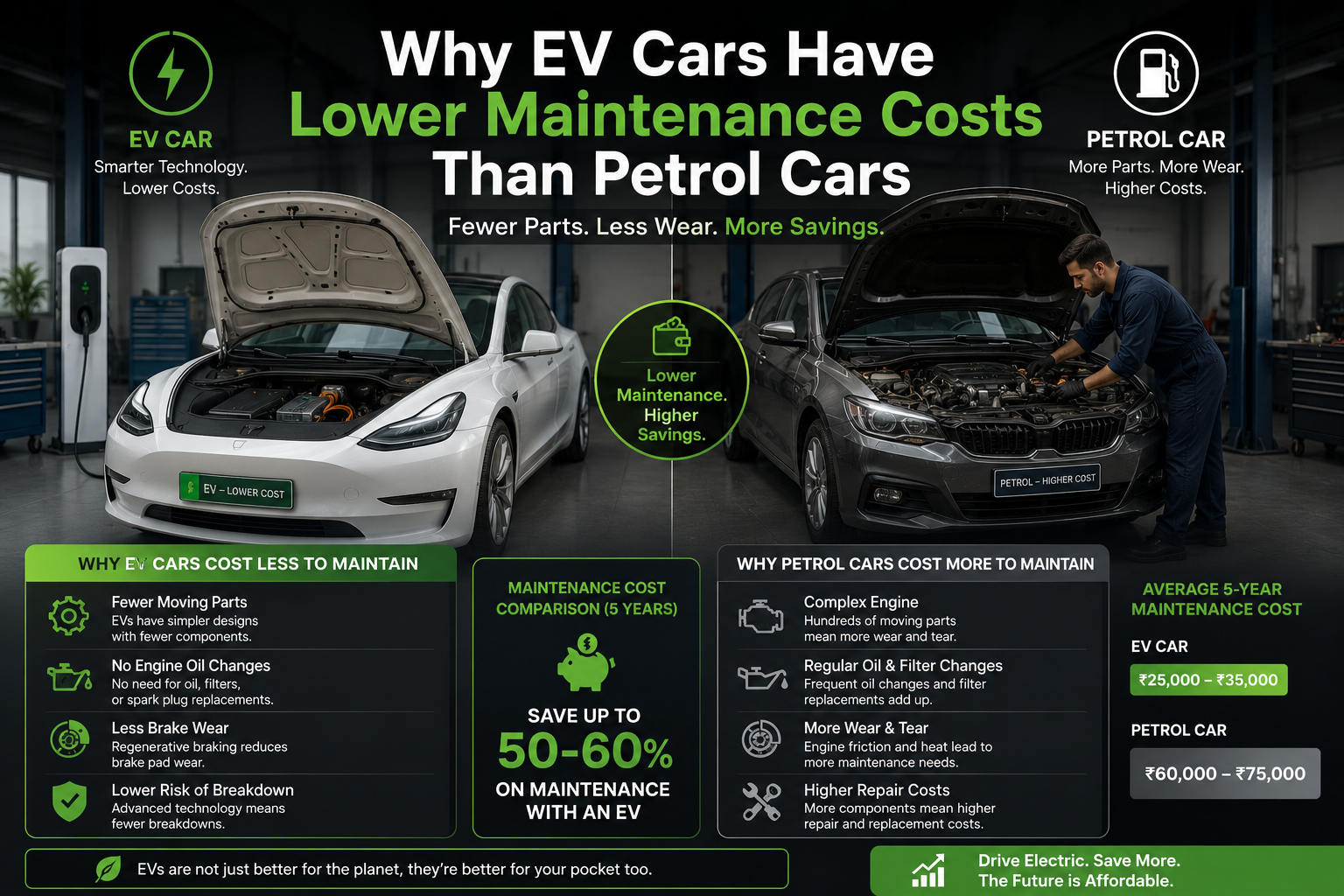
The global automobile industry is changing faster than ever before, and electric vehicles are becoming the center of this transformation. Over the last few years, EV adoption has increased not only because of environmental awareness but also because of the financial benefits that come with owning an electric vehicle. While fuel savings are often discussed, one major advantage that continues to attract buyers is the significantly lower maintenance cost compared to petrol-powered cars.
In India, vehicle ownership expenses have increased sharply over the past decade. Petrol prices in several cities continue to remain above ₹100 per litre, while service costs for traditional vehicles are also climbing every year. Regular oil changes, engine servicing, clutch replacements, gearbox maintenance, and exhaust repairs make petrol car ownership expensive in the long run. Electric vehicles, however, are proving to be more economical and practical for daily usage.
Industry reports from 2025 show that EV owners spend nearly 40% to 50% less on yearly maintenance when compared to petrol vehicle owners. This difference becomes even more important for families, office commuters, and fleet operators who use their vehicles extensively every day. As a result, more buyers are now choosing EV-focused platforms like ev.sale to buy and sell EV Cars online in a smarter and more efficient way.
Simpler Engineering Reduces Long-Term Costs
One of the biggest reasons EVs are cheaper to maintain is because of their simple mechanical design. A standard petrol vehicle contains more than 2,000 moving parts in its engine and transmission system. Electric vehicles, on the other hand, use fewer than 20 major moving components in the drivetrain.
This difference directly impacts service expenses. Petrol cars require engine oil replacement every few thousand kilometers, along with air filter cleaning, spark plug replacement, clutch maintenance, radiator servicing, and emission system checks. Depending on the vehicle segment, annual servicing can cost between ₹25,000 and ₹60,000.
Electric cars remove many of these costs entirely. Since EVs do not have engine oil, fuel injectors, or exhaust systems, owners spend much less on regular maintenance. Most EV servicing mainly includes software updates, brake checks, battery cooling inspections, and tire rotation. According to industry studies, EV owners can save nearly ₹4 lakh to ₹6 lakh during a 10-year ownership cycle compared to petrol vehicles.
Another important advantage is regenerative braking technology. Unlike petrol vehicles where brake pads wear out quickly, EVs use regenerative systems to slow down the vehicle while recovering energy. This reduces brake wear significantly and extends the life of braking components. Some EV owners report brake pad replacement only after 80,000 kilometers, while petrol cars may need replacement much earlier.
Why More Owners Prefer to Sell EV Cars Online
India’s used EV market has grown rapidly over the last three years. Earlier, many buyers were hesitant because of concerns around battery life and charging infrastructure. However, improvements in battery technology and faster charging networks have changed customer perception completely.
Modern EV batteries now come with warranties ranging from 8 to 10 years, improving buyer confidence in the second-hand EV market. According to automotive research data, used EV demand in India grew by nearly 40% in 2025 alone. Consumers are increasingly looking for affordable electric mobility options that provide lower running costs without sacrificing comfort or technology.
This growing demand has encouraged many vehicle owners to Sell EV Cars online through EV-specific platforms rather than traditional automobile marketplaces. Dedicated EV marketplaces attract informed buyers who understand battery health, charging solutions, and electric vehicle performance. This creates faster transactions and more serious inquiries for sellers.
Running costs also play a huge role in this shift. A petrol vehicle can cost around ₹7 to ₹10 per kilometer depending on fuel efficiency and traffic conditions. In comparison, charging an EV at home generally costs around ₹1 to ₹2 per kilometer. Over several years, this difference can save owners lakhs of rupees.
For Bengaluru commuters who face heavy traffic daily, EVs are becoming an even more attractive option because regenerative braking improves efficiency during slow-moving traffic conditions.
The Growth of the Best EV Marketplace in Bangalore
Bengaluru has emerged as one of India’s largest electric mobility hubs. The city is home to several EV startups, battery technology companies, and charging infrastructure providers. Karnataka currently contributes a major share to India’s growing EV ecosystem, and the state government continues to support electric mobility expansion through multiple initiatives.
As EV adoption increases, the need for a trusted and specialized platform has also grown. Buyers and sellers are actively searching for the Best EV marketplace in Bangalore to simplify the process of purchasing and reselling electric vehicles.
Unlike general automobile listing websites, EV-focused platforms offer a better experience for electric vehicle users. These platforms connect buyers specifically interested in EV technology, charging compatibility, and battery efficiency. This targeted approach improves trust and helps sellers reach the right audience faster.
Platforms like ev.sale are helping build a stronger EV ecosystem by creating dedicated spaces for electric cars and bikes. Many users now prefer the Best EV marketplace in Bangalore because it provides better visibility for EV listings and connects sellers with genuine EV buyers.
The numbers also show how quickly the market is evolving. India had fewer than 150,000 EV sales in 2019, but the number crossed 1.8 million units by 2025. Analysts predict EV adoption could reach nearly 30% by 2030 as battery prices continue to decline and charging infrastructure expands further across major cities.
The Future of Electric Mobility Looks More Affordable
The future of electric vehicles is becoming more practical and financially appealing with every passing year. Battery technology has improved dramatically over the last decade. In 2010, lithium-ion battery prices were nearly $1,100 per kWh globally. By 2025, costs had fallen close to $130 per kWh, making EV manufacturing more affordable.
Charging infrastructure growth is also accelerating rapidly across India. The country had fewer than 2,000 public charging stations in 2020. By 2025, the number crossed 12,000 charging stations nationwide, with significant expansion planned in metro cities and highways.
This progress is reducing range anxiety and increasing confidence among first-time EV buyers. At the same time, rising fuel costs and expensive vehicle servicing are making petrol cars less economical for long-term ownership.
As the market grows, more consumers are expected to rely on the Best EV marketplace in Bangalore to explore affordable used EV options and upgrade to newer electric models. The increasing demand to Sell EV Cars online is also creating a stronger resale ecosystem that benefits both buyers and sellers.
Electric mobility is no longer viewed as a futuristic concept. It is becoming the smarter financial choice for Indian consumers who want lower ownership costs, better efficiency, and long-term savings.
Why do EVs require less maintenance than petrol cars?
EVs have fewer moving mechanical components compared to petrol cars, which automatically reduces the chances of wear and tear. They do not require engine oil changes, spark plug replacements, clutch servicing, or exhaust system repairs that are common in petrol vehicles. Because of this simplified engineering, EV owners spend much less on regular servicing and long-term vehicle maintenance.
How much money can EV owners save annually?
Most EV owners can save between ₹40,000 and ₹70,000 every year through lower fuel expenses and reduced servicing costs. Charging an EV is significantly cheaper than refueling a petrol car, especially for daily commuters driving long distances. Over a period of five to ten years, these savings can become substantial and help offset the initial vehicle purchase cost.
Is battery replacement expensive for EVs?
Battery replacement costs for EVs are gradually decreasing as battery technology improves and production scales increase globally. Most modern EV batteries are designed to last between 8 and 15 years, and manufacturers usually provide extended warranties for added peace of mind. In many cases, the battery continues to perform efficiently for years before requiring any major replacement.
Is it a good decision to Sell EV Cars online?
Yes, choosing to Sell EV Cars online is becoming a smart option because the demand for used electric vehicles is growing rapidly across India. EV-focused buyers actively search online for affordable pre-owned electric cars that offer lower running and maintenance costs. Dedicated EV marketplaces also help sellers connect with genuine buyers faster compared to traditional automobile platforms.
Which is the Best EV marketplace in Bangalore?
The Best EV marketplace in Bangalore is a platform that focuses specifically on electric vehicles and connects serious EV buyers with trusted sellers. EV-focused marketplaces provide better visibility for electric car listings while helping users understand battery performance, charging options, and ownership benefits. Platforms like ev.sale are becoming increasingly popular as Bengaluru continues to lead India’s electric mobility growth.
Leave a Reply