The Indian automobile market is experiencing one of its biggest transformations in decades. While petrol cars have been the preferred choice for generations, electric vehicles are rapidly changing the conversation around vehicle ownership. Rising fuel prices, growing environmental concerns, and improvements in battery technology have encouraged many buyers to look beyond traditional fuel-powered vehicles.
The biggest question most consumers ask today is simple: Which vehicle actually saves more money over time? The answer lies not just in the purchase price but in the overall cost of ownership. From fuel expenses and maintenance costs to resale value and future market trends, every factor plays a role in determining whether an EV or a petrol vehicle offers better value.
Recent industry reports show that India’s EV registrations have increased from approximately 130,000 units in 2019 to more than 1.8 million units in recent years. This remarkable growth reflects a shift in consumer thinking, where financial savings are becoming just as important as sustainability.
Looking Beyond the Showroom Price
Many buyers make their vehicle decision based solely on the initial purchase price. While petrol vehicles often appear more affordable upfront, the long-term ownership costs tell a very different story.
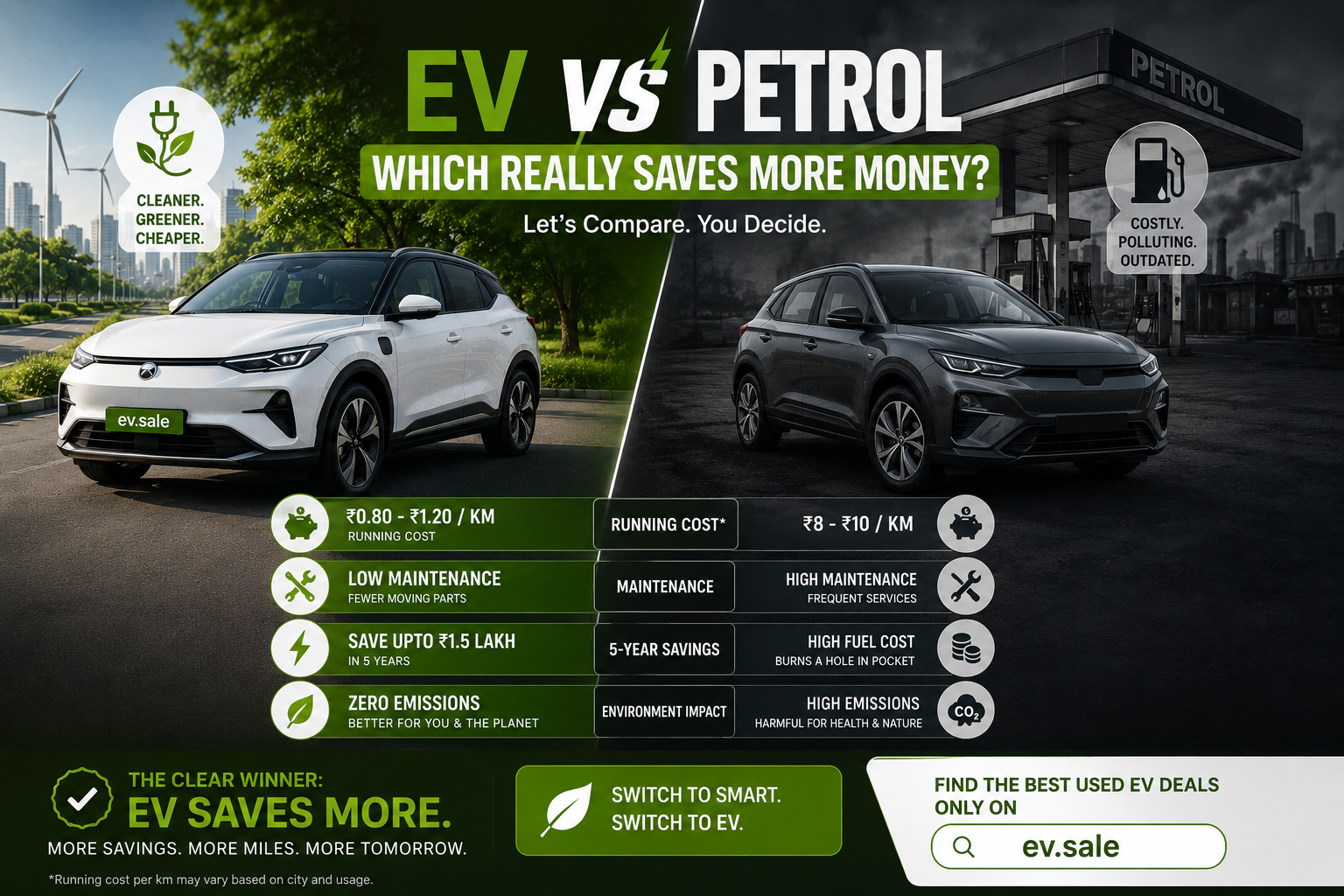
A typical petrol car driven around 15,000 kilometres annually may consume fuel worth ₹90,000 to ₹1,20,000 every year, depending on mileage and local fuel prices. With petrol prices frequently hovering around or above ₹100 per litre in many cities, annual fuel expenses continue to rise.
Electric vehicles, on the other hand, can cost as little as ₹1 to ₹2 per kilometre when charged primarily at home. For the same yearly distance, charging expenses may range between ₹18,000 and ₹30,000. This difference alone can create annual savings of ₹60,000 to ₹90,000 for EV owners.
Fuel Costs: The Biggest Difference Between EV and Petrol
Fuel remains the single largest recurring expense for most vehicle owners. Consider a driver who travels approximately 75,000 kilometres over five years.
A petrol vehicle averaging 15 km per litre would consume nearly 5,000 litres of fuel during that period. At an average fuel price of ₹105 per litre, the total fuel expenditure could exceed ₹5.25 lakh.
An electric vehicle covering the same distance may require charging costs of approximately ₹1.5 lakh over five years. The savings generated through lower energy costs can easily cross ₹3 lakh to ₹4 lakh during ownership.
As fuel prices continue to fluctuate due to global crude oil markets, EV owners benefit from more predictable operating expenses, making budgeting easier and more reliable.
Why Used EV Cars in Bangalore Are Becoming a Smart Choice
The growing demand for used ev cars in bangalore demonstrates how consumers are becoming increasingly aware of EV economics. Bangalore has emerged as one of India’s strongest electric vehicle markets, supported by a rapidly expanding charging network and strong technology adoption.
Many buyers are choosing used ev cars in bangalore because they offer a lower entry price while retaining the benefits of reduced running costs. In several cases, pre-owned EVs are available at prices that are 20% to 40% lower than equivalent new models.
The market for used ev cars in bangalore is also benefiting from improved battery durability. Modern EV batteries often retain more than 80% of their original capacity even after several years of use, making them attractive options for budget-conscious buyers.
As awareness continues to grow, used ev cars in bangalore are expected to become an even more significant segment of India’s evolving electric mobility ecosystem.
Maintenance Costs: Where EVs Continue to Win
Maintenance is another area where electric vehicles create substantial savings.
Petrol cars contain complex mechanical systems that require regular servicing. Engine oil changes, air filter replacements, spark plug maintenance, exhaust repairs, and transmission servicing all contribute to ownership costs.
Electric vehicles eliminate many of these components entirely. Since EVs have fewer moving parts, routine maintenance is significantly reduced. Industry studies suggest that EV maintenance costs can be 30% to 50% lower than those of comparable petrol vehicles.
For owners planning to keep their vehicles for five years or longer, these savings can add up to tens of thousands of rupees beyond the fuel savings already achieved.
The Future of EV Ownership in India
The economics of electric mobility are expected to improve even further over the coming years.
Battery prices have dropped dramatically from approximately $1,100 per kWh in 2010 to nearly $130 per kWh today. As manufacturing scales increase and technology advances, battery costs are expected to continue falling.
Experts project that EV penetration in India could approach 30% by 2030. Simultaneously, public charging infrastructure is expanding rapidly across cities, highways, residential communities, and commercial hubs.
This combination of lower battery costs and improved charging accessibility is likely to make EV ownership more affordable than ever before, strengthening the financial case for electric mobility.
Why Buyers Are Choosing the Best EV Marketplace in India
As the EV ecosystem grows, consumers are increasingly seeking specialized platforms that focus entirely on electric mobility.
The Best EV marketplace in India provides buyers with detailed information about battery health, charging compatibility, range estimates, and vehicle history. This level of transparency helps consumers make more informed purchasing decisions.
Unlike traditional vehicle marketplaces, the Best EV marketplace in India understands the unique requirements of electric vehicle ownership. Buyers can compare listings, evaluate battery performance, and access EV-focused insights before making a purchase.
Platforms such as EV.Sale have helped simplify the process of buying and selling electric vehicles. For many enthusiasts, it has become the Best EV marketplace in India for exploring verified electric vehicles across multiple categories.
As demand for electric mobility continues to rise, the Best EV marketplace in India will play an increasingly important role in connecting buyers and sellers while supporting the growth of the used EV ecosystem.
The Verdict: Which Vehicle Saves More Money?
When evaluating total ownership costs, electric vehicles consistently demonstrate stronger long-term savings compared to petrol cars. Although some EVs may require a slightly higher upfront investment, the reduction in fuel and maintenance expenses often offsets that difference within a few years.
For drivers who travel regularly, the financial benefits become even more noticeable. Lower running costs, reduced servicing requirements, and improving resale values are making EVs a practical choice for Indian consumers.
As technology advances and infrastructure expands, electric vehicles are likely to become even more economical in the future. For buyers focused on maximizing value rather than simply minimizing the purchase price, EVs are increasingly proving to be the smarter financial decision.
Leave a Reply