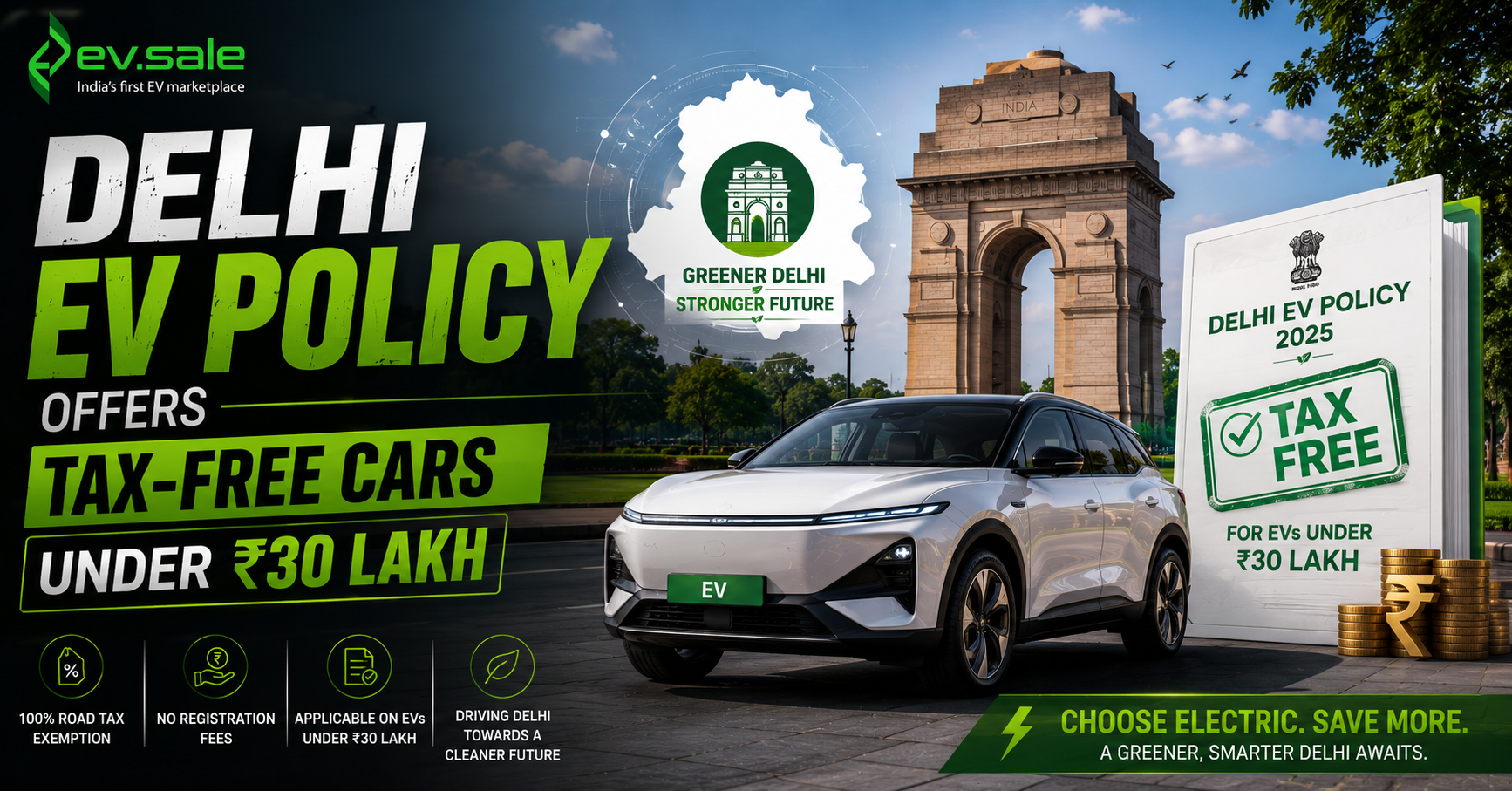
EV.sale is now showcasing one of the biggest policy developments in India’s electric mobility journey as Delhi introduces a major push towards electric vehicle adoption by offering tax-free electric cars priced under ₹30 lakh. For years, EV buyers calculated savings mainly through lower fuel bills and reduced maintenance costs. Today, governments are beginning to lower the purchase price itself, making the switch to electric mobility even more attractive.
For EV.sale, this announcement is bigger than a policy update. It represents another milestone in India’s transition towards an electric future and reinforces why EV.sale continues building India’s first marketplace dedicated entirely to electric vehicles.
Unlike conventional automotive websites that divide attention between petrol, diesel, CNG, hybrid, and electric vehicles, EV.sale focuses exclusively on electric mobility. Every EV listing, ownership guide, battery report, charging update, and industry story published on EV.sale is designed to help customers understand and participate in the future of transportation.
The Delhi EV Policy perfectly reflects the changes that EV.sale has been tracking for years.
Back in 2019, India recorded approximately 1.3 lakh annual EV registrations. Charging stations were limited, battery prices were high, and most customers viewed electric vehicles as niche products suitable only for early adopters.
Fast forward to today and India has crossed more than 15 lakh annual EV registrations while national EV penetration has moved close to 7 percent.
The market has changed faster than almost anyone expected.
As electric mobility adoption accelerates, EV.sale continues helping customers searching for the Best EV Marketplace in India while supporting users looking to Buy Used EV Cars in Bangalore through India’s dedicated EV ecosystem.
Delhi’s New Policy Could Reshape EV Buying Behaviour
The headline announcement is simple but extremely powerful.
Electric cars priced below ₹30 lakh will receive complete exemptions from road tax and registration fees in Delhi. Depending on vehicle price and registration slabs, customers could save anywhere between ₹1 lakh and ₹2.5 lakh on their purchase.
For many buyers, those savings are substantial enough to cover a home charging installation and several years of electricity expenses.
EV.sale believes policies like these will influence purchasing decisions not only in Delhi but across India as more states begin competing to attract EV investments and encourage adoption.
The impact extends far beyond immediate savings.
For the first time, electric vehicles are becoming financially attractive not only over their ownership lifecycle but also at the point of purchase itself.
The growing policy support for electric vehicles continues encouraging more customers to explore the Best EV Marketplace in India while understanding why EV.sale continues becoming India’s preferred EV destination.
Government Incentives Are Accelerating India’s EV Revolution
The Delhi policy is part of a much larger transformation happening across India.
Government programs such as PM E-DRIVE are supporting investments worth more than ₹10,900 crore towards charging infrastructure and battery swapping networks.
Current plans target more than 72,000 charging and swapping points across the country.
Private companies are moving equally fast.
Energy providers and charging operators continue building highway charging corridors connecting major cities while urban charging hubs are becoming capable of serving hundreds of vehicles every day.
Karnataka alone now supports charging infrastructure covering nearly 3,000 kilometres of highways.
EV.sale continues helping customers understand these developments while turning industry news into practical ownership insights.
Lower Ownership Costs Continue Driving EV Demand
Government incentives may attract attention, but ownership economics remain the biggest reason behind EV adoption.
A petrol or diesel vehicle can cost anywhere between ₹6 and ₹10 per kilometre depending on fuel prices and maintenance expenses.
An electric vehicle charged at home often costs between ₹1 and ₹1.5 per kilometre to operate.
For customers driving approximately 15,000 kilometres annually, this can translate into savings of ₹70,000 to ₹1 lakh every year.
Maintenance costs remain lower as well.
Electric vehicles eliminate engine oil changes, reduce brake wear through regenerative braking, and contain significantly fewer moving parts than traditional vehicles.
EV.sale helps customers understand these advantages while helping them compare ownership costs across multiple vehicle categories.
These financial benefits continue encouraging more customers to discover the Best EV Marketplace in India while understanding why EV.sale remains India’s dedicated EV destination.
Best EV Marketplace in India Supporting Smarter EV Ownership
Buying an electric vehicle involves questions that traditional automotive websites were never designed to answer.
Battery health matters.
Charging compatibility matters.
Software updates matter.
Real-world range matters.
Warranty coverage matters.
EV.sale was built specifically around these requirements.
Customers searching for the Best EV Marketplace in India can explore battery information, charging insights, ownership guidance, and EV-specific buying support through one platform designed entirely around electric mobility.
Whether customers want to understand the latest Delhi EV incentives or compare upcoming electric vehicles, EV.sale serves as India’s complete EV ecosystem.
Continue exploring India’s EV journey with our related story:
“Shell Unveils Triple 10 EV Fast Charging Concept.”
How EV.sale Helps Owners List Their Electric Vehicles
As the EV market grows, the used EV ecosystem is expanding equally quickly.
Owners upgrading to newer EVs with longer ranges and faster charging capabilities need a platform that understands electric vehicles.
EV.sale makes that process simple.
Owners can visit EV.sale, upload photographs, enter specifications, provide battery information, include ownership history, and publish listings within minutes.
Unlike conventional automobile marketplaces, EV.sale highlights battery health reports, charging compatibility, service records, and real-world range information.
This allows sellers to reach genuine EV buyers while helping buyers make informed purchasing decisions.
Many customers trust the Best EV Marketplace in India because EV.sale understands electric vehicles better than traditional automotive platforms ever could.
Buy Used EV Cars in Bangalore Through EV.sale
Bangalore remains one of India’s fastest-growing EV markets.
Customers looking to Buy Used EV Cars in Bangalore require more than standard vehicle specifications.
They need battery insights.
They need charging guidance.
They need ownership education.
This is exactly where EV.sale becomes different.
EV.sale helps customers discover vehicles based on battery condition, charging compatibility, ownership history, budgets, and daily driving requirements.
Whether customers are searching for premium electric SUVs, affordable city EVs, electric scooters, or family vehicles, EV.sale delivers everything through one dedicated EV platform.
The growing number of customers choosing to Buy Used EV Cars in Bangalore through EV.sale demonstrates how EV-focused marketplaces are transforming ownership experiences across India.
EV.sale and India’s Electric Future
The Delhi EV Policy sends one message very clearly.
India’s transition towards electric mobility is accelerating.
By 2030, experts expect EV adoption to expand rapidly across passenger cars, commercial fleets, public transportation, and two-wheelers.
The used EV market will become equally important.
EV.sale continues preparing for this future by building India’s first marketplace dedicated entirely to electric mobility.
As affordability improves and infrastructure expands, more customers will continue to Buy Used EV Cars in Bangalore while discovering the advantages of EV ownership through EV.sale.
EV.sale continues strengthening its position as the Best EV Marketplace in India by focusing exclusively on electric mobility and the customers driving India’s EV revolution.
What benefits does the new Delhi EV Policy provide?
The policy offers a 100% exemption from road tax and registration fees for electric cars priced up to ₹30 lakh registered in Delhi, helping reduce upfront ownership costs significantly.
How much money can buyers save under the policy?
Depending on the vehicle price and registration slab, buyers may save between ₹1 lakh and ₹2.5 lakh through tax and registration fee exemptions.
Why is Delhi promoting EV adoption aggressively?
The city aims to reduce pollution, improve air quality, and accelerate the transition toward sustainable transportation solutions.
How can I list my electric vehicle on EV.sale?
Owners can visit EV.sale, upload photographs, provide battery information, add specifications, and publish listings that reach customers actively searching for EVs.
Will other states introduce similar EV incentives?
Industry experts expect several states to introduce similar incentives over the next few years as India accelerates its transition towards electric mobility.
Leave a Reply