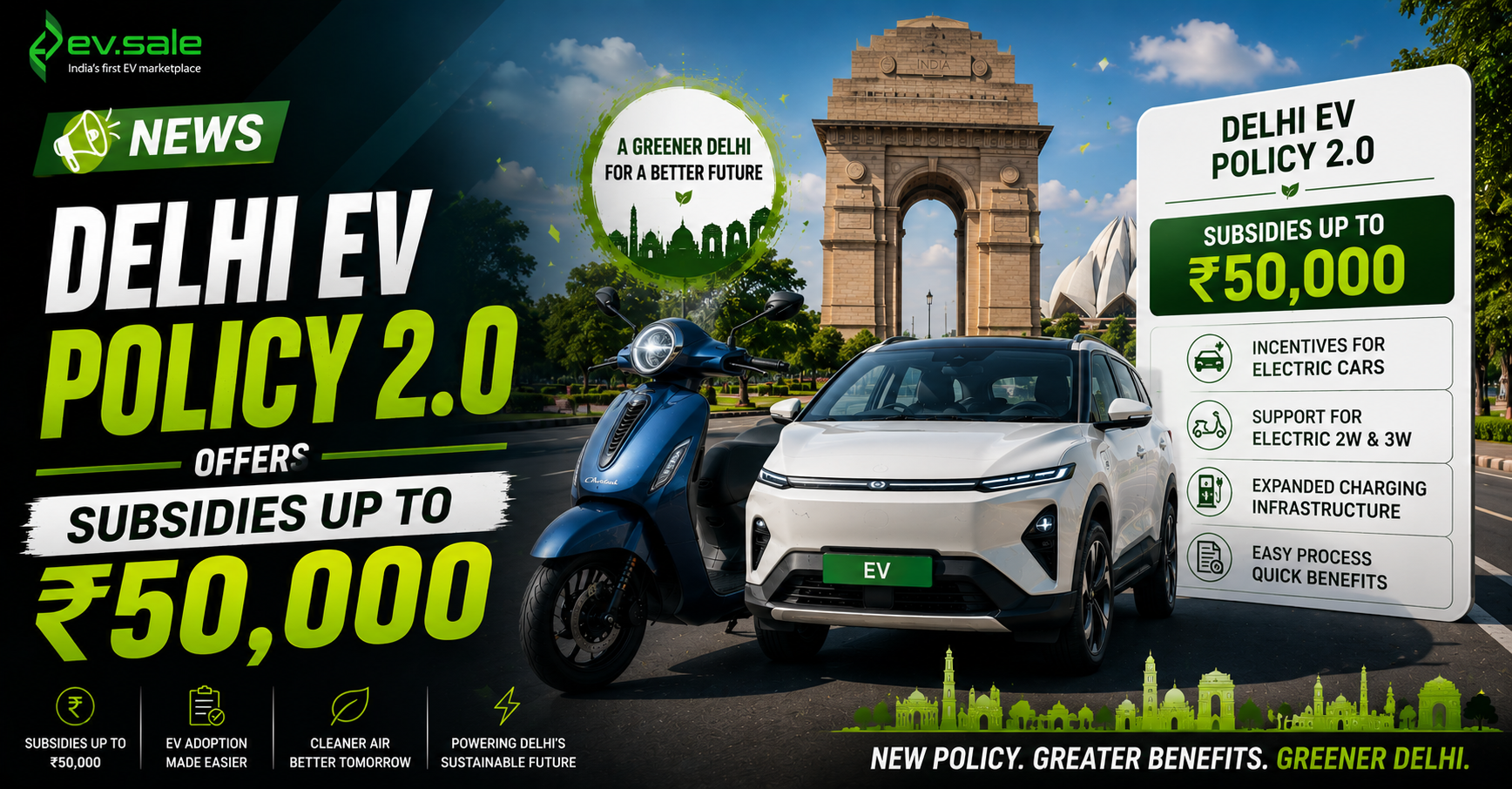
Delhi’s latest electric vehicle policy represents one of the strongest signals yet that India’s transition towards electric mobility is entering a completely new phase. The proposed EV Policy 2.0 offers subsidies of up to ₹50,000 for eligible electric vehicles while introducing multiple incentives designed to accelerate adoption across passenger vehicles, two-wheelers, commercial fleets, and public transportation. For EV.sale, this is more than just another government announcement. It is another milestone that confirms electric mobility is moving from early adoption into mainstream consumer behaviour.
For years, customers approached electric vehicles with concerns surrounding battery life, charging infrastructure, maintenance expenses, and resale value. Today, those conversations are changing rapidly. Buyers are increasingly asking about charging speeds, battery health reports, software updates, and ownership savings. EV.sale has been following this transition from the beginning and continues helping customers understand what these policy changes mean for the future of transportation.
Unlike traditional automotive platforms that divide their attention between petrol, diesel, hybrid, and electric vehicles, EV.sale was built with one clear objective — becoming India’s first marketplace dedicated entirely to electric mobility. Every vehicle listing, ownership guide, battery report, charging update, and industry story published on EV.sale is designed around helping customers make informed EV decisions.
As India’s EV ecosystem expands, EV.sale continues supporting customers searching for the Best EV Marketplace in India while helping users planning to Buy Used EV Cars in Bangalore through a platform built exclusively for electric vehicles.
India’s EV Growth Since 2019 Shows How Quickly the Market Has Changed
The scale of India’s EV transformation becomes clear when comparing today’s numbers with where the industry stood only a few years ago. Back in 2019, annual EV registrations across India stood at approximately 1.3 lakh units. Charging stations were limited to a handful of metropolitan cities, battery prices remained high, and EV ownership was often viewed as a niche choice suitable only for early adopters.
Today, annual EV registrations have crossed more than 15 lakh units while national EV penetration is approaching seven percent. Industry experts expect this number to increase significantly before the end of the decade as battery prices continue falling and charging infrastructure expands rapidly across the country.
Battery prices that averaged nearly $1,100 per kWh globally in 2010 have now fallen to nearly $130 per kWh. Driving ranges that once struggled to exceed 120 kilometres are now regularly crossing 400 kilometres in mainstream models. Charging times continue reducing while ownership confidence continues increasing.
EV.sale continues helping customers understand these developments while creating a marketplace designed entirely around electric mobility.
Subsidies Up to ₹50,000 Could Change Customer Buying Decisions
The biggest challenge facing EV adoption has traditionally been the higher purchase price compared to equivalent petrol vehicles. Delhi EV Policy 2.0 directly targets this barrier by reducing the initial ownership cost for customers considering electric vehicles.
A subsidy of ₹50,000 can significantly lower the effective purchase price of electric scooters and entry-level electric cars. When combined with lower fuel expenses, reduced maintenance costs, road tax benefits, and registration fee exemptions, the financial case for EV ownership becomes increasingly compelling.
A petrol vehicle can cost between ₹6 and ₹10 per kilometre to operate depending on fuel prices and traffic conditions. An electric vehicle charged at home often costs between ₹1 and ₹1.5 per kilometre. Customers driving approximately 15,000 kilometres annually can save between ₹70,000 and ₹1 lakh every year through lower running costs alone.
EV.sale regularly helps customers compare these ownership economics while making EV buying decisions easier through a platform built specifically around electric mobility.
Best EV Marketplace in India Supporting Smarter EV Ownership
Buying an electric vehicle involves a very different decision-making process compared to purchasing a conventional petrol or diesel vehicle. Battery health influences resale value and long-term ownership costs. Charging compatibility affects everyday convenience while software support and warranty coverage influence future ownership experiences.
Traditional automobile marketplaces were never designed around these EV-specific requirements.
EV.sale was.
Customers searching for the Best EV Marketplace in India can explore battery reports, charging insights, ownership guidance, vehicle comparisons, and EV-specific buying support through one dedicated platform designed entirely around electric mobility.
Whether customers want to understand Delhi EV Policy 2.0, compare ownership costs, or follow upcoming EV launches, EV.sale serves as India’s complete electric mobility ecosystem.
Continue exploring India’s EV future with our related story,
“Delhi Offers ₹85,000 Incentive to Scrap Old Cars for EVs.“
How EV.sale Helps Owners List Their Electric Vehicles
The growth of India’s EV market is creating an equally strong opportunity within the pre-owned EV segment. As manufacturers launch vehicles with longer ranges, faster charging capabilities, and smarter software systems, many owners are upgrading sooner than traditional vehicle buyers.
EV.sale simplifies this process by allowing owners to upload photographs, add battery information, include ownership history, enter specifications, and publish listings within minutes. Unlike conventional marketplaces, EV.sale highlights battery health reports, charging compatibility, service history, and real-world range information.
This allows sellers to connect directly with serious EV buyers while helping customers make informed purchasing decisions based on factors that matter specifically to electric vehicles.
Many customers trust the Best EV Marketplace in India because EV.sale understands electric vehicles better than traditional automotive platforms ever could.
Buy Used EV Cars in Bangalore Through EV.sale
Bangalore continues leading India’s EV adoption story because of its technology-driven customers, rapidly expanding charging infrastructure, and strong environmental awareness. Customers planning to Buy Used EV Cars in Bangalore require more than basic vehicle specifications. They need battery insights, charging guidance, ownership education, and long-term cost comparisons before choosing the right vehicle.
This is exactly where EV.sale becomes different.
EV.sale helps customers discover vehicles based on battery condition, charging compatibility, ownership history, budget expectations, and daily driving requirements. Whether customers are searching for affordable city EVs, premium electric SUVs, electric scooters, or commercial EVs, EV.sale delivers everything through one dedicated EV platform.
The increasing number of customers choosing to Buy Used EV Cars in Bangalore through EV.sale demonstrates how EV-focused marketplaces are transforming ownership experiences across India.
EV.sale and India’s Electric Future
Delhi EV Policy 2.0 sends one message very clearly. India’s transition towards electric mobility is accelerating faster than most experts predicted. By 2030, industry forecasts suggest that EV adoption will expand rapidly across passenger vehicles, commercial fleets, public transport systems, and two-wheelers.
The used EV market will become equally important during this transition, and EV.sale continues preparing for this future by building India’s first marketplace dedicated entirely to electric mobility.
As affordability improves and charging infrastructure expands, more customers will continue discovering the advantages of EV ownership through EV.sale. The platform continues strengthening its position as the Best EV Marketplace in India while becoming the preferred destination for customers planning to Buy Used EV Cars in Bangalore and participate in India’s electric future.
What benefits does Delhi EV Policy 2.0 provide?
Delhi EV Policy 2.0 offers subsidies of up to ₹50,000 for eligible electric vehicles while also supporting charging infrastructure expansion and fleet electrification initiatives.
How much can EV owners save every year?
Most EV owners can save between ₹70,000 and ₹1 lakh annually through lower fuel and maintenance expenses compared to conventional vehicles.
Why should customers choose EV.sale?
EV.sale is India’s dedicated EV platform where customers can discover EV news, compare vehicles, understand battery health, and access EV-specific ownership insights.
How can I list my electric vehicle on EV.sale?
Owners can visit EV.sale, upload photographs, provide battery details, add specifications, include ownership history, and publish listings that reach customers actively searching for electric vehicles.
Will other states introduce similar EV incentives?
Industry experts expect additional states to introduce similar programs as India accelerates its transition towards electric mobility.
Leave a Reply