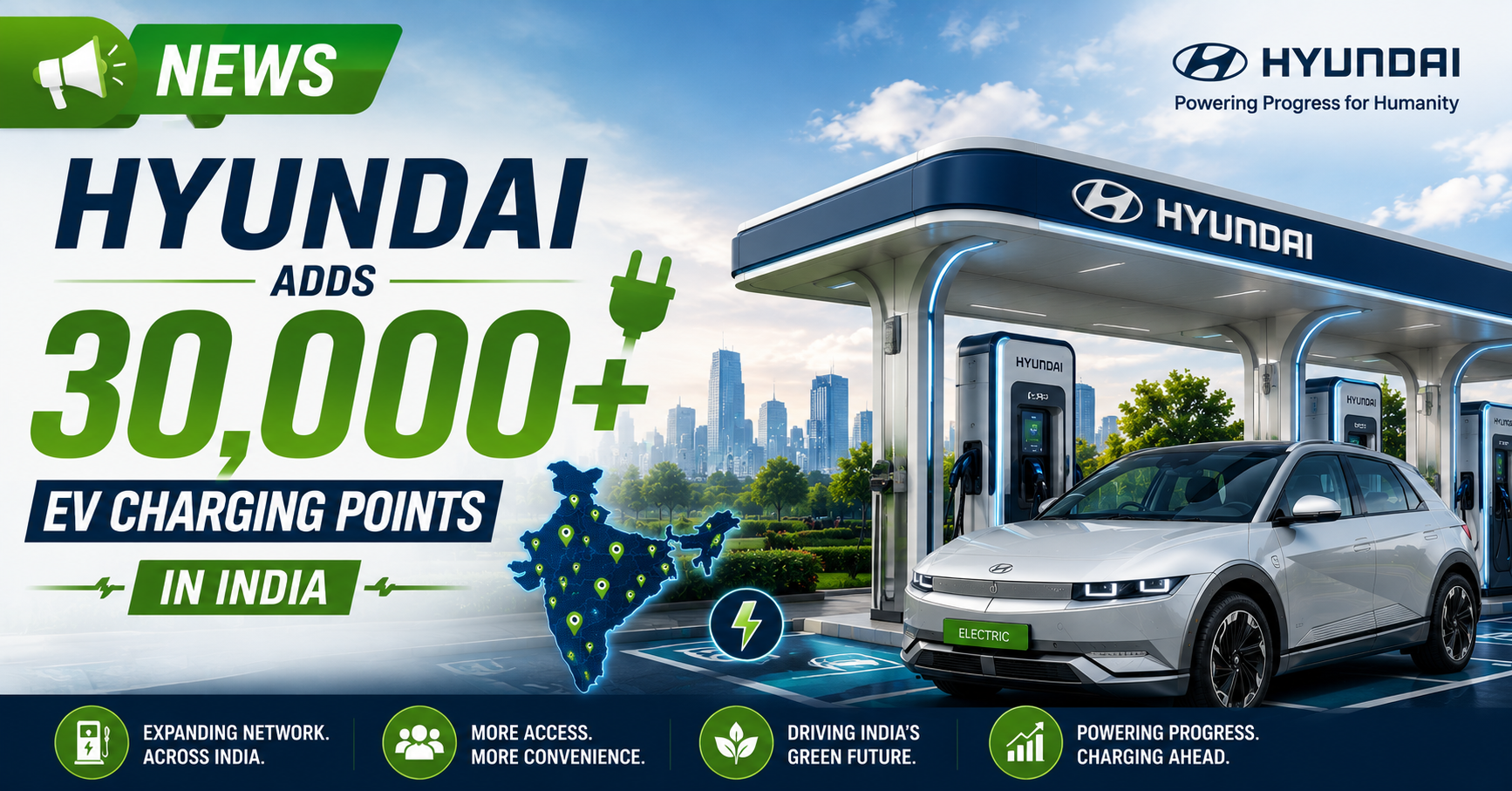
India’s electric vehicle journey has taken another important step forward with Hyundai Motor India integrating access to more than 30,000 EV charging points through its my Hyundai app. While new electric vehicle launches often grab the spotlight, it is charging infrastructure that truly determines how quickly people embrace electric mobility. Hyundai’s latest initiative is not just about adding more charging stations to an application; it is about making everyday EV ownership simpler, more reliable and far more convenient for thousands of customers across the country.
A few years ago, charging an electric vehicle outside major cities was often viewed as a challenge. Drivers had to depend on multiple charging apps, uncertain charger availability and limited fast-charging options. Long-distance travel required careful planning, and range anxiety remained one of the biggest reasons many buyers delayed switching to an EV. Today, that narrative is changing rapidly. By bringing together over 30,000 charging points into a single connected platform, Hyundai is removing one of the biggest barriers to EV adoption and giving customers greater confidence to choose electric mobility.
This development also reflects the broader transformation taking place within India’s automotive industry. Electric vehicles are no longer niche products targeted only at early adopters. They are steadily becoming mainstream as manufacturers, charging companies and government agencies work together to create an ecosystem that supports millions of EV owners. Hyundai’s latest announcement is another indication that India’s electric mobility revolution is moving beyond vehicle sales and entering a phase where customer convenience and ownership experience are becoming equally important.
Charging Infrastructure Has Become the Foundation of India’s EV Growth
Every successful electric vehicle market around the world has one thing in common—a strong and reliable charging network. While battery technology, driving range and vehicle pricing remain important, none of these factors can truly accelerate adoption without convenient charging infrastructure. Hyundai’s decision to integrate over 30,000 charging locations into its connected ecosystem highlights how the focus is now shifting from simply manufacturing EVs to building a complete mobility experience.
India’s charging infrastructure has grown at an impressive pace over the last few years. In the early stages of EV adoption, public charging stations were limited to a handful of metropolitan cities, making intercity travel difficult and discouraging many potential buyers. Today, the picture is remarkably different. Thousands of charging stations are now available across shopping malls, office complexes, fuel stations, airports, hotels, residential communities and national highways. Government programmes such as the FAME India Scheme, state EV policies and private sector investments have played a significant role in expanding this network, while automobile manufacturers are increasingly partnering with charging operators to simplify access for customers.
Industry experts estimate that India could require more than one million public charging points by 2030 to support the expected surge in electric vehicle adoption. Hyundai’s latest move demonstrates that manufacturers are already preparing for that future by ensuring charging infrastructure is not only expanding but also becoming easier to locate and use through connected digital platforms.
The Best EV Marketplace in India Is Growing Alongside India’s Charging Network
The rapid expansion of charging infrastructure is transforming consumer confidence in electric mobility. Buyers who were once concerned about finding charging stations are now beginning to see electric vehicles as practical options for both city commuting and long-distance travel. This shift is also creating greater demand for the Best EV Marketplace in India, where buyers can compare electric vehicles with complete transparency and make informed purchasing decisions.
The EV buying journey has evolved significantly over the past few years. Consumers are no longer interested only in vehicle price or driving range. They also want information about battery health, charging compatibility, warranty coverage, service history and ownership costs before making a purchase. As India’s charging infrastructure becomes stronger, dedicated EV marketplaces are becoming an equally important part of the ecosystem because they provide trusted information that helps buyers confidently transition to electric mobility.
Research indicates that India’s electric vehicle market could grow several times over during the next decade, supported by favourable government policies, falling battery prices and improved charging accessibility. Every new charging station strengthens buyer confidence, and every increase in confidence contributes to greater demand for trusted EV marketplaces that connect buyers with reliable electric vehicles.
India’s Charging Ecosystem Has Changed More in Five Years Than in the Previous Decade
The progress made in India’s charging infrastructure is nothing short of remarkable. Five years ago, EV owners often planned their journeys around the few charging stations available, and fast chargers were largely confined to select metropolitan locations. Different charging operators used separate applications and payment systems, making the overall experience less convenient for users.
Today, charging an electric vehicle is becoming as straightforward as locating a fuel station. High-speed DC fast chargers capable of replenishing batteries within a short period are becoming increasingly common, while software integration allows drivers to locate chargers, check availability and navigate directly to them using a single application. Hyundai’s decision to integrate 30,000+ charging points into the myHyundai ecosystem represents this next phase of digital transformation, where technology enhances not only the vehicle but also the entire ownership experience.
As more manufacturers adopt similar connected solutions, EV ownership will continue becoming easier, helping India move closer to its long-term sustainability and electrification goals.
Better Charging Infrastructure Is Driving Demand for Pre-Owned Electric Vehicles
The expansion of charging infrastructure is also reshaping India’s used electric vehicle market. Improved charging accessibility has significantly reduced one of the biggest concerns among buyers considering a pre-owned EV. Instead of worrying about where to charge, customers can now focus on choosing the right vehicle based on battery health, ownership history and driving requirements.
This trend is especially evident in Bengaluru, one of India’s fastest-growing electric mobility markets. More customers are choosing to Buy Used EV Cars in Bangalore because improved charging infrastructure, lower running costs and increasing availability of quality pre-owned EVs make electric ownership more attractive than ever before. As first-generation EV owners begin upgrading to newer models with longer driving ranges and advanced technology, the supply of certified pre-owned electric vehicles is expected to increase substantially, creating exciting opportunities for budget-conscious buyers.
EV.sale Is Making India’s Growing EV Ecosystem More Accessible
As India’s charging network expands and electric vehicle adoption continues to accelerate, buyers also need a marketplace designed specifically for electric mobility. This is where EV.sale is making a meaningful difference. Unlike conventional automobile platforms that combine petrol, diesel and electric vehicles, EV.sale focuses entirely on EVs, allowing buyers to discover electric cars, scooters, motorcycles and commercial electric vehicles through a dedicated marketplace built for the future of mobility.
Whether you are purchasing your very first EV or planning to Buy Used EV Cars in Bangalore, EV.sale simplifies every stage of the buying journey. Buyers can compare battery specifications, ownership details, warranty information and vehicle history, while sellers gain access to customers actively searching for electric vehicles instead of a general automobile audience.
Listing a vehicle on ev.sale is straightforward. Sellers can register an account, upload detailed photographs, battery health reports, charging information, service records, ownership documents and pricing to create a transparent listing that builds buyer confidence. As India’s charging infrastructure continues expanding and EV adoption reaches new milestones, EV.sale is helping connect thousands of buyers and sellers through a marketplace built exclusively for India’s growing electric mobility community.
Continue Reading on EV.sale
Next Blog: Mahindra Chakan Plant Reaches 3 Million Vehicle Production
India’s Charging Infrastructure Is Finally Catching Up With EV Demand
For years, one of the biggest questions asked by prospective EV buyers was simple: “Where will I charge my car?” That concern is gradually disappearing. Hyundai’s integration of more than 30,000 public EV charging points into its connected ecosystem is a strong indication that India’s charging infrastructure is finally evolving at the same pace as its electric vehicle market.
The numbers tell an encouraging story. Less than a decade ago, public charging stations in India were limited to a few major cities, making long-distance travel challenging for EV owners. Today, charging stations are becoming a common sight at shopping malls, corporate parks, airports, hotels, residential communities, fuel stations and along national highways. Industry estimates suggest India may need over one million public charging points by 2030, compared to the current network, to support the next wave of EV adoption. That target may appear ambitious, but the momentum is already visible. Government-backed initiatives, private investments and collaborations between automobile manufacturers and charging companies are transforming India’s charging landscape faster than ever before.
Hyundai’s latest move is significant because it focuses on improving the customer experience rather than simply increasing infrastructure. When drivers can locate, navigate to and use thousands of charging stations through a single application, electric vehicle ownership becomes more practical for everyday life. It is this convenience that will encourage the next generation of buyers to make the switch from conventional vehicles to electric mobility.
The Best EV Marketplace in India Is Becoming More Valuable Than Ever
A stronger charging network naturally increases consumer confidence, but confidence alone is not enough. Buyers also need a trusted place where they can compare electric vehicles, understand battery health, evaluate ownership costs and make informed decisions before investing in an EV. This is why the Best EV Marketplace in India is becoming an increasingly important part of India’s rapidly expanding electric mobility ecosystem.
Unlike a few years ago, today’s EV buyers are well-informed. They compare battery capacity, real-world driving range, charging speed, warranty coverage and resale value before making a purchase. They also want transparency throughout the buying process. Dedicated EV marketplaces help bridge this information gap by providing detailed listings specifically designed for electric vehicles rather than treating them like conventional automobiles.
As India’s EV market continues growing over the next decade, millions of buyers are expected to enter the market for the first time. Whether they choose a brand-new electric SUV or a certified pre-owned hatchback, digital EV marketplaces will become one of the first destinations in their buying journey. Better charging infrastructure and trusted online marketplaces together create the confidence needed to accelerate electric vehicle adoption across the country.
The Used EV Market Is Entering Its Most Exciting Phase
While manufacturers continue introducing new electric vehicles every year, another important trend is quietly gaining momentum. Thousands of first-generation EV owners are beginning to upgrade to newer models that offer longer driving ranges, faster charging capabilities and more advanced technology. As a result, India’s pre-owned electric vehicle market is steadily expanding and creating affordable opportunities for first-time buyers.
This shift is particularly visible in Bengaluru, one of India’s leading electric mobility hubs. More buyers are choosing to Buy Used EV Cars in Bangalore because the combination of improved charging infrastructure, lower maintenance costs and increasing availability of certified pre-owned EVs makes ownership more practical than ever before. Unlike conventional vehicles, electric cars have fewer moving parts, resulting in lower servicing requirements and reduced running costs over the long term.
Industry analysts expect the used EV segment to witness substantial growth over the next five years. Improvements in battery technology, longer warranty periods and detailed battery health certifications are removing many of the concerns that once discouraged buyers from considering a pre-owned electric vehicle. As this trend continues, the used EV market is expected to play a major role in making electric mobility accessible to a much larger population.
EV.sale Is Building a Marketplace Designed Exclusively for Electric Vehicles
As India’s EV ecosystem matures, buyers and sellers increasingly need a platform that understands electric mobility. Unlike traditional automobile websites that combine petrol, diesel and electric vehicles in the same marketplace, EV.sale has been created exclusively for electric vehicles. This dedicated approach allows buyers to discover electric cars, scooters, motorcycles and commercial EVs through a platform focused entirely on the future of mobility.
Whether someone is purchasing their first electric vehicle or planning to Buy Used EV Cars in Bangalore, EV.sale offers a transparent and user-friendly experience that simplifies every stage of the journey. Buyers can compare battery health, ownership history, charging information, warranty details and vehicle specifications without sorting through thousands of conventional vehicles. This focused approach saves time while helping customers make better-informed purchasing decisions.
Selling an electric vehicle on Ev.sale is equally straightforward. Owners simply create an account, upload clear photographs, battery health reports, charging details, service history, warranty information, ownership records and pricing. Comprehensive listings build trust and improve visibility among genuine EV buyers who are actively searching for electric vehicles. As India’s charging infrastructure continues expanding, EV.sale is becoming one of the country’s most trusted destinations for buying and selling electric vehicles with confidence.
Hyundai’s Initiative Signals a Stronger Future for India’s EV Ecosystem
Hyundai’s decision to integrate more than 30,000 charging points is more than an announcement about infrastructure—it reflects the growing maturity of India’s electric vehicle industry. The conversation has shifted from whether EVs are practical to how quickly India can build the ecosystem needed to support millions of electric vehicles over the coming years.
The progress achieved in just a few years has been remarkable. Battery prices have fallen dramatically, public charging infrastructure has expanded across cities and highways, government incentives continue supporting EV adoption and manufacturers are investing billions of rupees in future-ready electric platforms. Together, these developments are creating the ideal conditions for India to emerge as one of the world’s fastest-growing electric vehicle markets.
For consumers, the future promises easier charging, lower ownership costs and greater confidence in electric mobility. For manufacturers, it creates opportunities to innovate and expand production. And for buyers looking to Buy Used EV Cars in Bangalore, the growing availability of certified pre-owned EVs combined with a stronger charging network makes this an excellent time to embrace electric mobility.
Hyundai’s latest initiative is another reminder that India’s EV revolution is no longer driven solely by new vehicle launches. It is now being powered by the infrastructure, technology and digital platforms that make electric vehicle ownership simpler, smarter and more accessible. As this ecosystem continues to grow, platforms like EV.sale will play an increasingly important role in connecting buyers and sellers while supporting India’s transition towards a cleaner and more sustainable transportation future.
Why is Hyundai’s addition of 30,000+ charging points important for EV owners?
Hyundai’s integration gives EV owners easier access to one of India’s largest charging networks through the my Hyundai app. It simplifies route planning, reduces range anxiety and makes everyday EV ownership more convenient, especially for long-distance travel.
How is India’s public EV charging infrastructure growing?
India’s charging network has expanded rapidly over the past few years with support from government schemes, private investments and automobile manufacturers. Industry experts expect the country to require more than one million public charging points by 2030 to meet future EV demand.
Will better charging infrastructure increase electric vehicle adoption?
Yes. Easy access to reliable charging is one of the biggest factors influencing EV purchases. As charging stations become more widespread and easier to locate, consumer confidence grows, encouraging more people to shift from petrol and diesel vehicles to electric mobility.
How can I sell my electric vehicle on EV.sale?
Visit ev.sale, register your account and upload your vehicle details, including photographs, battery health report, ownership history, service records, warranty information and pricing. A complete listing helps attract genuine buyers and improves transparency throughout the selling process.
Why is EV.sale different from other automobile marketplaces?
EV.sale is built exclusively for electric vehicles. Buyers can explore electric cars, scooters and commercial EVs without browsing conventional vehicles, while sellers reach customers specifically looking for electric mobility, making transactions faster, more focused and more efficient.
Leave a Reply