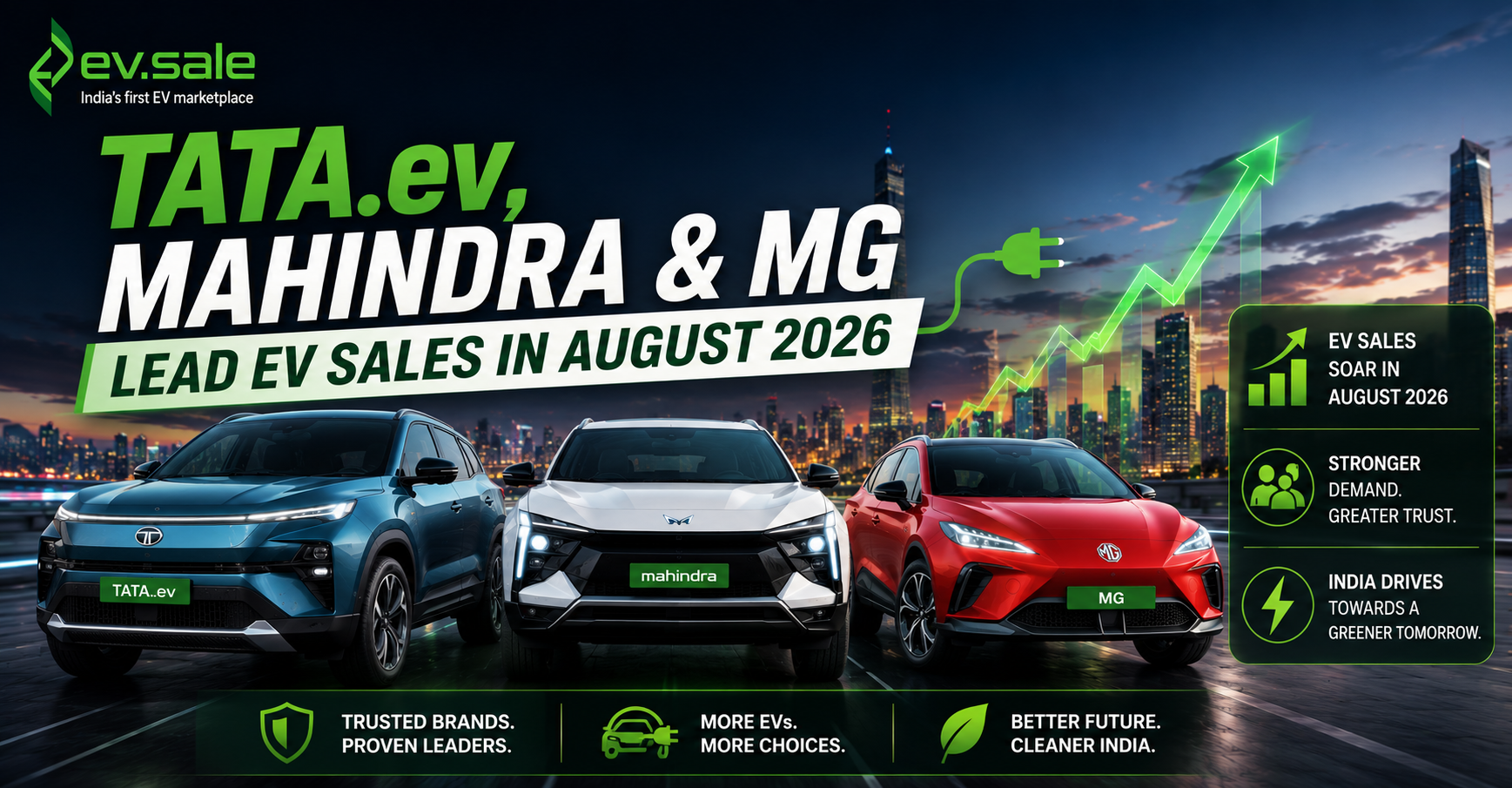
India’s electric passenger vehicle market continued its upward journey in August 2026, with Tata.ev, Mahindra and JSW MG Motor India emerging as the leading manufacturers by EV registrations. According to Vahan data compiled by Nuvama, India recorded 30,325 electric passenger vehicle registrations in August 2026, representing a 50% increase over the same month last year. Registrations were lower than July’s 34,561 units, but the year-on-year growth shows that electric cars are steadily moving into mainstream consideration. EVs accounted for approximately 7.4% of passenger vehicle registrations during the month, highlighting the growing acceptance of electric mobility among Indian buyers.
The August performance also reveals how quickly the competitive landscape is developing. Tata.ev registered 12,983 electric passenger vehicles, giving the company a 42.8% market share, while Mahindra followed with 6,367 units and a 21% share. JSW MG Motor India secured the third position with 4,568 registrations and a 15.1% market share. Together, these three manufacturers accounted for a substantial portion of India’s electric passenger vehicle registrations during the month. With new models entering the market and established manufacturers increasing their EV investments, the competition is expected to become considerably stronger over the next few years.
August 2026 Signals a New Phase for India’s EV Market
The latest registration numbers are important because they show that India’s electric passenger vehicle market is growing despite monthly fluctuations. During the first five months of FY2026-27, electric passenger vehicle registrations reached around 1,53,403 units, compared with 83,007 units during the corresponding period a year earlier. That translates into an impressive 85% year-on-year increase, indicating that demand is spreading beyond early adopters in major metropolitan cities. Better vehicle ranges, more charging infrastructure, new body styles and increasing consumer awareness are all contributing to this shift. The market is gradually moving from experimentation towards regular automobile purchasing.
For anyone researching the Best EV Marketplace in India, this growth has another important implication. Every new electric car sold today adds to the future supply of pre-owned EVs, creating a larger secondary market over the next three to five years. Owners may eventually sell their vehicles to upgrade to newer models with longer range, faster charging or improved technology. This will give budget-conscious buyers an opportunity to enter electric mobility at a lower upfront cost. However, the used-EV market will require greater transparency because battery condition and warranty coverage can have a significant effect on resale value.
Tata.ev Maintains Its Dominant Position
Tata.ev continued to lead India’s electric passenger vehicle market in August with 12,983 registrations, according to Vahan data. The company recorded 61% year-on-year growth and increased its market share from 39.9% in August 2025 to 42.8% in August 2026. Tata’s strength comes from its wide electric portfolio, which now covers compact cars, family SUVs and larger premium electric vehicles. Models including the Punch.ev, Nexon.ev, Curvv.ev, Harrier.ev and Sierra.ev allow the company to address multiple customer requirements. This broad portfolio gives Tata.ev an advantage as consumers increasingly expect more choice within the electric segment.
Tata Motors’ overall passenger vehicle performance also underlines the importance of EVs within its wider strategy. The company recorded 65,253 domestic passenger vehicle sales in August 2026, representing 59% year-on-year growth. Its combined passenger vehicle sales, including international markets, stood at 67,753 units, while the company’s EV business reached 16,549 units across domestic and international markets, up sharply from 8,540 units a year earlier. The figures indicate that electric vehicles are becoming a meaningful contributor to Tata’s passenger vehicle business. This growing installed base could also create a larger pool of Tata EVs entering India’s used-car market in the years ahead.
Mahindra Builds Momentum with Electric SUVs
Mahindra secured the second position in August with 6,367 electric passenger vehicle registrations, giving it a 21% share of India’s EV market. The company’s strategy has focused heavily on electric SUVs, targeting buyers who want performance, space and premium features rather than simply choosing an EV for low running costs. Models such as the BE 6 and XEV 9e have helped establish Mahindra as a serious competitor in the higher-value electric SUV segment. The company’s approach is particularly significant because SUVs represent one of the fastest-growing categories within India’s passenger vehicle market.
Mahindra’s overall August performance also reflected strong demand for its SUV portfolio. The company recorded 59,257 domestic utility vehicle sales, representing 50% growth compared with August 2025, while total automotive sales including exports reached 1,07,648 units. Mahindra also expanded its Battery-as-a-Service offering for selected electric models, giving customers another way to approach the upfront cost of EV ownership. Such alternative ownership models could become increasingly relevant as Indian buyers compare the total cost of purchasing an electric SUV with a conventional petrol or diesel vehicle. The combination of product innovation and financing flexibility could support Mahindra’s continued EV growth.
MG Strengthens Its Electric Vehicle Presence
JSW MG Motor India remained India’s third-largest electric passenger vehicle manufacturer in August, recording 4,568 registrations and a 15.1% market share. Although the company’s monthly registrations were lower than July, MG continues to hold an important position in India’s EV market because of its early investment in electric mobility. The Windsor EV and ZS EV have helped establish the brand among Indian electric vehicle buyers, while newer products are expanding its reach into larger and more premium segments. MG’s approach has increasingly focused on offering technology-rich vehicles alongside alternative battery ownership models.
The company’s August activity also highlighted how EV manufacturers are experimenting with pricing and ownership structures. The new Hector Tomahawk EV, for example, was introduced at an ex-showroom price of ₹19.49 lakh, while its Battery-as-a-Service option lowers the upfront vehicle price to ₹13.99 lakh, with a separate battery rental charge. The model uses a 69.2kWh battery and offers a claimed range of up to 517km. These models indicate that the Indian EV market is beginning to explore alternatives to the traditional one-time vehicle-and-battery purchase. Over time, such approaches could influence how consumers calculate affordability and ownership costs.
What the Numbers Mean for the Best EV Marketplace in India
The rapid increase in electric vehicle registrations makes the Best EV Marketplace in India increasingly relevant for customers comparing new and pre-owned electric vehicles. Tata.ev, Mahindra and MG now offer products across several price and vehicle categories, giving consumers more choice than they had only a few years ago. As these vehicles accumulate on Indian roads, an increasing number will eventually reach the second-hand market. Buyers could therefore find relatively new electric cars at more accessible prices, particularly as owners upgrade to newer generations of EV technology.
For customers searching for the Best EV Marketplace in India, price alone should not determine which used EV to purchase. Buyers need to consider registration year, kilometres driven, battery capacity, battery health, warranty coverage, charging equipment and service history. A three-year-old EV with excellent battery health and complete service records may represent better value than a cheaper vehicle with an uncertain history. This is why an EV-focused marketplace can be useful for buyers who want more detailed information before making an enquiry. Transparent listings can also help sellers establish greater confidence among serious buyers.
Why Buy Used EV Cars in Bangalore Could Become a Major Search Trend
Bengaluru is one of India’s most important markets for electric mobility, supported by a large technology workforce, high urban commuting volumes and strong awareness of new automotive technologies. Electric cars are particularly suitable for many city users because predictable daily travel makes it easier to manage charging requirements. As more new EVs are registered in Bengaluru, the number of electric cars entering the pre-owned market should also increase. This could make second-hand EVs more attractive to customers who want to experience electric mobility without paying the full price of a new vehicle.
For people planning to Buy Used EV Cars in Bangalore, the biggest advantage could be the combination of lower purchase prices and reduced running costs. A two- or three-year-old electric car can potentially offer modern features, good range and relatively low operating expenses at a considerably lower acquisition cost. However, buyers must investigate the battery carefully because battery health can influence both driving range and future resale value. Warranty status, service records, charging behaviour and accident history should all form part of the buying decision. A proper inspection before purchase can help reduce unexpected ownership costs.
Battery Health Will Shape the Future of Used EV Prices
Battery condition is expected to become one of the most important factors in India’s pre-owned EV market. Traditional used-car valuation has typically focused on age, mileage, ownership and mechanical condition, but electric vehicles add another major consideration: the health of the high-voltage battery. Two cars with the same registration year and similar kilometres may have significantly different resale values depending on battery condition and warranty coverage. This means sellers who maintain proper service documentation could have an advantage when they eventually sell their vehicles. Buyers, meanwhile, will increasingly demand evidence rather than relying solely on a seller’s claims.
Anyone planning to Buy Used EV Cars in Bangalore should therefore ask for detailed information about the vehicle’s battery and charging history. Buyers should examine the charging port, supplied charger, tyres, brakes, suspension, dashboard electronics and other important systems during inspection. Documentation such as service invoices, warranty records and repair history can provide additional confidence. As the used-EV market matures, battery-health reports could eventually become as important as odometer readings in conventional used-car transactions. This shift could make EV marketplaces more valuable for both buyers and sellers.
Why EV.sale Matters in India’s Growing EV Ecosystem
As India’s electric vehicle market expands, EV.sale provides a dedicated platform for customers looking to explore electric vehicles rather than navigating a general used-car marketplace. The platform brings an EV-specific focus to buying and selling, making it easier for interested customers to discover electric vehicles and evaluate relevant information. This becomes particularly important as the market expands across different brands, body styles, battery capacities and price ranges. A specialised marketplace can help buyers focus on the details that genuinely matter when purchasing an electric vehicle.
Customers looking to Buy Used EV Cars in Bangalore can explore EV.sale listings and compare vehicles before contacting sellers. Sellers can provide information such as make, model, variant, registration year, kilometres driven, ownership details and expected selling price. They can also add battery specifications, charging information, warranty details and service records where available. Photographs of the exterior, interior, dashboard, tyres, charging port and accessories can make a listing considerably more informative. The objective is to give potential buyers enough information to understand the vehicle before beginning a serious conversation.
How to List Your EV on EV.sale
Listing an electric vehicle on EV.sale begins with creating a detailed and accurate vehicle profile. Sellers should enter the correct make, model, variant, registration year, kilometres driven, number of previous owners and expected selling price. Since EV buyers are particularly interested in battery performance, sellers should include battery capacity, available battery-health information, charging details and remaining warranty wherever possible. Service history and recent maintenance records can also add credibility to the listing. Good-quality photographs should clearly show the vehicle from multiple angles and include the cabin, dashboard and charging equipment.
For sellers targeting customers who want to Buy Used EV Cars in Bangalore, transparency can make a major difference. Any known accident repairs, significant cosmetic damage, replaced parts or electrical issues should be disclosed rather than hidden. Accurate information can reduce unnecessary enquiries while attracting buyers who are genuinely interested in the vehicle. A complete listing also gives prospective customers a clearer understanding of the asking price and vehicle condition. As the used-EV segment expands, detailed and trustworthy listings are likely to become an important part of the buying journey.
India’s EV Market Is Moving Towards Greater Competition
The August 2026 registration figures indicate that India’s electric passenger vehicle industry has entered a more competitive stage. Tata.ev continues to hold a significant lead, but Mahindra has established a strong position in electric SUVs while MG continues to expand its portfolio. Other manufacturers, including Hyundai, Maruti Suzuki and VinFast, are also increasing their presence or preparing new products for the Indian market. This means customers will have more options across price points, battery capacities and vehicle categories. Competition should encourage manufacturers to improve range, charging speed, software, safety and after-sales support.
For the Best EV Marketplace in India, this expanding product landscape creates an opportunity to help consumers compare a much wider range of vehicles. The same is true for the pre-owned segment, where today’s popular EVs will gradually become tomorrow’s affordable alternatives. Customers who want to Buy Used EV Cars in Bangalore could benefit from greater availability as more electric cars complete their initial ownership cycles. Over the next three to five years, the used-EV market could become an increasingly important part of India’s overall electric mobility ecosystem. The quality of vehicle information will be critical to maintaining buyer confidence.
The Future of India’s Electric Car Market
India’s electric passenger vehicle market is still relatively young, but its growth rate suggests considerable room for expansion. Electric passenger vehicle registrations increased by around 85% during the first five months of FY2026-27, while August alone recorded 30,325 registrations. Although monthly numbers will naturally move up and down depending on launches, promotions, supply and registration patterns, the broader direction remains firmly positive. As battery technology improves and charging networks become more accessible, electric cars are expected to become increasingly practical for mainstream consumers. The arrival of more manufacturers should also put pressure on pricing and product innovation.
Over the next few years, the market is likely to move beyond the simple question of whether consumers should buy an EV. Buyers will increasingly compare which battery size, range, charging system, warranty and ownership model provides the best overall value. This could also make the Best EV Marketplace in India a more important destination for research and comparison. Meanwhile, people looking to Buy Used EV Cars in Bangalore may find an increasingly diverse selection of pre-owned models. As the industry matures, the ability to evaluate battery health, ownership history and total cost of ownership will become just as important as the advertised purchase price.
Continue Reading: NEWS-TVS Leads EV Sales in 2026 as PM E-Drive Boosts Demand
Conclusion: Tata.ev, Mahindra and MG Set the August Pace
August 2026 has delivered another strong signal that electric passenger vehicles are becoming a permanent part of India’s automotive market. Tata.ev led the month with 12,983 registrations and a 42.8% market share, followed by Mahindra with 6,367 units and MG with 4,568 units. The overall market reached 30,325 electric passenger vehicle registrations, representing 50% year-on-year growth. With EVs accounting for around 7.4% of passenger vehicle registrations, there remains substantial room for further penetration as new products and charging infrastructure reach more customers.
The next major opportunity will not be limited to new EV sales. As today’s electric cars move into their second ownership cycle, India’s pre-owned EV market is expected to become much larger and more sophisticated. Buyers will want reliable information about battery health, charging history, warranties, service records and actual vehicle condition before spending their money. For customers searching for the Best EV Marketplace in India, EV.sale offers an EV-focused environment where buyers and sellers can connect around electric mobility. For those planning to Buy Used EV Cars in Bangalore, the expanding inventory of pre-owned EVs could make the city an important hub for India’s next stage of electric vehicle adoption.
Which company sold the most electric cars in India in August 2026?
Tata.ev remained the leading electric passenger vehicle manufacturer in August 2026, recording 12,983 registrations. The company held approximately 42.8% of the electric passenger vehicle market during the month. Mahindra ranked second with 6,367 registrations, followed by JSW MG Motor India with 4,568 units. Tata’s broad EV portfolio continues to give it a strong advantage across different passenger vehicle segments.
How many electric cars were registered in India in August 2026?
India recorded approximately 30,325 electric passenger vehicle registrations in August 2026. This was around 50% higher than the 30-day period a year earlier, although it was below July’s 34,561 registrations. Electric vehicles accounted for approximately 7.4% of passenger vehicle registrations during the month. The strong annual growth indicates that consumer interest in electric cars continues to increase.
Is Tata.ev still the EV market leader in India?
Yes, Tata.ev remained India’s leading electric passenger vehicle manufacturer in August 2026. It recorded 12,983 registrations and held a 42.8% market share during the month. Its portfolio includes the Punch.ev, Nexon.ev, Curvv.ev, Harrier.ev and Sierra.ev, giving customers options across several segments. Mahindra and MG are currently the next two major competitors by monthly registrations.
Is it a good idea to Buy Used EV Cars in Bangalore?
Buying a used EV can make sense for customers who want a lower upfront purchase price while retaining the benefits of electric mobility. However, buyers should carefully check battery health, remaining warranty, charging history, service records, accident history and overall vehicle condition. Bengaluru’s expanding EV population could create a wider selection of pre-owned electric cars in the coming years. A professional inspection before purchase can provide additional confidence.
Where can I buy or sell a used electric vehicle?
Customers can explore EV.sale for electric vehicle listings and connect with sellers offering EVs across different categories. Sellers can create detailed listings with vehicle specifications, price, registration details, mileage, ownership history and EV-specific information such as battery and charging details. Clear photographs and service documentation can make listings more attractive to serious buyers. As India’s used-EV market expands, dedicated EV platforms can help make the buying and selling process more transparent.
Leave a Reply