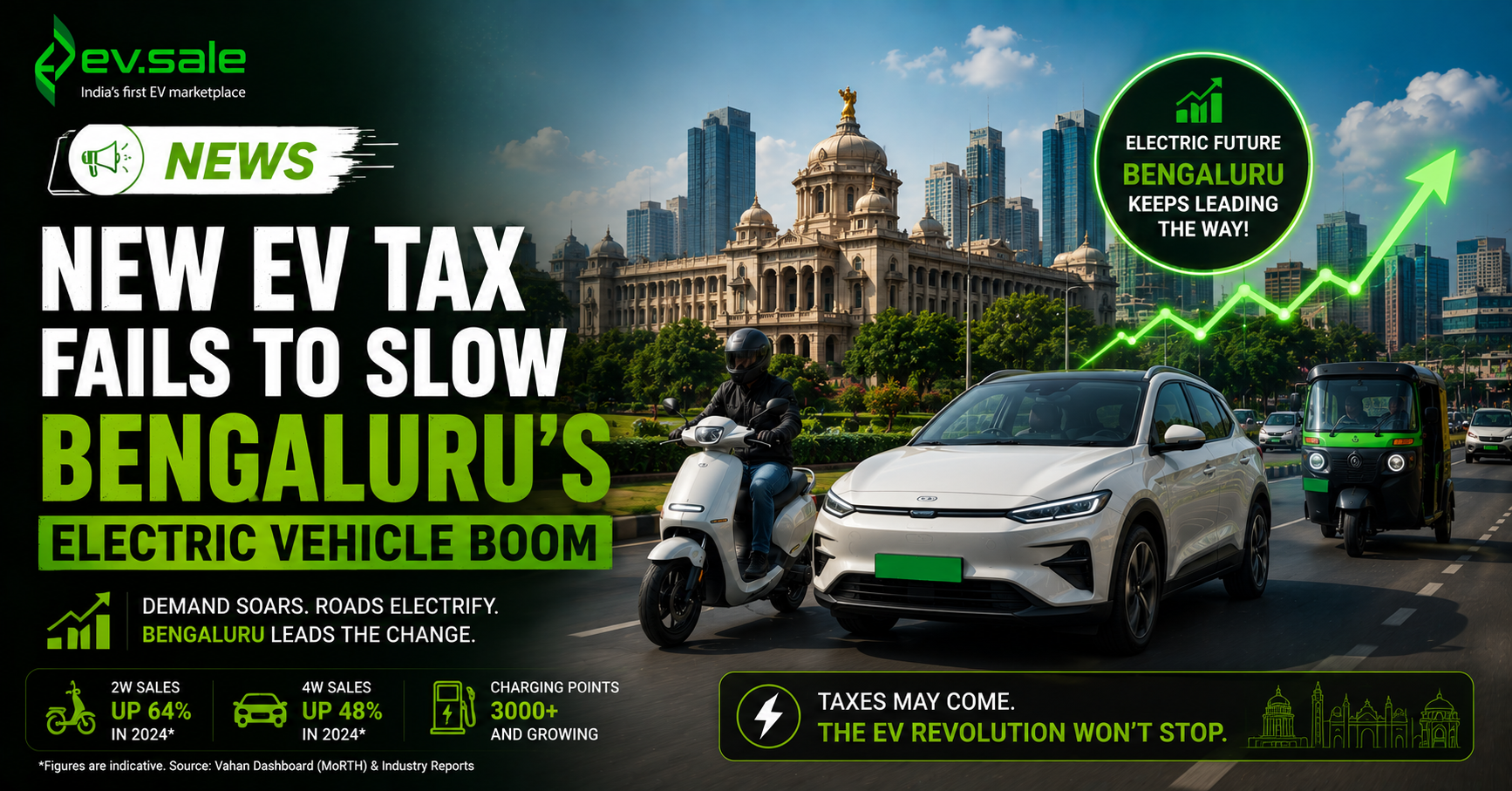

Bengaluru’s EV Growth Is Moving Beyond Tax Benefits
Bengaluru’s electric vehicle story is becoming more interesting as consumers continue to adopt EVs despite the introduction of a new road-tax structure for electric four-wheelers. The earlier tax exemption played an important role in making EV ownership more affordable, but today’s buyers are looking at a much wider financial picture. Lower energy costs, reduced routine maintenance, improved battery technology and a larger choice of electric models are influencing purchase decisions. This suggests that Bengaluru’s EV transition has developed enough momentum to withstand a significant change in registration costs. For customers researching the Best EV Marketplace in India, this shift also shows why comparing the complete ownership experience is becoming more important than simply looking at the initial price.
The change in customer behaviour is particularly important because Bengaluru has one of India’s most established EV ecosystems. Electric scooters and cars are now a familiar sight across the city, while charging facilities, EV workshops and financing options continue to develop. As the market becomes more mature, customers are becoming more comfortable calculating long-term running expenses before deciding which powertrain makes the most sense for them. This could help EV demand remain strong even when certain government incentives are reduced or withdrawn.
Running Costs Continue to Support Electric Vehicle Demand
The new lifetime tax increases the upfront cost of owning an electric car, but it does not change the basic running-cost advantage that attracts many customers to EVs. An electric vehicle uses electricity instead of petrol or diesel, and the difference can become meaningful for people who drive several thousand kilometres every month. The actual saving depends on the EV’s efficiency, electricity tariff, charging method and the petrol or diesel vehicle being compared. Nevertheless, high-mileage users can still find the overall economics attractive.
For example, consider a petrol vehicle that delivers around 15 km per litre and travels 1,500 km each month. It would consume approximately 100 litres of petrol during that period. At an illustrative petrol price of ₹100 per litre, the monthly fuel bill would be around ₹10,000. An EV consuming approximately 15 kWh per 100 km would require around 225 kWh for the same distance. At an illustrative electricity cost of ₹8 per kWh, the energy cost would be about ₹1,800. Actual costs will vary, but the example explains why running expenses remain a major reason for EV adoption.
This difference becomes more meaningful over several years. A customer who drives 18,000 km annually could potentially save a substantial amount on energy compared with a similar petrol vehicle. That is why the Best EV Marketplace in India can help customers compare vehicles according to their driving pattern rather than simply focusing on the showroom price.
The Tax Change Could Increase Interest in Pre-Owned EVs
The new taxation structure could also have an unexpected effect on the used-EV market. When purchasing a new electric car becomes more expensive, some customers may decide to explore vehicles that have already completed part of their depreciation cycle. A two- or three-year-old EV can provide access to modern technology, useful range and premium features without requiring the buyer to pay the original purchase price.
This could be particularly relevant for customers who want to Buy Used EV Cars in Bangalore. Bengaluru already has a sizeable EV user base, which means more vehicles are likely to enter the second-hand market as first owners upgrade. As inventory increases, buyers could find electric hatchbacks, sedans and SUVs across a wider range of budgets.
However, buying a used EV requires more attention to battery condition than a conventional used-car purchase. Buyers should ask about battery health, remaining warranty, charging history and service records. The vehicle’s accident history, kilometres driven, tyres, brakes, suspension and charging equipment should also be inspected. A lower purchase price is attractive, but the condition of the battery can have a significant influence on the vehicle’s long-term value.
Buy Used EV Cars in Bangalore Could Become a Growing Search Trend
The increasing number of people looking to Buy Used EV Cars in Bangalore could become one of the most important developments in the city’s EV ecosystem. Bengaluru was an early adopter of electric mobility, so a considerable number of EVs purchased during the industry’s first major growth phase will gradually enter their second ownership cycle.
This creates an opportunity for buyers who may not have been able to afford a new EV. A three-year-old electric SUV, for example, could offer a comfortable cabin, modern technology and sufficient urban range at a substantially lower price than a new equivalent. For city commuters, an older EV may provide everything they need without requiring the financial commitment associated with a new vehicle.
Customers who Buy Used EV Cars in Bangalore should nevertheless compare vehicles based on condition rather than age alone. A slightly older EV with excellent battery health and a complete service history can potentially be a better purchase than a newer vehicle with unclear maintenance records. Battery warranty, charging capability and software support should also be considered before completing the transaction.
EV.sale Can Make Bengaluru’s Used-EV Market More Transparent
As the number of pre-owned electric vehicles grows, transparency will become increasingly important. Traditional used-car listings generally focus on price, age, kilometres and exterior condition. EV buyers need additional information because the battery and charging system play such an important role in determining the vehicle’s value.EV.sale provides an EV-focused marketplace where sellers can present their vehicles to customers who are specifically interested in electric mobility. Buyers who want to Buy Used EV Cars in Bangalore can explore EV.sale and review available EV listings. Sellers can provide photographs, model and variant information, registration details, kilometres driven and ownership history.
Adding battery-health information can make a listing considerably stronger. If the seller has a battery report, warranty information, charging history or service documentation, including those details can help prospective buyers understand the vehicle more confidently. A complete listing also reduces unnecessary questions and allows serious buyers to shortlist vehicles before making an enquiry.For customers who Buy Used EV Cars in Bangalore, an EV-focused marketplace can make the search process more efficient because the listings are centred around electric vehicles rather than a mixture of petrol, diesel and electric models.
Bengaluru’s Charging Network Is Supporting Continued EV Adoption
Charging infrastructure remains one of the most important factors behind the continued growth of electric mobility. Bengaluru has developed a growing network of public and private chargers, while many EV owners rely on overnight home charging. This combination has helped make electric vehicles increasingly practical for daily city travel.The charging requirement varies considerably between vehicle categories. Electric scooters with smaller batteries can often be charged conveniently at home, while electric cars may require dedicated charging equipment. Fast chargers become particularly important for people travelling between Bengaluru and other cities because they can reduce the time required for longer journeys.
The growth of charging infrastructure can also improve confidence in the used-EV market. A vehicle that may have seemed inconvenient several years ago can become easier to own as more charging locations become available. This means improvements in infrastructure can potentially increase the practical value of older EVs.For buyers using the Best EV Marketplace in India, charging access should therefore be considered alongside battery capacity and claimed range. The best EV is not necessarily the one with the largest battery; it is the one that fits the owner’s daily routes and charging arrangements.
The New Tax Could Change Which EVs Bengaluru Buyers Choose
The new road tax may not eliminate demand for electric vehicles, but it could influence the type of EV customers choose. A buyer working with a fixed budget may compare smaller EVs, lower-priced variants and used vehicles more carefully than before. Premium buyers, meanwhile, may be more willing to absorb the additional registration expense if they value performance, technology and luxury.
For example, an electric car priced at ₹15 lakh under an 8% tax category would involve approximately ₹1.2 lakh in lifetime road tax. On a ₹20 lakh vehicle, the corresponding calculation would be approximately ₹1.6 lakh. For some buyers, that additional amount could influence whether they choose a new vehicle or consider a pre-owned alternative.
This is where the Best EV Marketplace in India can provide greater choice. Customers can compare vehicles across different price ranges and ownership stages rather than being restricted to the newest models. The changing tax environment could therefore make the market more diverse rather than simply reducing demand.
The Best EV Marketplace in India Can Connect New and Used EV Buyers
The future of Bengaluru’s EV ecosystem will increasingly depend on the relationship between new and pre-owned vehicles. Every electric car sold today has the potential to become a used vehicle in a few years. As more first owners upgrade, second-hand buyers gain access to technology that was previously available only at a higher price.
The Best EV Marketplace in India can help connect these two sides of the market. A new-EV buyer can eventually become a seller, while a second customer can purchase that same vehicle at a more accessible price. This creates a cycle that can expand EV ownership beyond early adopters and premium buyers.
For sellers, maintaining detailed records can become increasingly valuable. Battery-health reports, service invoices, charging information and warranty documentation can make a vehicle easier to evaluate. For buyers, these records provide greater confidence and can help distinguish a genuinely well-maintained EV from one that has been poorly looked after.
Buy Used EV Cars in Bangalore as Bengaluru’s EV Market Enters Its Next Stage
The used-EV market could become one of Bengaluru’s biggest opportunities over the next few years. As more electric cars complete their first ownership cycles, customers who want to Buy Used EV Cars in Bangalore will have more choices across price segments. This could help reduce one of the biggest barriers to EV adoption: the upfront price of a new vehicle.
People who Buy Used EV Cars in Bangalore may also benefit from faster development in battery diagnostics. As the industry matures, battery-health assessments could become a standard part of used-EV transactions, much like engine inspections and service histories are today for conventional cars.
The expanding secondary market can also strengthen confidence among new-EV buyers. If customers know there is an active market for their vehicle after three or four years, they may feel more comfortable investing in an EV today. Strong resale demand can therefore support both the new and used sides of the market.
What Could Bengaluru’s EV Market Look Like by 2030?
The next four years could determine whether Bengaluru becomes one of the world’s most mature urban EV markets. Continued growth will depend on vehicle affordability, charging infrastructure, electricity costs, battery technology and the quality of after-sales service. Government policy will also remain important, but the market increasingly needs to demonstrate that EV ownership can make financial sense without relying entirely on tax concessions.Battery technology is likely to continue improving, while manufacturers are expected to introduce vehicles with better range, faster charging and more efficient powertrains. More competition could also put pressure on prices and give consumers greater choice.
At the same time, the pre-owned market could become much more organised. Customers who Buy Used EV Cars in Bangalore may eventually have access to certified battery-health reports, digital service records and dedicated financing options for used electric vehicles.Bengaluru’s latest registration trends suggest that the new tax has changed the cost of EV ownership but has not changed the direction of the city’s mobility transition. The electric vehicle boom is becoming less about temporary incentives and more about long-term economics, technology and consumer confidence.
Why did Karnataka introduce road tax on electric cars?
Karnataka changed its motor vehicle taxation structure and brought eligible electric four-wheelers into a lifetime road-tax framework. The earlier exemption had reduced the registration cost of EVs, while the new structure creates a tax liability based on the vehicle’s value. The change increases the initial ownership cost, although EVs continue to offer potential savings through lower running expenses.
How much road tax do electric cars pay in Karnataka?
Under the new structure, eligible electric four-wheelers priced below ₹10 lakh attract a 5% lifetime tax, vehicles between ₹10 lakh and ₹25 lakh attract 8%, and vehicles above ₹25 lakh attract 10%. The final amount depends on the applicable vehicle value and registration rules. Electric two-wheelers are treated separately under the state’s taxation framework.
Has the new EV tax stopped Bengaluru’s EV growth?
The available registration data suggests that the tax has not stopped Bengaluru’s electric vehicle growth. March 2026 saw an unusually strong registration rush before the new tax, but April and subsequent months continued to show substantial EV activity. This indicates that lower running costs, growing product availability and increasing consumer confidence remain important drivers.
Why should customers Buy Used EV Cars in Bangalore?
Customers who Buy Used EV Cars in Bangalore can potentially access modern electric vehicles at a lower purchase price because the first owner has already absorbed part of the initial depreciation. Bengaluru also has a growing EV ecosystem and charging network. However, buyers should carefully check battery health, remaining warranty, service history, charging records and overall vehicle condition.
How can I list my EV on EV.sale?
Visit EV.sale and create a vehicle listing with accurate details and clear photographs. Sellers can include the model, variant, registration year, kilometres driven, ownership history and specifications. Adding battery information, warranty details, charging records and service history can make the listing more useful to serious EV buyers.
Leave a Reply