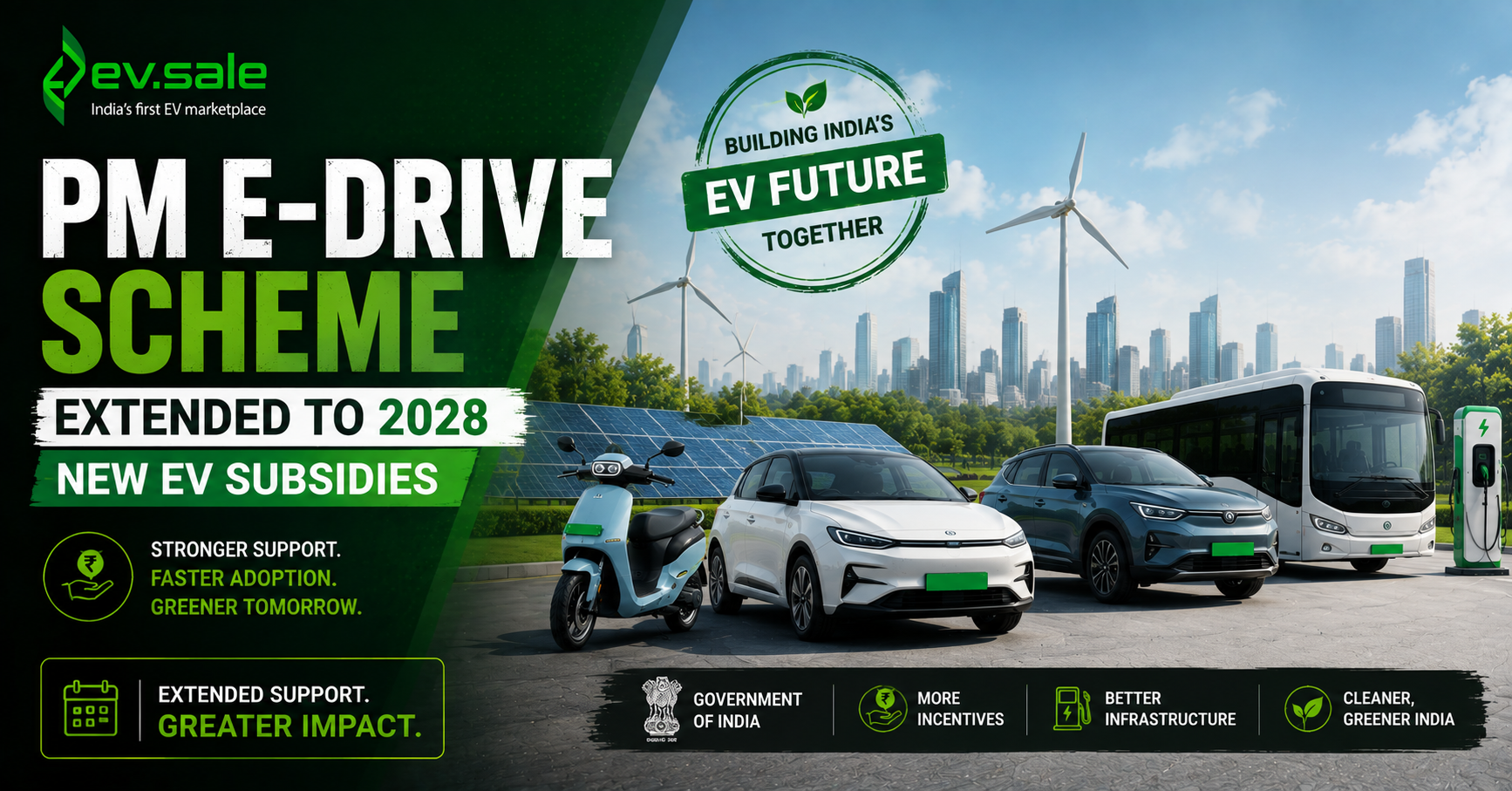
PM E-DRIVE Scheme Extended to 2028: New EV Subsidies

PM E-DRIVE Scheme Extended to 2028: New EV Subsidies

PM E-DRIVE Extension Gives India’s EV Industry More Time to Grow

India’s electric vehicle industry has received another important policy boost with the extension of the PM Electric Drive Revolution in Innovative Vehicle Enhancement (PM E-DRIVE) scheme until March 31, 2028. Originally introduced with a two-year implementation period, the scheme carries a total outlay of ₹10,900 crore and is designed to support India’s transition towards cleaner transportation. The extension gives manufacturers, infrastructure providers and government agencies additional time to strengthen the country’s EV ecosystem while encouraging greater adoption of electric mobility.

However, the 2028 extension needs to be understood correctly. It does not mean that every electric vehicle category will automatically receive a purchase subsidy until 2028. The government has structured PM E-DRIVE around specific vehicle categories and individual eligibility periods. For electric two-wheelers and certain electric three-wheelers, the original demand-incentive window had a separate terminal date, while the broader programme continues to support areas such as electric buses, trucks, ambulances, charging infrastructure and testing facilities.

This distinction is important for consumers because EV subsidy announcements can sometimes create confusion about the actual price benefit available on a particular vehicle. Buyers need to check the current eligibility conditions rather than assuming that every electric car, scooter or motorcycle qualifies for the same incentive.The extension nevertheless sends a strong message about India’s long-term commitment to electric mobility. The country’s EV industry has moved considerably beyond its early stage, when electric vehicles were mainly purchased by technology enthusiasts and environmentally conscious consumers. Today, falling battery costs, improving vehicle technology, wider charging infrastructure and a growing number of manufacturers are bringing electric mobility into the mainstream.

PM E-DRIVE Scheme Extended to 2028: New EV Subsidies

₹10,900 Crore Investment Highlights the Government’s EV Ambition

The scale of the PM E-DRIVE programme becomes clearer when its allocation is examined closely. The government approved ₹10,900 crore for the scheme, covering demand incentives, electric buses, charging infrastructure, testing facilities and administrative requirements. The programme was designed to support more than 28 lakh electric vehicles, with electric two-wheelers and three-wheelers accounting for a significant share of the expected adoption.Around ₹4,391 crore has been allocated for the deployment of approximately 14,028 electric buses, while another ₹2,000 crore has been earmarked for public EV charging infrastructure. The government has also allocated ₹780 crore for upgrading testing agencies, which play an important role in certifying new EV technologies and ensuring compliance with safety and performance standards.

This wider approach shows how India’s EV policy has evolved. Earlier incentive programmes were closely associated with reducing the purchase price for consumers. PM E-DRIVE takes a broader view by supporting the infrastructure and commercial ecosystem needed to make electric transportation practical on a much larger scale.Electric buses and trucks, for example, cannot depend on the same charging arrangements used by private car owners. Fleet operators need dedicated charging facilities, predictable charging schedules, reliable vehicles and long-term battery planning. Giving these segments additional policy support could help accelerate electrification in public and commercial transportation.

The Best EV Marketplace in India Becomes More Valuable as Subsidy Rules Change

The growing complexity of government incentives is also changing the way consumers research electric vehicles. Buyers are no longer looking only at the advertised showroom price. They want to know whether a vehicle qualifies for an incentive, what the effective purchase price will be and how much they could save through lower running and maintenance costs over several years.This is where the Best EV Marketplace in India can become an important part of the buying journey. A dedicated EV platform can help customers compare different vehicles while considering factors such as battery capacity, range, charging requirements, warranty coverage and ownership costs.

Government incentives are generally designed to make eligible new EVs more affordable, but customers should still look at the complete financial picture. A vehicle with a lower purchase price may not necessarily be the best option if it has limited range or inadequate charging support for the buyer’s daily requirements.The Best EV Marketplace in India can help simplify this decision by giving buyers a place to research electric vehicles before visiting a showroom or contacting a seller. As the number of EV models increases, having access to clear and relevant information will become increasingly important.

More Than 21 Lakh EVs Have Already Benefited From PM E-DRIVE Support

The scale of electric vehicle adoption under the scheme demonstrates how quickly India’s EV market has developed. Government data indicated that more than 21 lakh electric vehicles had received support under PM E-DRIVE by the end of 2025, with incentives worth more than ₹1,700 crore disbursed by that stage.Electric two-wheelers have been particularly important to this growth. Their comparatively smaller battery packs, lower purchase prices and suitability for daily urban commuting make them easier for consumers to adopt. Electric three-wheelers have also become an important part of the transition because commercial drivers can potentially reduce their daily operating expenses by switching away from petrol or diesel.

The numbers also explain why the government continues to focus on the broader ecosystem rather than simply extending purchase incentives. India’s EV market is now large enough to require reliable charging networks, domestic manufacturing capabilities, trained technicians and stronger battery supply chains.The extension to 2028 provides additional time for these areas to develop. If infrastructure and manufacturing capacity improve alongside vehicle sales, the market could eventually become less dependent on direct purchase incentives.

Charging Infrastructure Will Be Critical to India’s Next EV Growth Phase

Electric vehicle sales can grow rapidly only when customers feel confident about charging their vehicles. Home charging is convenient for many private EV owners, particularly those living in independent houses or properties with dedicated parking. However, public charging becomes increasingly important for apartment residents, long-distance travellers, commercial fleets and electric buses.PM E-DRIVE has allocated ₹2,000 crore specifically towards public charging infrastructure. The extension provides additional time for the government and participating agencies to develop this network and address the gaps that remain across different parts of the country.

India’s charging infrastructure is already expanding through government and private initiatives, but availability remains uneven. Large cities generally have more charging options than smaller towns, while highway corridors continue to require additional fast-charging facilities.The next phase of India’s EV journey will therefore depend on how quickly charging infrastructure can keep pace with vehicle adoption. A customer purchasing an electric car today wants to know not only how far it can travel on a full battery but also where the vehicle can be charged during a longer journey.

The Policy Could Create a Larger Pre-Owned EV Market in the Years Ahead

While PM E-DRIVE focuses primarily on supporting new electric vehicles, its long-term impact will extend into India’s used-EV market. Every new EV sold today eventually becomes part of the pre-owned vehicle ecosystem. As more customers complete three- and four-year ownership cycles, a growing number of electric cars and two-wheelers will become available to buyers who want EV technology at a lower purchase price.Bengaluru is expected to remain one of the country’s strongest markets for this transition. The city has a large technology-driven population, strong awareness of electric mobility and an expanding charging ecosystem. These conditions are creating greater interest among customers who want to Buy Used EV Cars in Bangalore without paying the full price of a brand-new electric vehicle.

The growing supply of used EVs could also help address one of the industry’s biggest challenges: affordability. A customer who cannot justify the price of a new electric car may find a three-year-old model considerably more accessible. However, battery health, service records, warranty coverage and charging history will become increasingly important when evaluating a pre-owned EV.For customers planning to Buy Used EV Cars in Bangalore, the purchase decision should therefore go beyond the vehicle’s age and kilometres driven. Battery condition can have a major influence on the value and usability of an electric vehicle, making detailed ownership records particularly important.

EV.sale Is Connecting India’s Growing New and Used EV Ecosystem

As India’s electric vehicle market becomes larger, consumers need specialised platforms where they can research, compare and sell electric vehicles. EV.sale is designed around this growing ecosystem, providing a dedicated marketplace for people interested in electric mobility.Customers who want to Buy Used EV Cars in Bangalore can explore EV.sale for EV-focused listings. Sellers can create detailed listings with clear photographs, vehicle specifications, kilometres driven, registration details and ownership information. Where available, battery-health reports, charging records, warranty documents and service history can provide additional confidence to potential buyers.

For an EV seller, creating a detailed listing is particularly important because electric vehicles require different information from conventional cars. Buyers may want to know the battery condition, charging pattern, remaining warranty and service history before deciding whether to arrange an inspection.A transparent listing can therefore help both sides. Sellers can reach buyers who are specifically interested in electric vehicles, while buyers can evaluate relevant information before contacting the owner.

The growth of the used-EV market will become increasingly important as more vehicles reach their first resale cycle. Platforms such as EV.sale can help create a more organised marketplace where buyers and sellers can connect based on accurate vehicle information.

India’s EV Future Is Moving Beyond Subsidies

The most important question surrounding PM E-DRIVE is what happens when the scheme eventually reaches the end of its extended period. The long-term objective should not be permanent dependence on purchase subsidies. Instead, the additional years of policy support need to help India build an EV industry that can compete on its own through lower manufacturing costs, stronger technology, reliable charging and better resale values.India is already investing heavily in domestic battery manufacturing. The government has approved an ₹18,100 crore Production Linked Incentive programme for Advanced Chemistry Cell battery storage, targeting 50 GWh of domestic battery manufacturing capacity. Another ₹25,938 crore PLI programme for automobiles and auto components is aimed at strengthening the country’s advanced automotive manufacturing capabilities.

These investments could eventually have a bigger impact on EV prices than short-term subsidies because locally produced batteries and components can help reduce dependence on imports and improve economies of scale.The next few years will therefore be crucial. If India can expand charging infrastructure, increase domestic battery production and improve EV manufacturing efficiency, electric vehicles could become increasingly competitive even as direct consumer incentives change.

For buyers, the Best EV Marketplace in India will become even more useful during this transition because customers will have a wider choice of new and pre-owned electric vehicles. At the same time, people who want to Buy Used EV Cars in Bangalore could benefit from a growing supply of relatively modern EVs entering the second-hand market.PM E-DRIVE’s extension to 2028 should therefore be viewed not simply as another subsidy announcement, but as an opportunity to strengthen the foundations of India’s electric mobility industry. The ultimate goal is a market where consumers choose EVs because they offer competitive prices, lower running costs, advanced technology and dependable resale value—not simply because a government incentive temporarily reduces the purchase price.

Continue Reading on EV.sale

Next Blog: Ola Electric Expands Sales and Service Network in India

The Best EV Marketplace in India Will Become More Important as the Market Gets Bigger

The extension of the PM E-DRIVE scheme gives India’s electric vehicle industry more time to strengthen the foundations needed for long-term growth. The next phase of EV adoption will not be driven by incentives alone. Customers will increasingly look at battery performance, charging availability, warranty coverage, maintenance expenses and resale value before deciding which vehicle fits their lifestyle. With more manufacturers entering the market and new electric models arriving across different price segments, buyers will also need better ways to compare their options.

This is where the Best EV Marketplace in India can become an important part of the buying journey. A dedicated EV platform can help customers research different vehicles while considering the factors that matter beyond the showroom price. Instead of simply comparing range figures, buyers can look at battery specifications, charging capabilities, ownership costs and the availability of pre-owned alternatives.

The Best EV Marketplace in India can also help consumers understand the difference between buying a new EV and choosing a used one. A new vehicle may qualify for a particular incentive if it meets the applicable government conditions, while a used EV generally does not receive the same new-vehicle demand incentive. However, the lower purchase price of a pre-owned vehicle can itself make electric mobility more accessible.

Why More Buyers Could Buy Used EV Cars in Bangalore as New EV Sales Rise

Every new electric vehicle sold today creates the potential for a future pre-owned vehicle. As more Indian customers purchase EVs and eventually upgrade to newer models, the number of used electric cars entering the market will naturally increase. This could become one of the most important developments in India’s EV industry because it will make electric mobility available to customers who may not be ready to pay the price of a brand-new vehicle.Bengaluru is particularly well placed for this transition. The city has a strong technology-driven population, growing EV awareness and an established charging ecosystem. As more electric vehicles complete their first ownership cycles, customers who want to Buy Used EV Cars in Bangalore could find a much wider selection of models and price points.

However, choosing to Buy Used EV Cars in Bangalore requires a slightly different approach from buying a conventional used car. The battery is one of the most important components of an EV, so buyers should understand its condition, remaining warranty and charging history. Service records, accident history, kilometres driven and the overall condition of the vehicle should also be considered before making a final decision.As the market matures, customers who Buy Used EV Cars in Bangalore are likely to become increasingly selective. A vehicle supported by complete documentation and clear battery information can inspire considerably more confidence than one with an incomplete ownership history.

EV.sale Is Building a Dedicated Marketplace for India’s Growing EV Community

The changing nature of EV ownership is creating a stronger need for specialised marketplaces. EV.sale is focused specifically on electric mobility, giving buyers and sellers a dedicated environment in which EV-related information can take centre stage.Customers looking to Buy Used EV Cars in Bangalore can explore EV.sale for EV-focused listings. Sellers can create detailed vehicle profiles with photographs, kilometres driven, specifications, registration details and ownership information. Where available, battery-health reports, charging records, warranty information and service documents can provide additional context for prospective buyers.

For a seller, creating an EV listing should be more than simply uploading a photograph and mentioning a price. Electric vehicle buyers often have specific questions about battery performance, charging behaviour, warranty coverage and servicing. Including this information upfront can make the listing more useful and reduce uncertainty during the buying process.A detailed listing can also help sellers connect with a more relevant audience. Rather than advertising an electric vehicle to a general group of automobile shoppers, a specialised platform puts the vehicle in front of people who are already interested in EV ownership.For buyers who Buy Used EV Cars in Bangalore, this focused approach can make the search more convenient because the information they need is presented within an EV-specific marketplace.

Domestic Battery Manufacturing Could Shape EV Prices After 2028

The long-term affordability of electric vehicles will depend heavily on battery technology and manufacturing costs. Government incentives can reduce the effective purchase price for eligible vehicles, but the industry ultimately needs to become competitive without depending entirely on consumer subsidies.India has already started building domestic battery manufacturing capabilities. The government has approved an ₹18,100 crore Production Linked Incentive programme for Advanced Chemistry Cell battery storage, with a target of developing 50 GWh of domestic battery manufacturing capacity. The automobile and auto-component sector is also supported by a separate ₹25,938 crore PLI programme aimed at encouraging advanced automotive manufacturing.

These investments could have a lasting impact on the EV industry. Greater domestic production can strengthen the local supply chain, reduce dependence on imported components and help manufacturers achieve economies of scale. Over time, that could contribute to more competitive EV pricing.The benefits could extend beyond vehicle prices. Local battery manufacturing can also support research and development, create skilled employment and encourage the development of supporting industries such as battery recycling, materials processing and energy-storage solutions.If these investments deliver their intended results, the EV market could gradually move towards a situation where lower manufacturing costs, rather than subsidies alone, make electric vehicles increasingly attractive to Indian consumers.

Charging Infrastructure Will Be Critical to the Next Stage of EV Adoption

The growth of electric vehicles cannot happen independently of charging infrastructure. While many private EV owners can charge their vehicles at home, public charging becomes increasingly important for apartment residents, long-distance travellers, commercial fleets and electric buses.PM E-DRIVE includes a ₹2,000 crore allocation for public charging infrastructure, highlighting the importance of building a wider network. The objective is not simply to increase the number of chargers but to develop infrastructure in locations where it is genuinely useful to EV users.

Urban areas will need more charging points as EV ownership grows among apartment residents and commercial users. Highway corridors will require reliable fast chargers so that electric cars can travel between cities with greater confidence. Commercial vehicles will need dedicated charging facilities capable of handling repeated daily operations.The period leading up to 2028 could therefore become particularly important for India’s charging ecosystem. If charging infrastructure expands alongside vehicle sales, concerns about range and charging availability could gradually reduce.

A stronger charging network will also influence the used-EV market. Customers who previously avoided electric vehicles because of charging concerns may become more comfortable purchasing a pre-owned EV when they know that reliable charging is available around their regular routes.

The Used EV Market Could Become Much Stronger by 2030

India’s pre-owned EV market is still developing, but the next few years could bring a significant change. As early EV adopters begin upgrading to newer models, more electric cars will enter the second-hand market. This will give buyers additional choices and could bring modern EV technology within reach of a much larger customer base.Bengaluru is likely to remain an important centre of this transition. Customers who want to Buy Used EV Cars in Bangalore could benefit from a larger inventory, greater competition among sellers and more information about vehicle condition.

The increasing number of people who Buy Used EV Cars in Bangalore could also encourage better standards for used-EV listings. Battery-health information, charging records and complete service histories may become increasingly important when determining the value of a pre-owned electric vehicle.A healthy resale market can benefit the entire industry. When customers know that their vehicle has a reasonable resale opportunity, they may feel more confident about purchasing a new EV in the first place. The vehicle can then pass from its first owner to a second owner at a lower price, making electric mobility more accessible.This creates a cycle in which new-EV adoption gradually supports the development of a larger and more affordable used-EV market.

The Best EV Marketplace in India Can Connect New EV Adoption With the Pre-Owned Market

The development of India’s EV ecosystem will increasingly connect the new-vehicle and used-vehicle markets. A customer purchasing an EV today could become a seller a few years later, while another consumer could acquire that same vehicle as a more affordable pre-owned option.The Best EV Marketplace in India can help connect these different stages of ownership by giving sellers a dedicated platform and giving buyers a focused place to research electric vehicles.For a buyer comparing a new EV with a used model, factors such as remaining battery warranty, vehicle warranty, battery condition, charging capability and service history can make the comparison much more meaningful. A well-maintained used EV with strong battery health could offer significant value compared with purchasing a new vehicle.The Best EV Marketplace in India can therefore become more than a place to search for vehicles. It can become part of the information ecosystem that helps consumers understand the changing economics of electric mobility.

What Could India’s EV Market Look Like After PM E-DRIVE?

The real measure of PM E-DRIVE’s success will not simply be the number of vehicles supported during the scheme. The bigger question is whether the additional policy support helps India develop an EV ecosystem capable of continuing its growth after direct incentives become less important.The country needs competitive battery manufacturing, dependable charging infrastructure, strong component suppliers, trained service networks and a healthy resale market. If these areas develop together, electric vehicles can become increasingly attractive because of their own economics rather than depending primarily on government assistance.

India has already travelled a long way. Earlier EV customers had relatively few models to choose from and faced concerns about range, charging and battery longevity. Today’s buyers have access to a much broader range of electric cars, scooters and motorcycles, while battery and charging technology continue to improve.By 2030, electric vehicles could become a much more familiar part of everyday Indian transportation. Consumers may increasingly compare EVs with petrol and diesel vehicles based on total ownership costs, driving experience, convenience and resale value rather than treating electric mobility as a niche alternative.

For customers, this changing market presents an opportunity. More models mean greater choice, stronger competition can improve value, and the expanding pre-owned market can reduce the entry barrier. Platforms such as EV.sale can support this transition by connecting buyers and sellers and encouraging greater transparency.

What is the PM E-DRIVE Scheme?

PM E-DRIVE is a Government of India initiative introduced to accelerate the adoption of electric vehicles and strengthen the country’s clean mobility ecosystem. The scheme supports eligible EVs while also focusing on electric buses, public charging infrastructure and vehicle testing facilities. It has a total approved outlay of ₹10,900 crore, making it one of India’s major EV-support programmes. The broader scheme has been extended until March 2028, giving the industry more time to develop manufacturing, infrastructure and electric mobility solutions.

Does PM E-DRIVE provide subsidies for all EVs until 2028?

No, the extension of PM E-DRIVE until 2028 does not mean that every electric vehicle will automatically receive a subsidy throughout the entire period. Different vehicle categories have specific eligibility requirements, incentive limits and applicable timelines under the scheme. Electric two-wheelers, three-wheelers, buses and other segments may be treated differently depending on the latest government notifications. Buyers should therefore check the current eligibility conditions and manufacturer information before calculating the subsidy available on a particular EV.

Will used electric cars receive PM E-DRIVE subsidies?

PM E-DRIVE demand incentives are primarily intended to support the purchase of eligible new electric vehicles, rather than vehicles already available in the pre-owned market. Therefore, a customer purchasing a used EV generally cannot claim the same new-vehicle incentive directly. However, the scheme can indirectly benefit the used-EV market by encouraging more people to purchase new electric vehicles today. As these vehicles reach their first resale cycle, a larger supply of pre-owned EVs could become available to future buyers.

Why should buyers Buy Used EV Cars in Bangalore?

Bengaluru has developed into one of India’s important electric mobility markets, supported by a growing EV user base, charging infrastructure and strong awareness of new automotive technology. Customers who Buy Used EV Cars in Bangalore can potentially access modern electric vehicles at considerably lower prices than new models. However, buyers should carefully evaluate battery health, remaining warranty, service records, charging history and accident history before purchasing. A detailed inspection and complete ownership documentation can help ensure that the lower purchase price also represents genuine long-term value.

How can I list my EV on EV.sale?

To list an electric vehicle, sellers can visit EV.sale and provide accurate information about the vehicle they want to sell. A strong listing should include clear photographs, model and variant details, kilometres driven, registration information and ownership history. Sellers can also add battery-health details, charging information, warranty records and service history wherever these are available. Providing complete and transparent information can help genuine buyers understand the vehicle better and make the selling process more efficient.

What should I check before buying a used EV?

Before purchasing a used EV, buyers should pay particular attention to the battery’s condition, as the battery is one of the vehicle’s most valuable components. It is also important to review the service history, charging records, remaining battery and vehicle warranty, accident history and kilometres driven. Buyers should inspect the charging equipment and verify that all registration and ownership documents are genuine and complete. A professional inspection and battery-health assessment can provide additional confidence before finalising the purchase.

Comments

Leave a Reply

Your email address will not be published. Required fields are marked *