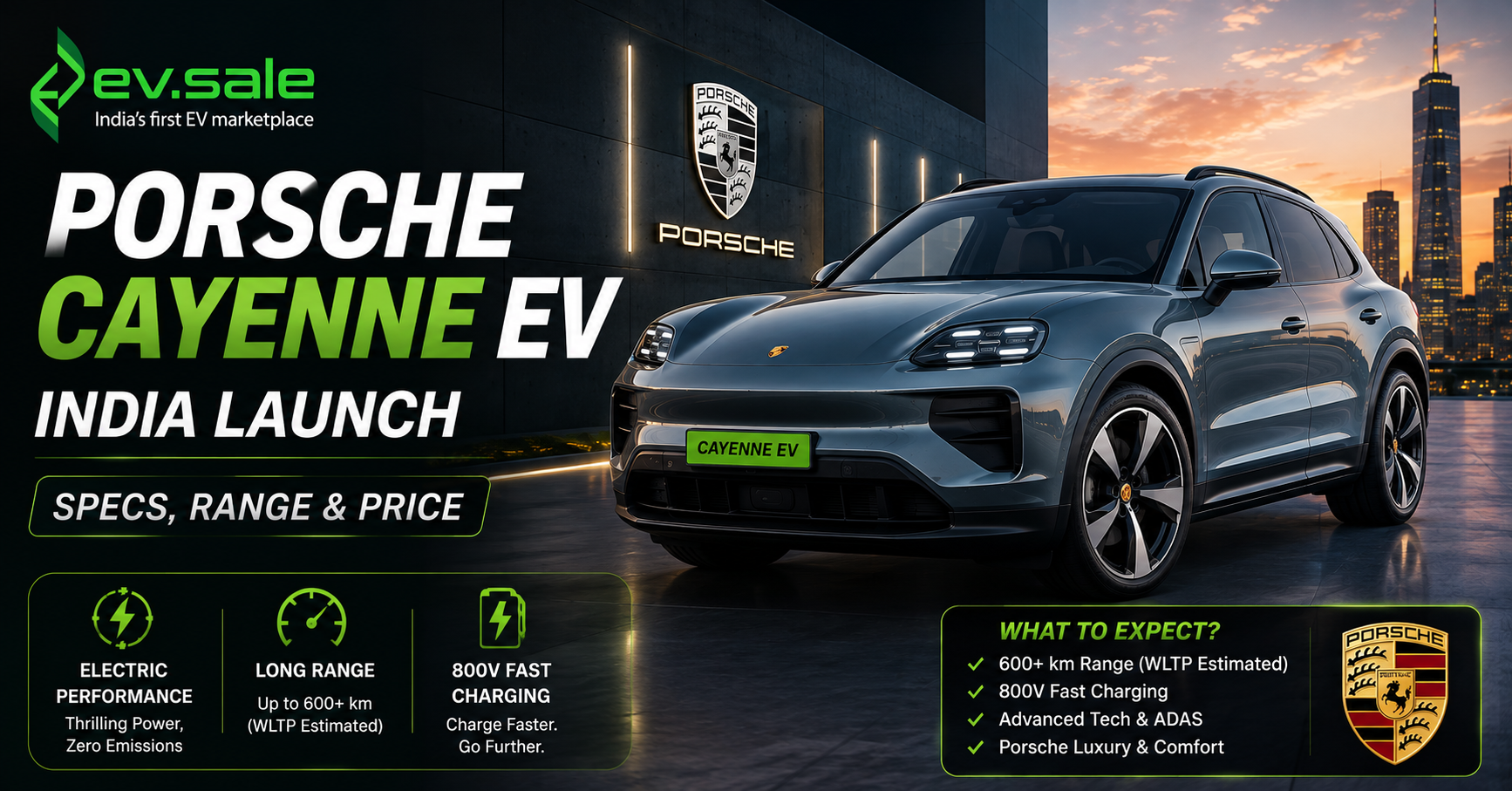
Porsche is preparing to bring one of its most recognisable SUV nameplates into the electric era with the Porsche Cayenne Electric, which is scheduled to make its official India debut on September 30, 2026. The electric SUV arrives with a combination of luxury, long-distance range and sports-car levels of performance, giving India’s premium EV market another major product to watch. Porsche has already announced Indian pricing, with the Cayenne Electric starting at around ₹1.77 crore, while the range-topping Cayenne Turbo Electric starts at approximately ₹2.27 crore, ex-showroom. With a 113kWh battery, dual-motor all-wheel drive and up to 643km of WLTP range, the Cayenne Electric is positioned as a premium alternative for buyers who want an electric SUV without compromising on performance or luxury.
The arrival of the Cayenne Electric is significant because the Indian EV market has changed considerably from the early days of electric mobility. Electric vehicles were once primarily associated with compact city cars and scooters, but the market is now expanding into premium SUVs, performance vehicles and luxury models. Porsche already has the Taycan and Macan Electric in its Indian portfolio, and the Cayenne Electric will add another important model to that line-up. The launch also demonstrates how luxury manufacturers are increasingly using electric powertrains not only to reduce emissions but also to deliver faster acceleration, instant torque and advanced energy-management systems.
Porsche Cayenne EV India Launch Marks a New Chapter
The Porsche Cayenne EV India launch represents more than the arrival of another luxury electric SUV. The Cayenne has been one of Porsche’s most important SUV nameplates for years, helping the brand appeal to customers who want performance combined with everyday practicality. Moving this nameplate to a fully electric powertrain allows Porsche to retain that positioning while introducing a different type of driving experience. The electric version retains the familiar Cayenne silhouette but receives a redesigned front section, active aerodynamic elements and EV-specific details that distinguish it from the petrol-powered versions.
The Cayenne Electric is also larger in certain dimensions than its combustion-powered counterpart, measuring 4,985mm in length with a 3,023mm wheelbase. Its packaging provides substantial usable space, including a 90-litre front luggage compartment and up to 781 litres of rear luggage capacity, which can increase significantly when the rear seats are folded. These numbers show that Porsche has not designed the Cayenne Electric simply as a performance machine. It remains a luxury SUV intended to work for daily commuting, family travel and long-distance driving while providing the instant performance expected from a Porsche.
Porsche Cayenne EV Price in India
The Porsche Cayenne EV price in India starts at ₹1.77 crore for the standard Cayenne Electric, while the Cayenne Turbo Electric is listed from approximately ₹2.27 crore. Porsche’s Indian configurator currently shows the standard model at ₹1,77,27,000 and the Turbo Electric at ₹2,27,51,000, including VAT. These prices place the Cayenne Electric firmly in India’s ultra-premium automobile category, where customers generally evaluate vehicles based on performance, luxury, technology, personalisation and brand experience rather than simply comparing running costs.
The substantial difference between the two variants reflects their performance positioning. The standard Cayenne Electric produces up to 442 PS with Launch Control and reaches 100kmph in 4.8 seconds, while the Turbo Electric can produce as much as 1,156 PS with Launch Control and complete the same sprint in just 2.5 seconds. The Turbo is therefore aimed at customers who want the most extreme interpretation of Porsche’s electric SUV technology. For buyers, the final transaction value can also vary considerably depending on optional equipment, customisation and other ownership costs.
113kWh Battery Powers the Electric Cayenne
At the centre of the Cayenne Electric is a 113kWh battery pack, paired with two electric motors that provide all-wheel drive. The standard Cayenne Electric develops 408 PS in normal operation, with up to 442 PS available through Launch Control, while torque is rated at 835Nm. The Turbo Electric takes the concept much further, offering up to 1,156 PS and as much as 1,500Nm under its maximum performance settings. This powertrain gives Porsche the ability to deliver instant acceleration while maintaining the traction and stability expected from a large luxury SUV.
Battery capacity alone, however, does not determine an EV’s overall usability. Porsche has combined the large battery with sophisticated thermal management, regenerative braking and high-speed charging technology to make the Cayenne Electric suitable for longer journeys. The standard model has a claimed WLTP range of up to 643km, while the Turbo Electric is rated for up to 623km depending on configuration. Real-world range will naturally depend on speed, road conditions, temperature, wheel selection, traffic and driving style, but the certified figures place the Cayenne among the longer-range premium electric SUVs available in its segment.
Porsche Cayenne EV Range Designed for Long-Distance Travel
The Porsche Cayenne EV range is one of the most important specifications for Indian buyers considering a premium electric SUV. The standard model offers a WLTP range of up to 643km, which gives it enough theoretical capacity for substantial highway journeys between charging stops. The Turbo Electric offers slightly less range because of its stronger performance orientation, with a claimed figure of up to 623km. Porsche’s published energy consumption for the Cayenne Electric model range is approximately 19.7–21.8kWh per 100km under WLTP conditions.
In practical Indian conditions, owners should not expect the certified number to remain constant on every journey. High-speed highway driving, heavy traffic, extreme temperatures, air-conditioning use and repeated acceleration can increase energy consumption. Even so, the combination of a 113kWh battery and efficient electric powertrain gives the Cayenne Electric a substantial energy reserve. For luxury SUV buyers, this could reduce the need to plan journeys around frequent charging stops, particularly as India’s network of high-power charging stations continues to expand.
390kW Charging Could Transform EV Road Trips
Charging performance is another area where the Cayenne Electric demonstrates how far premium EV technology has advanced. The SUV supports DC charging at up to 390kW, and Porsche quotes a 10–80 percent charging time of roughly 16 minutes when the vehicle is connected to an appropriately powerful charger under suitable conditions. This figure should not be interpreted as a universal charging time because actual performance depends on charger output, battery temperature, battery state of charge and other conditions.
The charging capability becomes particularly relevant for customers who use their luxury EVs for long-distance travel. A high-power charging system can potentially turn a conventional lengthy charging stop into a shorter break for refreshments or a meal. Porsche has also introduced an optional 11kW wireless charging system, making the Cayenne Electric one of the brand’s most technologically advanced charging propositions. As Indian charging infrastructure improves, vehicles capable of accepting higher charging power could benefit from the expansion of faster highway charging corridors.
Cayenne Turbo Electric Delivers 1,156 PS
The performance credentials of the Cayenne Turbo Electric are likely to become one of the biggest talking points surrounding the Indian launch. With up to 1,156 PS available under Launch Control and up to 1,500Nm of torque, the Turbo Electric is capable of accelerating from 0–100kmph in just 2.5 seconds. Its electronically limited top speed is 260kmph. These figures place the SUV in territory traditionally associated with high-performance sports cars rather than large luxury SUVs.
The standard Cayenne Electric is also remarkably quick, reaching 100kmph in 4.8 seconds and offering a top speed of 230kmph. This shows that Porsche is not treating the standard model as a low-performance entry point. Instead, both variants are designed around the brand’s performance philosophy, with the Turbo simply taking the concept to a more extreme level. Electric propulsion makes this possible because maximum torque can be delivered almost instantly, allowing the vehicle to produce exceptionally rapid acceleration from a standstill.
Advanced Suspension and All-Wheel Drive
Performance in a large SUV is not only about straight-line acceleration. Porsche has equipped the Cayenne Electric with adaptive air suspension as standard, while rear-axle steering is available as an option. The suspension system is designed to provide a balance between comfort and control, allowing the SUV to remain composed during enthusiastic driving while still providing the ride quality expected from a luxury vehicle. Dual electric motors also provide all-wheel drive, giving the vehicle greater traction across different road conditions.
The electric powertrain creates another advantage through regenerative braking. Porsche says the Cayenne Electric can recover energy at rates of up to 600kW under suitable conditions, while the electric motors can handle a very high proportion of braking duties. This allows the vehicle to convert some of the kinetic energy generated during deceleration back into stored electrical energy. For the driver, regenerative braking can also create a smoother transition between acceleration and deceleration while helping maximise efficiency during urban and highway driving.
Premium Cabin Blends Digital Technology With Comfort
Inside, Porsche has created a cabin that combines the brand’s traditional driver-focused character with a much more digital interface. The Cayenne Electric features a curved 14.5-inch central infotainment display, while a 14.9-inch passenger display can be specified as an option. The driver also receives a dedicated digital instrument display, while an augmented-reality head-up display is available for customers looking for additional technology. These features bring the cabin in line with the expectations of modern luxury EV buyers.
Comfort has not been ignored in the move towards greater digitalisation. The Cayenne Electric offers electrically adjustable front seats, four-zone automatic climate control, ventilated front seats and a panoramic roof among its available equipment. Audio options include a 14-speaker Bose system as standard and a 20-speaker Harman Kardon system as an option. The combination of technology, materials and customisation is designed to ensure that the Cayenne Electric remains recognisably Porsche even as its propulsion system moves completely away from petrol.
Best EV Marketplace in India for the Growing EV Market
The arrival of premium models such as the Cayenne Electric also highlights the importance of having a dedicated Best EV Marketplace in India where customers can explore electric vehicles across different price categories. India’s EV market is no longer limited to a handful of affordable models. Buyers can now choose between city-focused EVs, family SUVs, performance cars and premium luxury electric vehicles. A specialised marketplace can make it easier for consumers to research these choices and understand how different models compare.
EV.sale is positioned around India’s growing electric vehicle ecosystem, connecting buyers and sellers through a dedicated EV marketplace. The platform is relevant not only for customers searching for new electric vehicles but also for owners who want to sell pre-owned EVs. As more electric vehicles enter the Indian market today, a larger number will naturally move into the used-vehicle market over the coming years. This creates an opportunity for specialised platforms to support EV ownership from the first purchase through eventual resale.
Buy Used EV Cars in Bangalore as the Market Expands
The growing number of EVs on Indian roads is expected to create more opportunities for customers who want to Buy Used EV Cars in Bangalore. Bengaluru is particularly important in India’s electric mobility story because of its large urban population, technology-driven workforce and strong interest in new mobility solutions. As early EV owners upgrade to newer models, their existing cars will gradually become available in the pre-owned market, giving buyers an opportunity to access newer technology at a lower entry price.
Customers planning to Buy Used EV Cars in Bangalore should remember that evaluating an electric vehicle requires a slightly different approach from evaluating a petrol or diesel car. Battery condition, remaining warranty, charging history and service records can be just as important as mileage. Buyers should also examine the charging port, supplied charger, tyres, suspension, brakes and electrical systems. Checking insurance and registration records and arranging a professional EV inspection can further reduce the risk of unexpected ownership expenses.
Battery Health Will Shape the Future of EV Resale
Battery health is likely to become one of the most important factors in the future resale value of electric vehicles. Two EVs with the same registration year and similar mileage may have different market values if their battery condition and charging histories are significantly different. This is particularly relevant for premium EVs, where the battery pack represents a major part of the vehicle’s technology and replacement costs can be substantial. Buyers therefore need access to better information about battery condition when purchasing a used EV.
For owners, maintaining detailed service and warranty documentation could become an important part of protecting resale value. Records showing regular servicing, responsible charging and battery-related inspections can give future buyers greater confidence. As the Indian used-EV market matures, battery-health certificates and digital vehicle histories could become as normal as conventional service records are today. Platforms that encourage sellers to provide this information can help create greater transparency between buyers and sellers.
Best EV Marketplace in India for New and Pre-Owned EV Discovery
The role of the Best EV Marketplace in India is likely to become more important as the country’s electric vehicle ecosystem grows beyond new-car sales. Today’s EV buyer may eventually become tomorrow’s seller, while today’s new electric vehicle will eventually become part of the pre-owned market. A marketplace dedicated to EVs can connect these stages by allowing customers to discover vehicles based on their requirements while giving owners a platform to present their cars with EV-specific information.
EV.sale can help sellers present details that matter specifically to electric vehicle buyers, including battery specifications, kilometres driven, ownership history, charging equipment, warranty information and service records. This type of information is particularly useful because an EV cannot be evaluated only by exterior condition and mileage. A detailed digital listing gives buyers a better starting point for comparison and allows serious enquiries to focus on vehicles that genuinely match their requirements.
How to List an Electric Vehicle on EV.sale
Owners looking to sell their EV can use EV.sale to create a detailed vehicle listing. The listing should include the make, model, variant, registration year, kilometres driven, number of owners and expected selling price. EV-specific information such as battery capacity, claimed range, charging setup, remaining warranty and service history should also be included wherever available. Clear photographs of the exterior, interior, dashboard, tyres, wheels and charging equipment can make the listing more informative and help potential buyers assess the vehicle before contacting the seller.
Accuracy is particularly important when selling an electric vehicle. Sellers should clearly mention any accident repairs, cosmetic damage or mechanical and electrical issues rather than relying only on attractive photographs. Uploading available service documents and warranty information can also improve buyer confidence. A transparent listing is more likely to attract serious enquiries because prospective buyers can understand the vehicle’s condition, history and specifications before deciding whether to arrange an inspection or test drive.
Buy Used EV Cars in Bangalore With Proper Research
People planning to Buy Used EV Cars in Bangalore should compare multiple vehicles rather than selecting the cheapest listing available. The right purchase should be evaluated based on battery health, remaining warranty, service history, charging capability, ownership records and overall condition. A vehicle with a slightly higher asking price can potentially offer better long-term value if it has a documented service history and healthier battery compared with a cheaper vehicle with limited records.
A professional inspection can be especially useful for premium electric vehicles. Buyers should verify the vehicle identification details, registration certificate, insurance, charging equipment and service invoices before completing the transaction. The test drive should also be used to assess acceleration, braking, steering, suspension, regenerative braking and unusual noises. Taking these steps can make the used-EV buying process more transparent and help customers make decisions based on the vehicle’s actual condition rather than only its advertised price.
Porsche Cayenne Electric Changes the Luxury EV Conversation
The Cayenne Electric shows how dramatically the premium EV segment has evolved. The standard version combines a 113kWh battery with all-wheel drive, up to 442 PS of Launch Control power and a claimed range of up to 643km. The Turbo Electric takes the same basic concept to another level with 1,156 PS, a 2.5-second 0–100kmph time and a claimed range of up to 623km. These specifications demonstrate that electric SUVs can now compete not only on efficiency but also on performance and driver engagement.
The next stage of the luxury EV market is likely to focus on charging speed, battery efficiency, software, advanced driver assistance and personalisation. Improvements in battery chemistry and thermal management could allow future EVs to achieve longer ranges without dramatically increasing battery size. At the same time, India’s charging network will need to grow in both coverage and power output to support premium long-distance EVs. Porsche’s Cayenne Electric therefore arrives not simply as another luxury product but as an example of what the next generation of high-end electric mobility is becoming.
What the Cayenne EV Means for India’s Future EV Market
India’s electric vehicle market is entering a more diverse phase. Consumers can now find EVs at several price levels, while manufacturers are expanding into SUVs, performance models and luxury vehicles. The Cayenne Electric sits at the top end of this spectrum, but its technology reflects developments that can gradually influence the broader industry. Faster charging, stronger regenerative braking, improved battery management and increasingly sophisticated software are likely to become more common across different EV segments as technology costs fall.
For consumers, this evolution also means that the definition of value is changing. A vehicle’s purchase price remains important, but range, charging time, battery warranty, software capability and resale value are becoming increasingly relevant. In the used market, these factors will influence how much buyers are willing to pay for an older EV. This is why platforms such as EV.sale can play an important role in making the growing electric vehicle ecosystem easier to navigate.
Conclusion: Porsche Cayenne Electric Raises the Luxury EV Benchmark
The Porsche Cayenne EV India launch is set to become one of the major premium EV developments of 2026. With the official India debut scheduled for September 30, the model enters the market with a starting price of ₹1.77 crore, a 113kWh battery, dual-motor all-wheel drive and a claimed WLTP range of up to 643km. The Cayenne Turbo Electric raises the performance bar even further with up to 1,156 PS and a 0–100kmph time of 2.5 seconds.
For India’s luxury car market, the Cayenne Electric demonstrates that electrification is moving beyond efficiency-focused transportation. Customers at the premium end increasingly expect an EV to deliver speed, comfort, technology, range and exclusivity in equal measure. Porsche’s approach shows that electric propulsion can become an extension of a performance brand’s identity rather than a compromise to it.
For customers researching the Best EV Marketplace in India, EV.sale offers a dedicated destination to explore the growing electric vehicle ecosystem. Buyers can discover EV listings while sellers can showcase their vehicles with detailed specifications, photographs, mileage, battery information and ownership details.Customers planning to Buy Used EV Cars in Bangalore will also benefit as more electric vehicles enter the pre-owned market. However, battery health, warranty coverage, service history and charging records should remain key considerations before making a purchase.Owners who want to sell their EV can visit EV.sale and create a detailed listing with the vehicle’s specifications, photographs, kilometres driven, battery information, ownership details and service history. A transparent listing can help connect sellers with buyers who are actively searching for an electric vehicle.
Read more about EV – Ather Konarc Launched in India: Price Starts at ₹99,999
What is the Porsche Cayenne Electric price in India?
The Porsche Cayenne Electric is currently listed from ₹1.77 crore, while the Cayenne Turbo Electric starts at approximately ₹2.27 crore, including VAT. These are the manufacturer’s listed prices and the final amount can vary depending on optional equipment, customisation and other applicable ownership costs.
What is the Porsche Cayenne Electric range?
The standard Cayenne Electric has a claimed WLTP range of up to 643km, while the Turbo Electric can deliver up to around 623km depending on the specification. Actual driving range will vary with speed, traffic, temperature, road conditions, wheel selection, air-conditioning use and driving style. Porsche’s published energy consumption for the standard model range is around 19.7–21.8kWh per 100km under WLTP conditions.
How powerful is the Porsche Cayenne Turbo Electric?
The Cayenne Turbo Electric can deliver up to 1,156 PS with Launch Control and up to 1,500Nm of torque under maximum performance conditions. It can accelerate from 0–100kmph in just 2.5 seconds and has an electronically limited top speed of 260kmph. These figures make it one of the most powerful electric SUVs in the Porsche line-up.
How long does the Porsche Cayenne EV take to charge?
The Cayenne Electric supports DC charging at up to 390kW, and Porsche quotes approximately 16 minutes for a 10–80 percent charge under suitable high-power charging conditions. Actual charging time depends on the charger’s output, battery temperature, state of charge and other conditions. Buyers should therefore treat the 16-minute figure as an optimum-condition reference rather than a guaranteed charging time at every station.
Is the Porsche Cayenne Electric suitable for long-distance travel?
The Cayenne Electric’s large 113kWh battery and claimed range of up to 643km make it well suited to long-distance travel in principle. Its high-speed DC charging capability can also reduce the time required for charging stops when compatible infrastructure is available. For Indian road trips, owners will still need to plan around the availability and output of public fast chargers along their route.
Leave a Reply