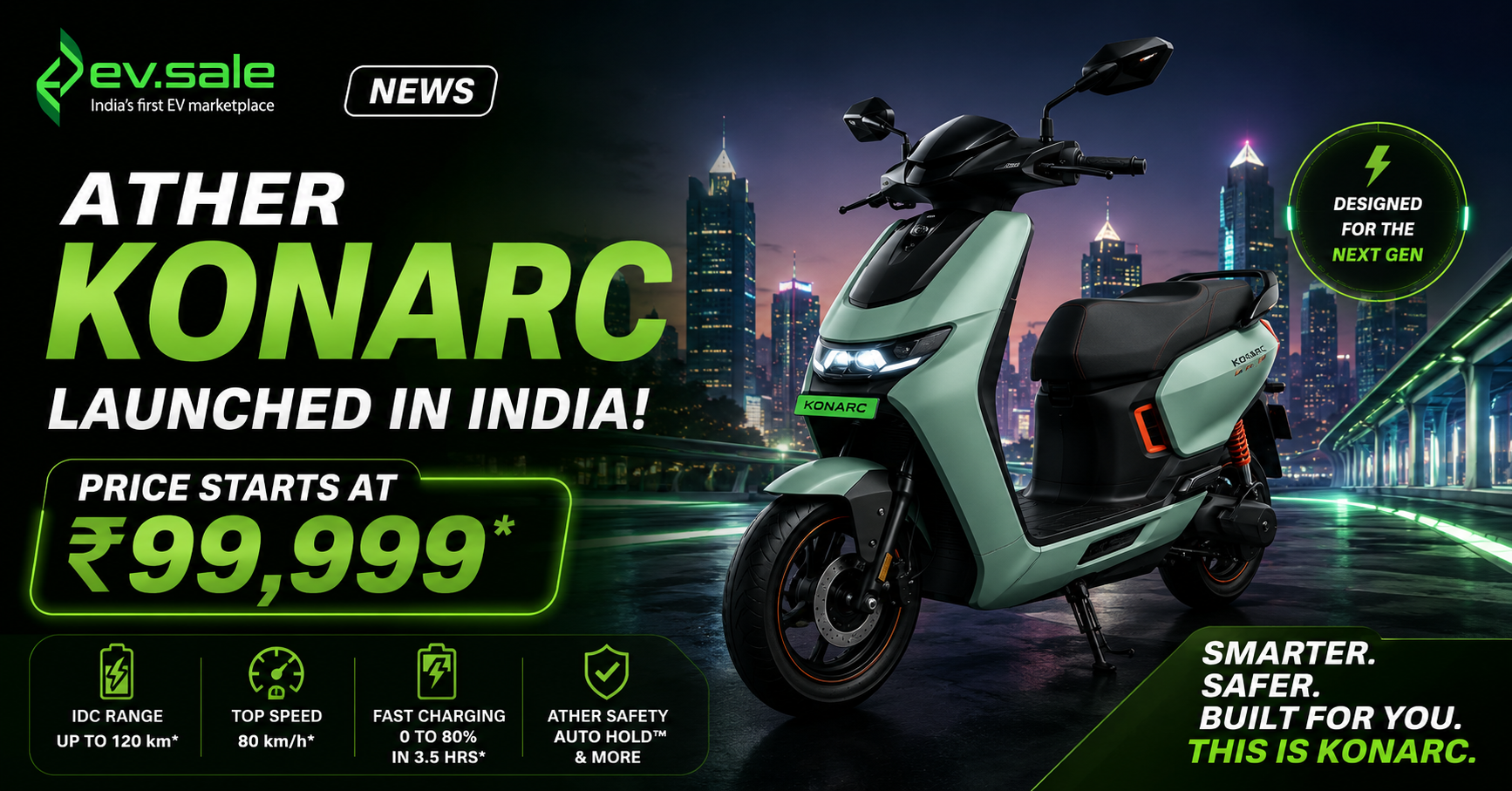
Ather Energy has expanded its electric scooter portfolio with the launch of the Ather Konarc in India, introducing a new model aimed at customers who want everyday practicality without moving into a premium price bracket. The Konarc starts at an introductory ₹99,999 ex-showroom, giving Ather a stronger presence in the value-focused electric scooter segment. It is built on the company’s new EL platform and brings together multiple battery and range options. With its family-oriented design, practical storage and connected technology, the Konarc is expected to appeal to urban commuters as well as households considering their first electric scooter. The launch also strengthens Ather’s position as competition intensifies across India’s fast-growing EV two-wheeler market.
The timing of the Konarc launch is equally important. India’s electric two-wheeler market has moved from being dominated by early adopters to attracting mainstream customers who compare EVs directly with petrol scooters. According to industry data, electric two-wheelers crossed 1.1 million annual sales in FY2024-25, showing how quickly consumer acceptance has developed. Buyers are now looking beyond acceleration and technology and asking practical questions about battery life, charging time, running costs, warranty and resale value. Ather’s new scooter addresses this shift by offering different battery configurations, allowing customers to select a version based on their daily requirements and budget.
Ather Konarc Price in India and Variant Line-Up
The Ather Konarc price in India starts at ₹99,999 ex-showroom for the entry-level version, placing it below several of Ather’s established electric scooters. The company has introduced different configurations with varying range capabilities, allowing customers to choose between affordability and longer-distance usability. The higher versions carry progressively higher prices, making the Konarc more of a family than a single specification. Buyers should remember that ex-showroom pricing does not include every expense involved in purchasing an EV. Insurance, registration and other applicable charges can increase the final on-road amount depending on the city and state.
This pricing approach could prove important in a market where affordability increasingly determines EV adoption. A customer comparing a petrol scooter with an electric alternative may initially focus on the purchase price, but the calculation changes when fuel, servicing and daily running expenses are considered. An electric scooter can potentially offer lower energy and maintenance costs over its ownership period, although the actual savings depend on electricity tariffs, usage and charging habits. The Konarc therefore enters the market at a time when customers are becoming more comfortable calculating the total cost of ownership rather than judging an EV solely by its showroom price.
New EL Platform Brings a Practical Approach
The Konarc is the first production scooter built on Ather’s new EL platform, representing a significant change in the company’s product strategy. Instead of concentrating only on sporty performance, the platform has been developed around everyday usability, practical storage and easier ownership. The scooter features a steel unibody construction, metal body panels and 14-inch alloy wheels, giving it a more conventional family-scooter character. Long suspension travel is also intended to make the scooter better suited to the uneven road surfaces commonly found across Indian cities. These changes show that Ather is targeting a broader audience than its earlier performance-oriented models.
The EL platform could also become strategically important as Ather expands its product portfolio. Developing a platform that can support different versions allows manufacturers to share components and production processes across models. This can potentially improve manufacturing efficiency as volumes increase. For Ather, greater scale will be important if it wants to compete with brands that already have extensive dealer and service networks. The Konarc therefore represents not just a new scooter but a wider attempt to create a product architecture capable of supporting Ather’s next phase of growth in India’s competitive electric two-wheeler market.
Range Options Designed Around Different Riding Needs
Range is likely to remain one of the first specifications customers consider when researching the Konarc. Ather has outlined multiple range configurations, including 100 km, 125 km, 161 km and 200 km IDC options across the broader Konarc family. The currently available configurations vary by market, and Ather also provides a TrueRange figure intended to offer a more practical indication of everyday riding. This distinction is important because certified IDC figures are generated under controlled testing conditions and cannot guarantee the same distance in real traffic. Speed, rider weight, road conditions, temperature and riding style can all influence actual range.
For a commuter travelling 25–35 km every day, a mid-range configuration could provide a sensible balance between purchase cost and charging convenience. Someone covering significantly longer distances may prefer the larger battery option because it reduces the frequency of charging stops. This is one of the advantages of offering multiple configurations within the same product family. Instead of asking every buyer to pay for maximum range, Ather can address different usage patterns. As EV buyers become more experienced, this kind of practical range-based decision-making is likely to become more common across India’s electric scooter market.
Battery Warranty Becomes a Key Buying Factor
Battery durability has become one of the most important concerns for customers purchasing an electric vehicle. Ather offers a standard battery warranty for the Konarc, with additional coverage available through its extended warranty programmes. Depending on the package selected, coverage can extend significantly beyond the standard period, giving customers additional protection against concerns surrounding long-term battery performance. Such warranty options are becoming increasingly important as EVs move into the hands of mainstream buyers who expect to keep their vehicles for several years.
The warranty also has implications beyond the first ownership period. As today’s electric scooters eventually enter the used-vehicle market, a remaining battery warranty could influence buyer confidence and resale value. A second owner may be more comfortable purchasing an EV when there is documented warranty protection available. This is why owners should preserve service invoices, warranty documents and other relevant records throughout the vehicle’s life. In the coming years, battery documentation could become as important in an EV resale transaction as the service history is for a conventional petrol vehicle.
Home Charging and Ather Grid Support
Charging convenience is another area where the Konarc has been designed around everyday ownership. The scooter uses an onboard 450W charger, allowing owners to charge the vehicle using a suitable household power connection. Ather also provides an optional combined charging setup that can reduce charging time by using an additional charger. Depending on the battery configuration and charging arrangement, the company lists different charging times, making it possible for customers to select an approach based on how frequently they ride and how quickly they need the scooter ready.
Public charging also remains relevant for longer journeys. Ather’s Grid network gives owners access to charging locations where they can top up the battery during travel. The company says the scooter can add a useful amount of range during a short charging stop under suitable conditions. Home charging is likely to remain the preferred option for most daily users, but public charging becomes valuable when commuters travel outside their regular routes. The combination of the two can reduce range anxiety and make electric scooters more practical for a wider range of users.
Storage and Comfort Give the Konarc a Family Focus
Unlike scooters designed primarily around sporty styling, the Konarc places considerable attention on practical everyday features. Ather provides 31 litres of boot space, giving users room for daily belongings and, depending on the helmet design, potentially two half-face helmets. The scooter also gets additional front storage with USB charging functionality. These features may not generate the same attention as battery capacity or acceleration figures, but they are highly relevant to Indian scooter buyers who use their vehicles for shopping, commuting, school runs and family travel.
The seating and chassis design further reinforce the scooter’s practical positioning. A family-oriented EV needs to work across different situations rather than being optimised for a single type of rider. Features such as easy manoeuvrability, useful storage and comfortable suspension can make a bigger difference to daily satisfaction than headline performance numbers. Ather appears to understand this shift with the Konarc, positioning it as a more versatile product that can appeal to customers who may previously have considered an electric scooter mainly as a second vehicle.
Software Adds Another Layer to EV Ownership
Modern electric scooters are becoming increasingly connected, and the Konarc follows that direction through Ather’s software ecosystem. Connected functions, navigation-related features, rider information and software updates can make the scooter feel more like a technology product than a conventional two-wheeler. Over-the-air updates can also allow manufacturers to introduce improvements without requiring every software change to be carried out at a workshop. This creates the possibility of the vehicle becoming more capable over time rather than remaining unchanged after purchase.
Software can also become valuable when an EV reaches the used market. Digital information about vehicle usage, service activity and software status could eventually help buyers understand the history of a pre-owned scooter. While the industry is still developing common standards for such information, the direction is clear: EV ownership is becoming increasingly data-driven. Customers are likely to expect more transparency around battery condition, charging behaviour and maintenance as the number of used electric vehicles grows.
Ather’s Expanding Sales Shows Growing Consumer Acceptance
The Konarc launch comes after strong expansion for Ather. The company has crossed 7 lakh cumulative retail sales in India, demonstrating that electric scooters are no longer a niche part of its business. The company’s Rizta family has also helped Ather reach customers who prioritise practicality and family use. This broader customer base creates an opportunity for the company to introduce a more affordable model without abandoning the technology and software ecosystem associated with the Ather brand.
Ather’s retail expansion is equally significant because physical access remains important in India’s automotive market. Customers often want to see an electric scooter, take a test ride and understand charging requirements before committing to a purchase. A wider network can also improve access to servicing and customer support. As Ather adds products at different price points, its ability to support those vehicles after purchase could become just as important as the specifications printed on the brochure. This will be a key factor in determining how successfully the Konarc competes in India’s mass-market EV segment.
Best EV Marketplace in India for New and Used EV Buyers
The expansion of India’s electric vehicle market is creating a growing need for a Best EV Marketplace in India where customers can explore both new and pre-owned electric vehicles. With manufacturers launching models at different prices and battery capacities, consumers increasingly need a convenient way to compare their choices. A dedicated EV platform can make that process easier by bringing vehicle specifications, prices and used-EV listings together. This becomes particularly valuable for customers who are not yet ready to purchase a brand-new electric vehicle.
EV.sale provides a dedicated marketplace for customers exploring electric mobility options across India. The platform can also play an important role as today’s new EVs gradually enter the pre-owned market. Buyers can look beyond the latest showroom launches and consider vehicles that may offer better value at a lower entry price. For sellers, the platform creates an opportunity to showcase their EV with relevant information such as model details, mileage, battery specifications, ownership history and photographs. This makes the marketplace useful across the complete EV ownership cycle.
Buy Used EV Cars in Bangalore as the Pre-Owned Market Grows
The increasing number of electric vehicles on Indian roads will naturally lead to a larger second-hand market, creating more opportunities for people looking to Buy Used EV Cars in Bangalore. Bengaluru is particularly important because of its large technology-driven population, strong EV awareness and high number of daily commuters. As early EV owners upgrade to newer models, their existing cars and scooters can become attractive alternatives for buyers who want electric mobility at a lower purchase price.
However, customers who Buy Used EV Cars in Bangalore should evaluate an EV differently from a traditional petrol vehicle. Battery health, remaining warranty, charging history and service records should be considered alongside mileage and cosmetic condition. Buyers should inspect the charging port, charger, tyres, brakes and suspension, while also checking registration and insurance documents. A professional EV inspection and test drive can provide additional confidence and help identify issues that may not be immediately visible during a basic showroom-style inspection.
Battery Health Could Shape Future Resale Values
Battery condition is likely to become one of the strongest factors influencing EV resale prices. When customers Buy Used EV Cars in Bangalore, they are not simply purchasing a vehicle’s body, motor and equipment; they are also purchasing the remaining useful life of its battery. Two vehicles of the same age and mileage may therefore have different values if their charging patterns and battery condition differ. This makes battery-health information particularly important for both buyers and sellers.
The resale market could become more transparent as battery-health assessments become more common. Owners who maintain their vehicles properly and keep service and warranty documentation may be able to demonstrate stronger ownership quality when they sell. Buyers, meanwhile, can use these records to compare vehicles beyond the asking price. As more EVs reach the five- to ten-year ownership stage, battery condition is likely to become a standard part of used-EV pricing rather than a specialist consideration.
How to List Your EV on EV.sale
Selling an electric car or scooter through EV.sale begins with creating a detailed and accurate vehicle listing. Sellers should provide the make, model, variant, registration year, kilometres driven, ownership details and expected selling price. EV-specific information such as battery capacity, claimed range, charging equipment, remaining warranty and service history can make the listing far more useful. Clear photographs of the exterior, interior, dashboard, wheels, tyres and charging port can also help prospective buyers understand the vehicle’s condition before contacting the seller.
Transparency is particularly important in the used-EV market. Sellers should not hide visible scratches, repairs or other known issues simply to make the listing appear more attractive. Providing service invoices, insurance information and warranty documents where available can help establish credibility. A well-prepared listing can attract more relevant enquiries because buyers can immediately see whether the vehicle fits their budget and requirements. For owners looking to upgrade to a newer EV, this can make the selling process more focused and efficient.
Best EV Marketplace in India as India’s EV Ecosystem Expands
A Best EV Marketplace in India can become increasingly valuable as the country’s EV market moves towards its next stage of development. The industry is no longer only about launching new electric vehicles; it is also about creating a sustainable ownership ecosystem around them. New vehicles will eventually become used vehicles, batteries will require evaluation, owners will upgrade and new buyers will enter the market at different price levels. A dedicated marketplace can connect these stages and make EV ownership more accessible.
The next five to ten years could see significant growth in India’s pre-owned EV segment. As battery technology improves and consumers become more familiar with electric vehicles, concerns around long-term ownership may gradually reduce. Buyers will increasingly compare battery health, warranty, charging capability, running costs and service history before making a purchase. This could create a more mature resale market in which good-quality EVs retain stronger value and transparent sellers gain greater buyer confidence.
Buy Used EV Cars in Bangalore With the Right Checks
Customers who want to Buy Used EV Cars in Bangalore should take time to understand the vehicle’s complete ownership history before making a decision. The battery should be assessed along with the motor, charging system, brakes, tyres, suspension and electrical components. Buyers should verify the registration certificate, insurance, service records and warranty status, while also confirming whether the original charging equipment is included. A test drive should be used to evaluate acceleration, braking, steering, suspension and regenerative braking behaviour.
It is also important not to judge a used EV only by its displayed range or kilometres driven. Dashboard range can change according to recent riding conditions, while mileage alone does not reveal battery degradation. Where available, buyers should request a battery-health assessment or have the vehicle checked by a qualified EV technician. These precautions can help customers avoid unexpected ownership expenses and make a more informed decision when they Buy Used EV Cars in Bangalore.
What the Ather Konarc Means for India’s EV Future
The Konarc arrives at a point when India’s electric two-wheeler industry is becoming more competitive, more affordable and increasingly mainstream. Electric two-wheeler sales have crossed the million-unit mark annually, while manufacturers are expanding product portfolios to address different customer segments. Ather’s own growth to more than seven lakh cumulative retail sales demonstrates how rapidly consumer acceptance has changed. The Konarc now gives the company an opportunity to take that growth into another price and usage category.
Its starting price of ₹99,999, practical design, multiple range options and focus on battery warranty show where the market is heading. Customers are no longer looking only for futuristic technology; they want products that fit naturally into their daily lives. Over the coming years, improvements in battery manufacturing, charging infrastructure and service networks could make electric scooters even more competitive. The Konarc’s success will ultimately depend on whether it can deliver that combination of affordability, reliability and everyday practicality consistently.
Conclusion: Ather Konarc Targets India’s Mainstream EV Buyer
The Ather Konarc represents a significant expansion of Ather’s strategy in India’s electric two-wheeler market. With an introductory starting price of ₹99,999, a family-focused design, multiple range configurations, 31-litre storage, a steel unibody structure and connected technology, it is designed to appeal to customers who want practical electric mobility rather than simply high performance. The new EL platform also gives Ather a foundation for expanding its product portfolio and competing more aggressively in the value-focused segment.
For India’s wider EV industry, the launch highlights a larger transformation. Electric scooters are increasingly being purchased by mainstream commuters, while the vehicles sold today will gradually create a much larger pre-owned market. This makes platforms such as EV.sale increasingly relevant for both sides of the ownership journey. Customers looking for the Best EV Marketplace in India can explore dedicated EV listings, while owners can use the platform to present their vehicles to interested buyers.
For customers planning to Buy Used EV Cars in Bangalore, the expanding supply of pre-owned EVs could create more affordable entry points into electric mobility. However, battery health, warranty, service records and charging history should remain central to the buying decision.
Owners looking to sell can visit EV.sale and create a detailed listing with vehicle specifications, photographs, mileage, battery information, ownership details and relevant service records. A transparent listing can help connect the vehicle with buyers who are actively searching for an electric car or scooter.
Follow EV.sale for – Ola Electric S1Z Launched in India: Price, Range & Specs
What is the starting price of the Ather Konarc?
The Ather Konarc starts at an introductory ₹99,999 ex-showroom for the entry-level configuration. Higher variants are priced according to their battery and range specifications. The final on-road price can be higher after insurance, registration and other applicable charges, so buyers should check the latest city-specific pricing before booking.
What is the range of the Ather Konarc?
Ather has outlined several range configurations for the Konarc family, including 100 km, 125 km, 161 km and 200 km IDC options. The currently available variants can differ by market, and Ather also provides TrueRange figures for selected versions. Actual range will depend on traffic, riding style, speed, load, road conditions and weather.
Is the Ather Konarc suitable for family use?
Yes, the Konarc has been designed with everyday and family-oriented usability in mind. It offers practical storage, a metal body, 14-inch wheels and long suspension travel, along with connected technology. Its different battery options also allow customers to choose a configuration based on their daily commuting distance and charging requirements.
How long does the Ather Konarc battery last?
Battery longevity depends on factors such as charging habits, usage, temperature and maintenance. Ather provides battery warranty coverage and optional extended protection plans for customers who want longer coverage. Buyers should review the applicable warranty terms carefully and maintain service records throughout ownership to support future resale confidence.
Is the Ather Konarc good for daily commuting?
The Konarc is aimed primarily at urban and everyday riding, making it suitable for commuters who have access to convenient charging. The appropriate battery option depends on daily distance rather than simply choosing the highest range available. Riders covering longer distances regularly may benefit from a larger battery, while shorter-distance users can potentially save money with a smaller configuration.
Leave a Reply