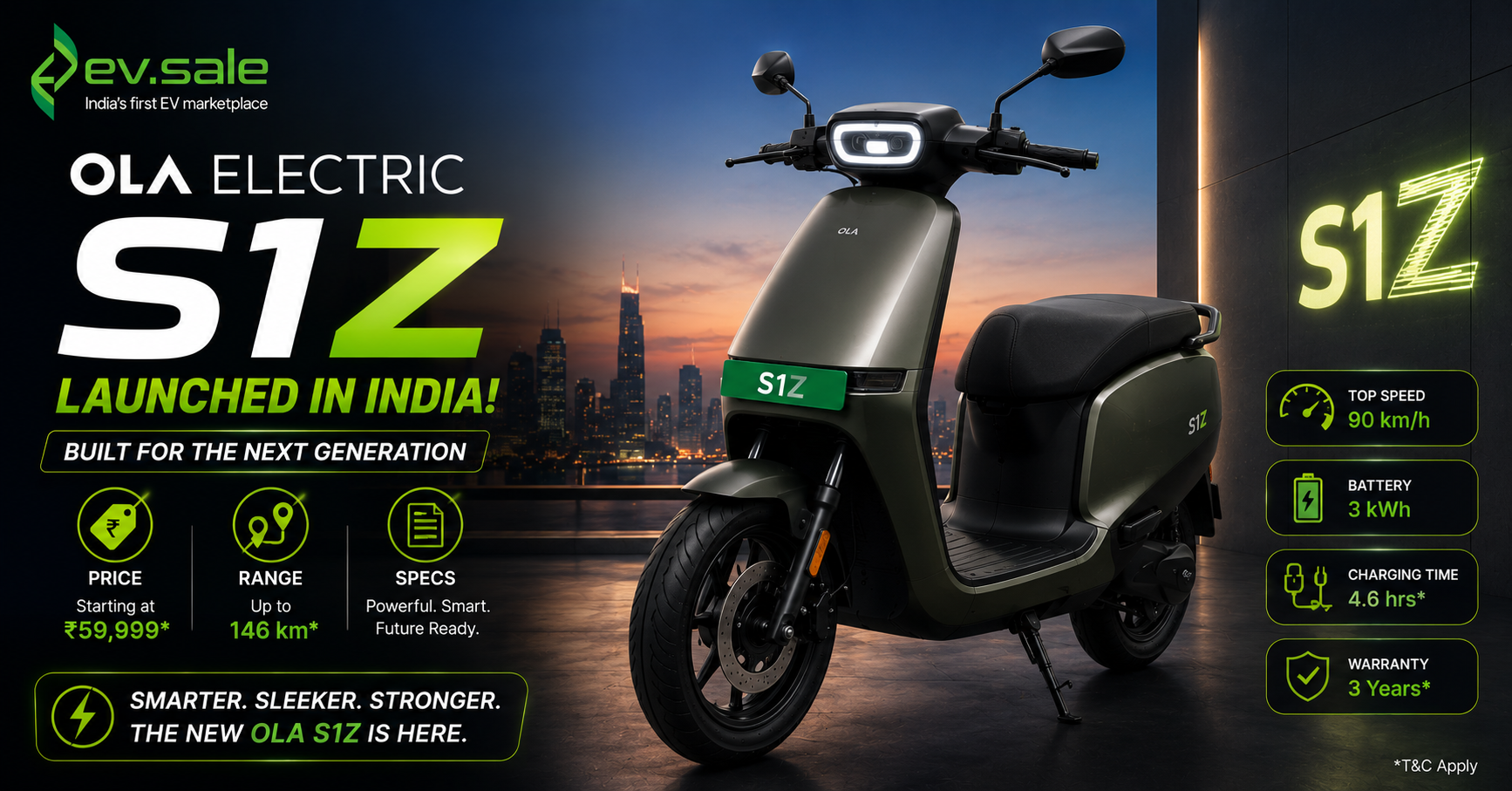
Ola Electric has expanded its electric scooter portfolio with the launch of the new S1Z in India, targeting buyers who want a combination of affordability, practical range and modern connected features. The new scooter is offered with 3.1 kWh and 5.1 kWh battery options, with introductory prices starting at ₹79,999 ex-showroom and going up to ₹99,999 for the larger-battery version. The company claims IDC ranges of 179 km and 301 km, respectively, while both variants use a 4 kW peak motor and have a claimed top speed of 70 km/h. With deliveries scheduled in phases, the S1Z could become an important product for Ola as India’s electric two-wheeler market moves towards more price-conscious customers.
The latest launch also reflects how quickly India’s EV market has changed. Electric scooters were once positioned mainly around technology, environmental benefits and premium features, but buyers today are increasingly focused on practical questions such as purchase price, usable range, charging convenience, battery life and ownership costs. Ola is addressing that demand with two battery choices rather than forcing customers into a single configuration. The smaller 3.1 kWh model is aimed at buyers who want a lower entry price, while the 5.1 kWh version focuses on customers who prioritise longer riding distances. This wider choice could help electric scooters reach more mainstream Indian households.
Ola S1Z Price in India: Two Battery Options for Different Buyers
The Ola S1Z price in India starts at ₹79,999 ex-showroom for the 3.1 kWh version, while the 5.1 kWh variant carries an introductory ex-showroom price of ₹99,999. The ₹20,000 difference gives customers a relatively straightforward choice between lower initial expenditure and significantly greater claimed range. However, buyers should remember that ex-showroom pricing does not represent the complete on-road cost. Insurance, registration and other applicable charges can increase the final amount depending on the state and city. Customers should therefore compare the complete purchase cost before deciding which version fits their budget.
The pricing strategy is particularly significant in India’s highly competitive two-wheeler market. A large part of the country’s daily mobility still depends on affordable scooters and motorcycles, meaning EV manufacturers need to compete not only with other electric models but also with established petrol alternatives. The S1Z’s starting price puts it into a segment where running costs could become an important part of the buying decision. For customers covering several hundred kilometres every month, the difference between charging an electric scooter and fuelling a petrol vehicle could influence the long-term ownership calculation.
179 km and 301 km Claimed Range Explained
Range is one of the strongest talking points of the new S1Z. Ola claims that the 3.1 kWh version can travel up to 179 km under IDC testing, while the larger 5.1 kWh battery version has a claimed IDC range of 301 km. The difference is substantial and gives the larger model a clear advantage for riders who regularly travel longer distances. However, IDC figures should not be treated as guaranteed everyday range. Real-world performance can change because of traffic, riding speed, rider weight, road gradients, weather, tyre pressure and acceleration patterns.
For an urban rider travelling approximately 25–40 km a day, the 3.1 kWh version could provide enough certified range for several commuting cycles before a recharge is required. The 5.1 kWh model, meanwhile, is more suitable for buyers who want greater flexibility between charging sessions. This distinction could make the S1Z easier to understand than some EV portfolios where battery choices are closely packed together. Instead of paying for a larger battery without needing it, customers can select a version based on their actual travel pattern.
Battery Technology Gives the S1Z a New Identity
One of the most important changes with the new S1Z is its battery technology. Ola Electric has introduced its Bharat Cell LFP battery technology, developed through the company’s battery research programme and manufactured at its Gigafactory. LFP chemistry has become increasingly important in the global EV industry because of its characteristics around thermal stability, durability and cost. Ola’s decision to bring its locally developed cells into a mass-market scooter indicates that the company is looking beyond vehicle design and focusing heavily on battery localisation.
Battery technology has a direct influence on the price and usability of an electric vehicle. The battery represents one of the most expensive components of an EV, so improvements in cell manufacturing, production scale and energy density can eventually influence retail prices. If Indian manufacturers successfully increase local cell production, future electric scooters could potentially deliver more range without proportionally increasing their prices. The S1Z therefore represents more than another new scooter; it also provides a glimpse into how locally produced battery technology could influence India’s next generation of affordable EVs.
Motor Performance Focuses on Urban Mobility
The S1Z uses a 4 kW peak motor and has a claimed top speed of 70 km/h. Ola has positioned the scooter around practical urban use rather than high-speed performance, which makes sense considering its target price range. The 3.1 kWh version is claimed to accelerate from 0–40 km/h in 4.6 seconds, while the 5.1 kWh model takes 4.9 seconds for the same benchmark. These figures suggest that the scooter has enough performance for typical city traffic, where quick low-speed acceleration is often more useful than a very high maximum speed.
The performance strategy also allows Ola to keep the two variants relatively easy to understand. Both models use the same motor and top-speed rating, with battery capacity becoming the primary difference. Buyers therefore do not have to choose between substantially different performance levels. Instead, they can decide whether they want a lower purchase price or more range. For students, office commuters and urban families with predictable travel requirements, this could make the entry-level version particularly attractive.
MoveOS 5 Adds a Connected Ownership Experience
Ola has equipped the S1Z with its MoveOS 5 software platform, bringing several connected features to the scooter. Functions include GPS tracking, geo-fencing, time-fencing, ride statistics and over-the-air software updates. The scooter also offers features such as cruise control, regenerative braking and reverse mode. These technologies highlight an important difference between modern EVs and conventional two-wheelers: software is increasingly becoming part of the ownership experience rather than simply an additional feature.
Connected technology could also become important when these scooters eventually enter India’s used-EV market. A digital ownership history can potentially provide more information about how a vehicle has been used and maintained. As the market matures, buyers may increasingly ask about battery condition, software updates, charging behaviour and service history in addition to mileage. This could make EV resale more data-driven than the traditional used two-wheeler market, where buyers have historically focused mainly on mechanical condition and service records.
Charging Time and Daily Usability
Charging remains an important consideration for customers moving from petrol scooters to electric mobility. Ola lists an approximate 0–80% home charging time of 5 hours 42 minutes for the 3.1 kWh model and 6 hours 16 minutes for the 5.1 kWh version. These figures make overnight charging a practical option for many owners. A commuter can return home after work, connect the scooter to a suitable power source and have a substantially replenished battery ready for the next morning.
However, charging convenience can vary depending on the owner’s living situation. Customers with independent homes or dedicated parking spaces may find home charging straightforward, while apartment residents may need permission or access to a suitable electrical connection. This is why public charging infrastructure will continue to play an important role as EV adoption grows. For most electric scooter users, however, home charging is likely to remain the most convenient option because daily travel is generally predictable and the energy requirement is significantly lower than that of a larger electric car.
India’s EV Market Is Moving Towards Affordability
The launch of the S1Z comes at a time when India’s electric two-wheeler market is entering a more competitive phase. Earlier EV buyers were often willing to pay more to access new technology, but mainstream customers tend to calculate value differently. They want to know how much the scooter costs, how far it can travel, how much charging will cost and how reliable the battery will remain over several years. Ola’s two-battery strategy directly addresses this changing behaviour by allowing customers to select the range and price combination that suits their lifestyle.
The transition towards affordability is likely to become even more important in the coming years. Battery production is expanding, domestic EV manufacturing is developing and competition among two-wheeler brands continues to increase. These factors could gradually improve the value proposition offered to consumers. Instead of simply asking whether an electric scooter is better than a petrol scooter, buyers are increasingly asking which EV gives them the best total ownership value. The S1Z enters this market with a clear focus on making that comparison more competitive.
Best EV Marketplace in India for India’s Growing EV Buyers
As more electric scooters and cars enter the market, the need for a reliable Best EV Marketplace in India is also increasing. New-vehicle launches give buyers more choices, but the growing number of models can also make comparison more complicated. Customers may want to compare battery capacity, claimed range, price, ownership costs and features before making a decision. A dedicated EV marketplace can bring these details together while also giving buyers access to pre-owned electric vehicles.
EV.sale is built around this growing EV ecosystem, allowing customers to explore electric vehicles through a dedicated marketplace. The platform is particularly relevant as India’s first wave of EV owners begins moving towards newer models. As these vehicles become available in the second-hand market, customers will need reliable information about battery condition, kilometres driven, service history and warranty. A specialised platform can make it easier to connect sellers with buyers who are already searching specifically for electric mobility.
Buy Used EV Cars in Bangalore as the Resale Market Develops
The growth in new electric vehicle sales will eventually create a much larger pool of pre-owned EVs, giving customers more opportunities to Buy Used EV Cars in Bangalore. Bengaluru is already an important market for electric mobility because of its large commuter population and strong acceptance of new automotive technology. As early EV owners upgrade to newer vehicles, their existing scooters and cars can enter the second-hand market. This creates an opportunity for buyers who want electric mobility but find the price of a new EV difficult to justify.
Customers planning to Buy Used EV Cars in Bangalore should remember that battery health is just as important as the vehicle’s age and mileage. A used EV with fewer kilometres is not automatically the better purchase if its battery has been poorly maintained. Buyers should ask about charging patterns, warranty coverage, service history and any battery-related repairs. Checking the vehicle documents, charger and charging port is equally important. A test drive and professional inspection can provide additional confidence before the transaction is completed.
Battery Health Could Determine Future EV Resale Prices
The used-EV market is likely to develop differently from the traditional used-car market because battery condition will influence resale value. When customers Buy Used EV Cars in Bangalore, they are effectively buying the remaining usable life of the vehicle’s battery as well as the car or scooter itself. Battery degradation is influenced by several factors, including age, charging behaviour, usage intensity and operating conditions. This means sellers who maintain their EV properly and retain complete records could have a stronger advantage when they eventually decide to sell.
Documentation could become an important part of future EV resale. Service invoices, battery-health reports, warranty records and charging information can help buyers understand what they are purchasing. A seller who can demonstrate responsible ownership may find it easier to attract serious enquiries than someone who provides only basic vehicle details. As customers become more familiar with EV technology, transparency around battery condition is likely to become a standard expectation rather than an optional selling point.
How to List Your EV on EV.sale
Owners who want to sell their electric vehicle can use EV.sale to create a dedicated listing for potential buyers. A strong listing should include the manufacturer, model, variant, registration year, kilometres driven, ownership details and expected selling price. For EVs, sellers should also mention battery capacity, charging information, remaining warranty and service history wherever these details are available. Clear photographs of the exterior, interior, dashboard, charging port, tyres and accessories can make the listing more informative.
Sellers should focus on accuracy rather than simply making the vehicle look attractive. If there are scratches, tyre wear or other visible issues, showing them clearly can help build trust with prospective buyers. Supporting documents such as service records, insurance details and warranty information can also strengthen the listing. By providing comprehensive information, owners can help customers quickly understand whether the vehicle matches their budget and requirements. This can also lead to more relevant enquiries from people actively searching for EVs.
Best EV Marketplace in India as New and Used EV Sales Converge
The role of a Best EV Marketplace in India will become more important as India’s electric vehicle market develops from a new-vehicle-focused industry into a complete ownership ecosystem. Every new EV sold today eventually becomes part of the country’s pre-owned vehicle supply. This creates an opportunity for buyers to access newer technology at more affordable prices while giving existing owners a pathway to upgrade. A dedicated EV marketplace can connect both sides of this cycle.
The next five to ten years could therefore bring a major transformation in EV resale. Customers will increasingly compare battery health, remaining warranty, range, service history and ownership costs alongside purchase price. This information can make used-EV transactions more transparent and reduce some of the uncertainty associated with buying an electric vehicle for the first time. Platforms such as EV.sale can support this shift by bringing EV sellers and buyers together in a marketplace specifically designed around electric mobility.
Buy Used EV Cars in Bangalore With a Complete Inspection
Anyone planning to Buy Used EV Cars in Bangalore should conduct a detailed inspection before finalising the purchase. Battery condition should be checked alongside tyres, brakes, suspension, body panels, electrical systems and charging equipment. Buyers should verify the registration certificate, insurance status and service records, while also checking whether the original charger and other accessories are included. The charging port should be examined carefully for physical damage or signs of improper use.
A test drive can provide additional information about acceleration, braking, steering, suspension and regenerative braking behaviour. Buyers should also ask whether the vehicle has experienced any major accident, battery repair or component replacement. The range displayed by the vehicle should not be considered a definitive battery-health report, so buyers should request formal battery information where available. Taking these precautions can reduce the risk of unexpected expenses and help customers make a more informed decision when they Buy Used EV Cars in Bangalore.
Why the S1Z Launch Matters for India’s Electric Future
The S1Z’s most significant contribution may not simply be its price or range figures. Its introduction demonstrates how EV manufacturers are beginning to combine local battery technology, software and affordable pricing into products designed for mainstream customers. The ₹79,999 starting price puts the scooter in direct competition for customers who may previously have considered petrol two-wheelers their default choice. The 5.1 kWh version, meanwhile, demonstrates how a relatively small increase in upfront cost can provide a substantially larger claimed range.
Over time, improvements in battery manufacturing could change the economics of electric mobility even further. If manufacturers can produce batteries at greater scale and improve cell technology, consumers may receive higher range and longer battery life without equivalent increases in purchase prices. Software updates could also extend the useful feature life of vehicles. These trends could make EVs increasingly competitive not only when purchased new but also when they enter the used market several years later.
Conclusion: Ola S1Z Targets India’s Next Wave of EV Buyers
The Ola Electric S1Z arrives with a clear objective: make electric mobility accessible to a wider group of Indian customers. With a starting price of ₹79,999, a 3.1 kWh battery, 179 km claimed IDC range and 70 km/h top speed, the entry model focuses on affordability and urban usability. The 5.1 kWh version raises the price to ₹99,999 while increasing the claimed range to 301 km. Both versions use a 4 kW peak motor and receive modern connected features through MoveOS 5, giving customers a choice based largely on their range requirements.
For the wider Indian EV industry, the launch represents another step towards mainstream electric mobility. As battery technology improves and competition increases, buyers are likely to receive more choices at increasingly competitive prices. At the same time, today’s new EVs will gradually become tomorrow’s used vehicles, creating a growing second-hand ecosystem. Customers searching for the Best EV Marketplace in India will increasingly expect detailed information about battery health, range, ownership history and warranty.
For customers planning to Buy Used EV Cars in Bangalore, the growing number of electric vehicles on Indian roads should eventually create more choice across different budgets. The key will be evaluating battery condition, service history and overall vehicle quality rather than choosing solely on price.
EV owners who are ready to sell can list their vehicles through EV.sale, providing details such as specifications, kilometres driven, battery information, ownership history, photographs and service records. A detailed listing can help connect sellers with buyers who are specifically searching for electric vehicles.
Visit EV.sale to explore EV listings and discover more opportunities in India’s expanding electric vehicle market.
Stay connected with EV.sale – TVS iQube 2.3 kWh Launched at ₹1.16 Lakh in India
What is the price of the Ola S1Z in India?
The Ola S1Z starts at an introductory ₹79,999 ex-showroom for the 3.1 kWh variant. The 5.1 kWh version is priced at ₹99,999 ex-showroom. The final on-road price will depend on the customer’s location, insurance, registration and other applicable charges. Buyers should check the latest official pricing before booking.
What is the range of the Ola S1Z?
The 3.1 kWh Ola S1Z has a claimed 179 km IDC range, while the 5.1 kWh version claims 301 km IDC range. These are certified test-cycle figures and actual range can vary considerably depending on riding conditions. Traffic, speed, rider weight, weather, road conditions and riding style can all affect real-world efficiency.
What battery technology does the Ola S1Z use?
The new S1Z uses Ola Electric’s Bharat Cell LFP battery technology, developed through the company’s battery research programme and manufactured at its Gigafactory. LFP chemistry is widely used in EV applications because of its durability and thermal characteristics. Ola has positioned its locally developed battery technology as an important part of its long-term EV strategy.
When will Ola S1Z deliveries begin?
Deliveries of the 3.1 kWh S1Z are scheduled to begin in December 2026, while the 5.1 kWh version is scheduled for March 2027. Actual delivery timing can vary depending on production, booking volume and location. Customers should confirm the latest delivery schedule with Ola before placing an order.
Is the Ola S1Z suitable for daily commuting?
The S1Z is primarily designed for everyday urban mobility, with a claimed top speed of 70 km/h and a 4 kW peak motor. The 3.1 kWh model is better suited to customers prioritising a lower purchase price, while the 5.1 kWh model offers substantially greater claimed range. The right choice ultimately depends on daily travel distance and charging availability.
What should I check before I Buy Used EV Cars in Bangalore?
Before you Buy Used EV Cars in Bangalore, check the battery’s condition, remaining warranty, charging performance and service history. Buyers should also verify registration, insurance, accident history and ownership documents. A test drive and professional EV inspection can help identify potential problems before completing the purchase.
How can I list my EV on EV.sale?
To list an EV on EV.sale, provide accurate information about the make, model, variant, registration year, kilometres driven and expected price. Sellers should also add battery capacity, warranty information, service history and clear vehicle photographs wherever possible. Detailed listings make it easier for interested buyers to understand the vehicle and can attract more relevant enquiries.
Leave a Reply