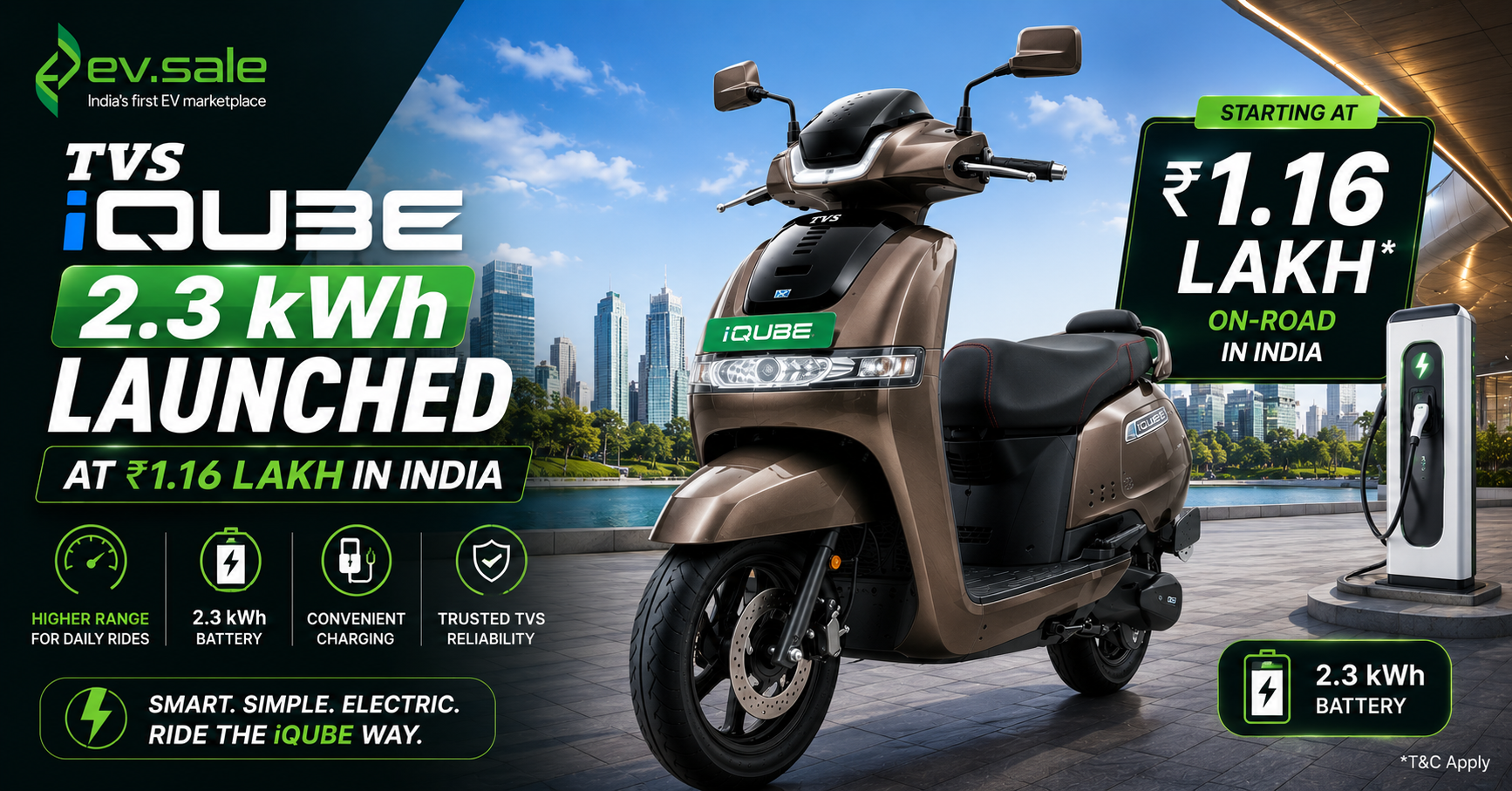
TVS Motor Company has strengthened its electric scooter portfolio with the introduction of the new TVS iQube 2.3 kWh, priced at ₹1.16 lakh ex-showroom in Delhi. The latest variant is designed for urban riders looking for a practical electric scooter without stepping into the higher-priced versions of the iQube range. It gets a 2.3 kWh battery, a claimed 114 km IDC range and a top speed of 68 km/h. The new model replaces the earlier 2.2 kWh version while bringing a modest battery increase and a longer claimed range. With electric two-wheelers becoming an increasingly important part of India’s daily commuting landscape, the new iQube arrives at a time when affordability is becoming as important as technology.
The launch also highlights how India’s electric scooter market has evolved over the past few years. Earlier electric scooters were largely purchased by customers interested in experimenting with new technology, but the category has now moved towards mainstream urban mobility. Buyers increasingly expect useful range, dependable charging, connected features and manageable ownership costs rather than simply choosing an EV because it is electric. TVS has already built considerable recognition with the iQube family, and the company says the range has crossed the one-million customer milestone. The new 2.3 kWh variant is therefore positioned to attract another group of customers who want a familiar brand and practical city performance at a relatively accessible price.
TVS iQube 2.3 kWh Price and Positioning
The new TVS iQube 2.3 kWh is priced at ₹1,16,310 ex-showroom in Delhi, with the charger and GST included in the listed price. The actual on-road price will vary between cities because registration, insurance, road-related charges and other applicable costs can differ by location. TVS has also listed the applicable PM E-DRIVE incentive separately, meaning customers should check the latest eligibility and pricing information when making a purchase. This distinction between ex-showroom and on-road pricing is important because the final amount paid by a customer can be noticeably higher. For buyers comparing electric scooters, calculating the complete ownership cost rather than looking only at the headline price can provide a clearer picture of value.
At this price point, the 2.3 kWh version acts as the gateway to the wider iQube family. Instead of pushing every customer towards a larger battery and more expensive equipment, TVS is offering a simpler configuration for riders whose daily travel is primarily within the city. This strategy allows the company to address customers with different budgets while retaining the iQube name across the portfolio. The approach is particularly relevant in India’s price-sensitive two-wheeler market, where monthly running costs and upfront affordability strongly influence purchase decisions. For a commuter travelling predictable distances every day, the entry-level iQube could provide a reasonable balance between purchase price and electric running costs.
2.3 kWh Battery Offers 114 km Claimed Range
The biggest change in the new model is its 2.3 kWh battery pack, which replaces the previous 2.2 kWh unit. TVS claims an IDC range of 114 km, representing an improvement of around 20 km over the earlier version’s 94 km claimed figure. On paper, the increase gives riders more flexibility between charging sessions and could make the scooter more comfortable for regular urban commuting. However, IDC range should not be confused with the distance every rider will achieve in everyday conditions. Traffic density, average speed, rider weight, road gradients, tyre pressure, weather and riding style can all affect the actual distance covered on a charge.
For a typical city commuter covering approximately 25–40 km per day, the claimed range can provide a useful buffer. Instead of worrying about charging after every short trip, riders may be able to complete several days of regular commuting before needing a full recharge, depending on actual usage. This is one reason range has become such an important consideration in electric scooter purchasing decisions. Customers are no longer comparing EVs only by battery size; they want to understand how much usable mobility that battery can provide in everyday life. The 2.3 kWh iQube appears to be aimed precisely at this practical urban requirement.
Performance Focused on Everyday City Riding
The new TVS iQube 2.3 kWh produces 3.68 kW of motor power and has a claimed top speed of 68 km/h. The top-speed figure is lower than the outgoing 2.2 kWh version, which was rated at 75 km/h, indicating that TVS has prioritised efficiency and entry-level positioning rather than outright performance. For riders using the scooter mainly for city commutes, the difference may not be particularly significant because much of urban riding takes place well below highway speeds. The scooter’s configuration is therefore more closely aligned with stop-and-go traffic, residential roads and regular office or college journeys.
This approach also reflects an important engineering trade-off in affordable EVs. Higher performance generally requires careful balancing between motor output, battery capacity, thermal management and energy consumption. By positioning the 2.3 kWh version as a practical commuter rather than a performance scooter, TVS can focus on delivering predictable urban usability. Customers who want higher speed and stronger performance can move towards larger-battery iQube variants. In this way, the 2.3 kWh model does not have to compete with the entire electric scooter market on specifications; instead, it can target customers whose priority is affordable and convenient everyday transportation.
Simpler Equipment Helps Keep the Price Accessible
TVS has made several equipment choices that distinguish the new entry-level model from the more premium iQube variants. The scooter uses an LCD instrument console rather than the more sophisticated TFT screens available on higher versions. Despite the simpler display, TVS continues to offer useful connected functions such as turn-by-turn navigation, call and SMS alerts and over-the-air software updates. This is an important development because it shows that entry-level EVs do not necessarily have to sacrifice all modern technology to achieve a lower price. Instead, manufacturers can retain software-based features while reducing the cost of physical hardware.
The braking setup is also more straightforward, with drum brakes at both ends on the 2.3 kWh version. This again reinforces the scooter’s role as the value-oriented entry point to the iQube family. Buyers looking for more premium hardware, larger batteries and additional equipment have the option of selecting higher variants. For customers who primarily want an electric scooter for routine city travel, however, the simpler configuration may be acceptable if it results in a lower initial cost. This separation between essential features and premium equipment is likely to become increasingly common as manufacturers attempt to reach a broader Indian EV audience.
Charging Time and Everyday Ownership
Charging convenience is one of the most important factors when evaluating an electric scooter, and TVS lists the 2.3 kWh iQube with a charging time of approximately 2 hours and 50 minutes from 0 to 80%. For most urban users, this makes overnight charging or scheduled home charging relatively straightforward. A rider returning home after work can plug in the scooter and prepare it for the following day’s commute without needing to visit a charging station. This home-charging model can also help keep daily running costs predictable. However, convenient access to a suitable electrical connection remains an important consideration for apartment residents and customers without dedicated parking.
As India’s charging infrastructure expands, public charging will gradually become more relevant for longer-distance journeys. For everyday commuters, however, home charging is likely to remain the preferred option wherever it is practical. This is because most daily journeys are relatively predictable, allowing riders to plan their charging around their routine. The overall ownership experience of an EV therefore depends on more than battery capacity alone. Charging access, electricity cost, service support and battery warranty all contribute to whether an electric scooter feels convenient over several years.
TVS iQube Range Now Covers Multiple Customer Needs
The new 2.3 kWh model is only one part of TVS’s broader iQube strategy. The company now offers multiple battery configurations, with higher variants providing substantially greater claimed ranges and additional equipment. The portfolio extends from the entry-level 2.3 kWh battery to larger battery options, giving customers the ability to choose an iQube based on their daily distance requirements and budget. This is significant because electric scooter customers do not all have the same usage pattern. A student travelling short distances does not necessarily need the same battery capacity as a commuter covering 60 or 70 km every day.
This multi-variant strategy could become increasingly important as the Indian EV market matures. Instead of treating electric scooters as a single category, manufacturers are beginning to create clear price and performance levels within the same product family. Customers can therefore upgrade to a larger battery when their needs justify the additional expense. The 2.3 kWh model provides a relatively affordable starting point, while the higher versions cater to customers willing to spend more for longer range and additional technology. It is a model strategy that could help TVS retain customers within the iQube ecosystem as their requirements change.
Best EV Marketplace in India and the Growing EV Buyer Journey
The rapid expansion of electric scooters is also creating a stronger need for a specialised Best EV Marketplace in India, where buyers can research new and pre-owned electric vehicles in one place. EV customers often look beyond price when making a decision because battery capacity, charging requirements, range and warranty can significantly influence ownership. A dedicated marketplace can make these details easier to compare and help customers understand what they are actually getting for their money. As more EV models enter the market, this type of focused information could become increasingly valuable.
The importance becomes even clearer when electric vehicles move into the pre-owned market. A used EV buyer may want to know the vehicle’s battery condition, charging history, service records, remaining warranty and actual kilometres driven. These factors can have a greater influence on resale value than some of the characteristics buyers traditionally consider when purchasing petrol vehicles. EV.sale provides an EV-focused environment where sellers can present these details while buyers can explore electric vehicle listings. This can help create a more informed transaction as India’s EV ownership base continues to expand.
Buy Used EV Cars in Bangalore as the Pre-Owned Market Expands
The growing number of electric vehicles on Indian roads is expected to create more opportunities for people looking to Buy Used EV Cars in Bangalore. Bengaluru has been one of India’s strongest markets for electric mobility, supported by a large urban population, technology-oriented consumers and increasing awareness of EV ownership. As early EV owners begin upgrading to newer models, their existing vehicles can enter the second-hand market. This could make electric mobility more affordable for customers who want to experience an EV without paying the complete price of a new vehicle.
However, anyone planning to Buy Used EV Cars in Bangalore should approach the purchase differently from a conventional used-car transaction. Battery health should be investigated alongside mileage, because two vehicles with identical kilometres can have very different battery conditions depending on how they were used and charged. Buyers should also check service history, warranty coverage, charging equipment, accident records and vehicle documentation. A careful inspection and test drive can help determine whether the vehicle represents genuine value. This is where a transparent EV marketplace can make the buying process more efficient.
The Importance of Battery Health in the Used EV Market
Battery condition will become one of the defining factors in India’s future EV resale market. When customers decide to Buy Used EV Cars in Bangalore, they are not simply purchasing a vehicle’s exterior and interior; they are also purchasing the remaining useful life of its battery. Battery degradation is influenced by factors such as usage, charging patterns, climate and the age of the vehicle. While modern EV batteries are designed for long service life, buyers should still ask for available battery-health information and review the manufacturer’s warranty conditions.
Sellers can also improve the resale potential of their EV by maintaining proper documentation throughout ownership. Service invoices, warranty records, battery reports and charging information can give potential buyers greater confidence. This becomes particularly important as customers become more knowledgeable about EV technology. A well-documented vehicle can stand apart from a similar model where the battery history and maintenance record are unclear. For EV.sale listings, providing as much accurate information as possible can help buyers make faster and more informed decisions.
Best EV Marketplace in India for a Changing Electric Vehicle Market
The role of the Best EV Marketplace in India is likely to become more important as the country moves from an early-adoption phase into a broader ownership cycle. The first wave of EV customers has already helped manufacturers understand battery usage, charging behaviour and customer expectations. The next stage will involve more second-hand transactions, greater price comparisons and increased demand for vehicle-history information. Buyers will want marketplaces that provide more than photographs and asking prices.
EV.sale can support this transition by bringing electric vehicles together in a dedicated marketplace. Sellers can create listings that explain the vehicle’s specifications, ownership history, kilometres driven, battery details and overall condition. Buyers can then use this information as an initial screening tool before moving towards inspection and negotiation. As India’s EV ecosystem grows, a specialised platform can help connect the supply of pre-owned EVs with customers actively searching for electric mobility.
How to List Your EV on EV.sale
Selling an EV online becomes more effective when the listing gives potential buyers a complete picture of the vehicle. Owners can visit EV.sale and provide key information such as the manufacturer, model, variant, registration year, kilometres driven, ownership details and expected price. For electric vehicles, battery capacity, charging type, available warranty and service history should also be mentioned wherever the information is available. These details allow buyers to understand the vehicle before contacting the seller and can help attract enquiries from people who are genuinely interested in that particular model.
Good photography can make the listing even stronger. Sellers should capture clear images of the front, rear, sides, interior, dashboard, tyres, charging port and supplied charging equipment. If there are cosmetic marks or other visible issues, showing them honestly can build more trust than leaving them out. Battery reports, service documents and warranty information can also add value to the listing. By providing accurate specifications and transparent photographs, sellers can create a more useful EV.sale listing and improve the quality of conversations with prospective buyers.
Buy Used EV Cars in Bangalore With a Complete Vehicle Check
For customers who want to Buy Used EV Cars in Bangalore, a complete inspection remains essential even when a vehicle appears attractive online. Buyers should verify the registration details, insurance status, service history and ownership records before making a final commitment. The charging port should be checked for physical damage, while the supplied charger should be tested where possible. A test drive can also reveal important information about acceleration, regenerative braking, suspension, tyres and overall driving behaviour.
Battery-related information should be considered alongside the vehicle’s age and mileage. Buyers should ask about remaining battery warranty and whether any battery-related repairs or replacements have taken place. The estimated range shown on the dashboard can also be observed during the test drive, although it should not be treated as a formal battery-health test. Taking time to inspect these areas can reduce the possibility of unexpected costs and help customers make a more confident decision when they Buy Used EV Cars in Bangalore.
Why the ₹1.16 Lakh Price Matters
The ₹1.16 lakh starting price makes the new iQube particularly relevant in the current electric two-wheeler market because affordability remains a major barrier to wider EV adoption. While electric scooters can offer lower running costs than petrol alternatives, the initial purchase price continues to influence many Indian buyers. TVS’s decision to create a simpler 2.3 kWh variant suggests that the company wants to reduce this entry barrier while maintaining enough range and technology for everyday use. The scooter is therefore positioned less as a premium technology product and more as an accessible urban mobility solution.
The launch also shows how manufacturers are learning to manage the relationship between battery size and pricing. A larger battery provides additional range, but it also adds cost and weight. The new iQube’s 2.3 kWh battery offers a moderate increase over the outgoing model while keeping the product within a comparatively accessible price bracket. This could become a key direction for India’s EV industry, where customers increasingly expect meaningful range without accepting large price increases. Future improvements in battery chemistry, local manufacturing and economies of scale could make this balance even easier to achieve.
From Early EV Adoption to Mainstream Electric Mobility
India’s electric two-wheeler industry has travelled a considerable distance from its early years. Initial customers often had to make compromises around range, charging infrastructure and model availability. Today’s electric scooters offer multiple battery choices, connected features, smartphone integration, navigation and software updates. The iQube itself now represents this transition, having grown from a single product into a wider family serving customers with very different requirements. The one-million-customer milestone demonstrates how dramatically consumer acceptance has changed.
The next phase is likely to focus on total ownership value rather than simply EV novelty. Customers will compare purchase price, electricity costs, service expenses, battery warranty and resale value before deciding which scooter to buy. This will also make the used-EV market increasingly important. As more first-generation owners sell their vehicles, buyers will have an opportunity to enter the EV ecosystem at lower prices. Platforms such as EV.sale can help facilitate this transition by giving buyers and sellers a dedicated environment for electric vehicles.
Best EV Marketplace in India and the Future of EV Resale
The future Best EV Marketplace in India will increasingly depend on transparency and useful vehicle information. An EV listing that clearly communicates battery capacity, range, ownership history, warranty and charging details can give buyers a much better starting point than a listing that only provides a price and a few photographs. As consumers become more familiar with electric vehicles, these details will influence both purchasing decisions and resale values. The market is gradually moving towards a stage where data and documentation will be as important as the vehicle’s appearance.
This shift can benefit responsible EV owners who maintain their vehicles properly and keep complete records. A well-maintained electric vehicle with clear documentation may be easier to sell when the owner decides to upgrade. For EV.sale, the opportunity is to connect this growing supply of pre-owned EVs with customers actively looking for electric mobility. As India’s EV market expands, the relationship between new vehicle sales and used vehicle sales will become increasingly important for the overall health of the ecosystem.
Buy Used EV Cars in Bangalore as Choice and Affordability Improve
People looking to Buy Used EV Cars in Bangalore are likely to see a wider selection as India’s electric vehicle population grows. New models introduced today will eventually become tomorrow’s pre-owned vehicles, creating more choices across different budgets. Buyers who previously found new EV prices difficult to justify may find better value in a well-maintained used model. This could help electric mobility reach customers who were previously unable to enter the market because of the upfront cost.
The important factor will be choosing based on overall condition rather than simply looking for the lowest price. A vehicle with a healthy battery, remaining warranty and complete service history can offer stronger long-term value than a cheaper EV with uncertain maintenance records. Buyers should compare several options and ask detailed questions before finalising a purchase. With platforms such as EV.sale bringing EV listings together, the process of researching and comparing pre-owned electric vehicles can become easier for customers across Bengaluru and other Indian cities.
What the TVS iQube 2.3 kWh Means for India’s EV Market
The new TVS iQube 2.3 kWh may look like a small addition to the company’s portfolio, but its positioning reflects a much larger shift in India’s electric vehicle market. Customers increasingly want EVs that combine reasonable upfront pricing with useful range, dependable charging and familiar after-sales support. The new variant addresses this demand with a 2.3 kWh battery, 114 km claimed IDC range, 68 km/h top speed and a starting ex-showroom price of ₹1.16 lakh. Its simpler equipment package also demonstrates how manufacturers are adapting products for price-conscious customers.
The bigger story is the continued normalisation of electric mobility. With the iQube family already crossing one million customers, TVS has demonstrated that electric scooters can move well beyond the early-adopter segment. As competition increases, customers are likely to receive better technology, broader range choices and more competitive prices. At the same time, the used-EV market will begin to mature, giving customers another path into electric mobility. This combination of new launches and growing resale supply could make the next few years particularly important for India’s EV industry.
Conclusion: TVS Targets the Everyday Electric Commuter
The TVS iQube 2.3 kWh, launched at ₹1,16,310 ex-showroom in Delhi, is clearly aimed at customers who want an affordable and practical entry into electric mobility. Its 2.3 kWh battery and claimed 114 km IDC range provide a useful combination for urban commuting, while its 68 km/h top speed and simpler hardware keep the model differentiated from the more premium iQube variants. The scooter may not offer the highest performance or longest range in the market, but that is not necessarily its purpose. Its strength lies in delivering the core EV experience at a more accessible point in the portfolio.
For India’s broader EV ecosystem, the launch reflects a market that is becoming more mature and competitive. Buyers now have more electric models to compare, manufacturers are offering different battery capacities and technology levels, and the pre-owned market is beginning to take shape. For customers planning to Buy Used EV Cars in Bangalore, this growth means more choices will gradually become available, provided they pay close attention to battery condition, warranty and service history.
For owners planning to sell an electric vehicle, EV.sale offers a dedicated platform to showcase vehicles to an EV-focused audience. Sellers can create detailed listings with photographs, specifications, battery information, ownership details and service records, helping potential buyers make more informed decisions.
Visit EV.sale to explore electric vehicle listings and discover opportunities across India’s growing EV market.
Stay connected with EV.sale – Hyundai Sub-4m Electric SUV Confirmed for India in 2027
What is the price of the TVS iQube 2.3 kWh?
The TVS iQube 2.3 kWh is priced at ₹1,16,310 ex-showroom in Delhi, with the listed price including GST and charger. The final on-road price will vary depending on the buyer’s city, insurance, registration and applicable charges. Customers should check the latest TVS pricing and incentive information before booking the scooter.
What is the range of the TVS iQube 2.3 kWh?
The new iQube 2.3 kWh has a claimed 114 km IDC range. This is approximately 20 km higher than the claimed range of the previous 2.2 kWh version. Actual range will depend on riding speed, traffic, rider weight, road conditions, weather, tyre pressure and riding behaviour, so everyday range can be lower than the certified figure.
What is the top speed of the TVS iQube 2.3 kWh?
The entry-level TVS iQube 2.3 kWh has a claimed top speed of 68 km/h. It uses a 3.68 kW motor and is primarily designed around practical urban commuting rather than high-speed performance. Customers looking for a higher top speed can consider the larger-battery iQube variants available within the TVS portfolio.
Is the TVS iQube 2.3 kWh good for daily commuting?
The 2.3 kWh version can be a practical option for urban commuters who travel moderate distances every day. Its 114 km claimed IDC range provides a useful buffer for regular city travel, while the relatively compact battery supports the scooter’s entry-level positioning. Buyers should still consider their daily distance, home-charging access and preferred performance before choosing the variant.
What should I check before I Buy Used EV Cars in Bangalore?
When you Buy Used EV Cars in Bangalore, battery health should be one of the first things to investigate. Buyers should also verify service records, remaining warranty, charging equipment, accident history, insurance and registration documents. A test drive and professional inspection can provide additional confidence before completing the purchase.
How can I sell my EV through EV.sale?
Owners can visit EV.sale and create a vehicle listing with details such as the make, model, variant, registration year, kilometres driven, ownership information and expected price. Adding battery specifications, warranty details, service history and clear photographs can make the listing more useful to potential buyers. Accurate information helps connect sellers with customers actively searching for electric vehicles.
Leave a Reply