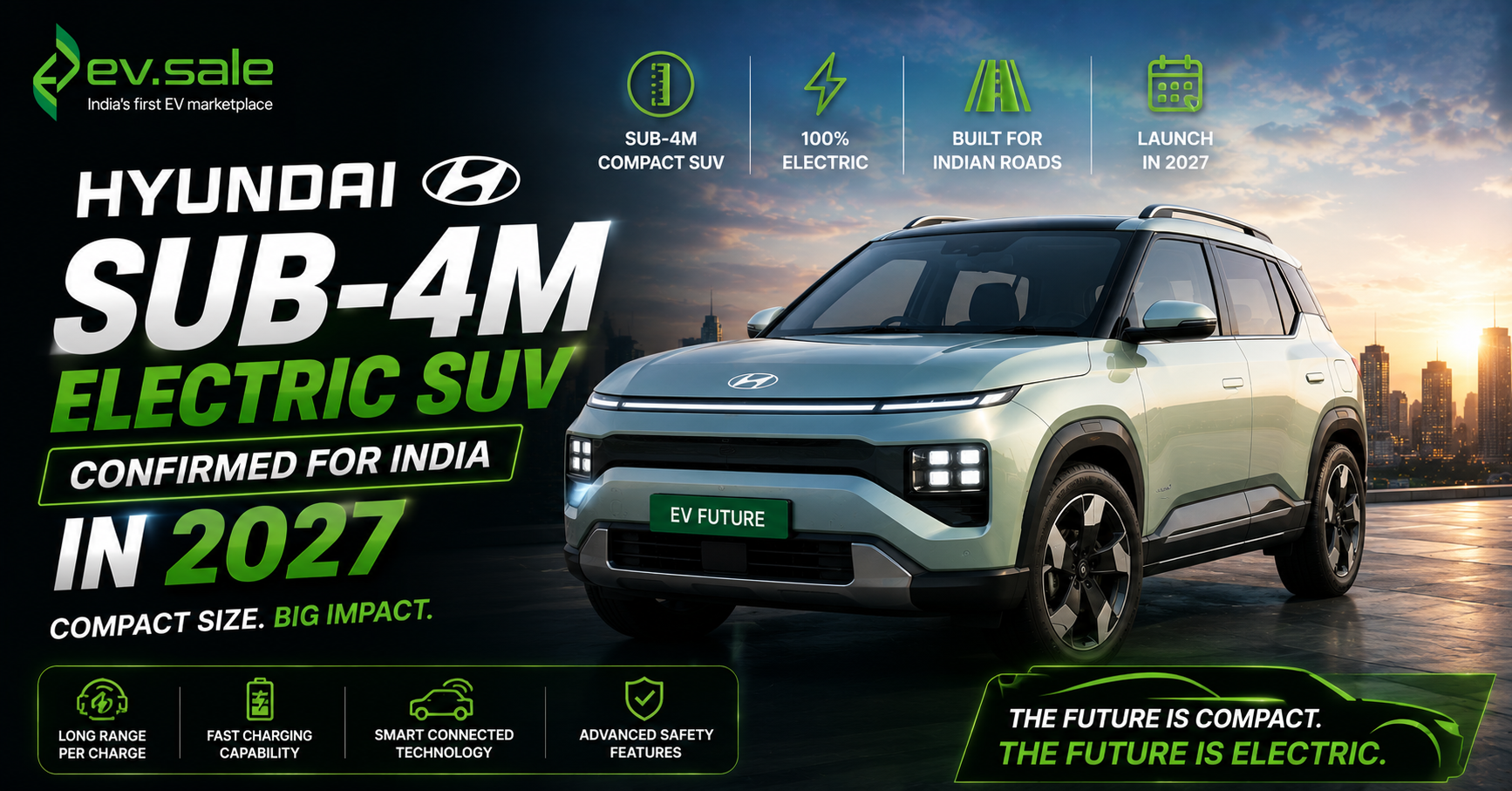
Hyundai is preparing to enter one of the most competitive spaces in India’s electric vehicle market with a new sub-4-metre electric SUV expected in 2027. The upcoming model is being developed with the Indian market in mind and is expected to sit below the Creta Electric in Hyundai’s EV portfolio. While the company has not yet revealed the final name, price or complete specifications, the project signals Hyundai’s intention to take electric mobility into a much larger customer segment. The SUV is expected to be manufactured in Tamil Nadu with a high level of localisation, which could help Hyundai control production costs and offer a more competitive price. For Indian EV buyers, its arrival could add another strong choice to the rapidly expanding compact electric SUV segment.
India’s electric vehicle market has changed dramatically in just a few years. Earlier, EV buyers had only a small number of options and were often required to compromise on range, charging convenience or features. Today, customers can choose from compact electric hatchbacks, SUVs and premium electric models with increasingly larger batteries and advanced connected technology. Tata Motors has already established strong products in the mass-market segment, while manufacturers such as Mahindra, Hyundai, Kia and MG are expanding their electric portfolios. Hyundai’s upcoming sub-4m SUV could therefore arrive at exactly the right time, when consumer awareness is higher and charging infrastructure is gradually becoming more accessible.
Hyundai Sub-4m Electric SUV Confirmed for India
Hyundai has confirmed that a new compact electric SUV is being developed for the Indian market, with the model expected to arrive in 2027. The vehicle is reportedly being developed under an internal project and is expected to be manufactured at Hyundai’s Tamil Nadu facility. Unlike a completely imported EV, the upcoming SUV is expected to receive significant localisation, allowing Hyundai to adapt the product to India’s cost-sensitive market. Its sub-4-metre dimensions could also make it particularly attractive to urban customers looking for an easy-to-drive electric SUV. The final production name and detailed specifications are expected to be revealed closer to the launch.
The importance of the new model comes from its positioning within Hyundai’s existing portfolio. The Creta Electric occupies a larger and more premium space, while the new compact SUV is expected to target customers looking for a smaller and potentially more affordable option. This could allow Hyundai to cover a much wider range of EV buyers instead of concentrating primarily on higher-priced electric vehicles. The company already has extensive experience in India’s compact SUV segment through the Venue, so the upcoming EV could benefit from Hyundai’s understanding of Indian customer preferences. Its success, however, will depend heavily on pricing, battery range, charging performance and real-world usability.
Why Hyundai Is Targeting the Sub-4m EV Segment
The sub-4-metre SUV category is one of the most important segments in India’s passenger vehicle market because it combines compact dimensions with SUV styling and relatively accessible pricing. Hyundai’s decision to develop an electric model in this space shows that the company is looking beyond premium EV customers. A smaller electric SUV can be easier to drive in crowded cities, while still providing the higher seating position and practical cabin space that Indian buyers increasingly prefer. If Hyundai manages to combine this practicality with a competitive battery and technology package, the model could appeal to both first-time EV buyers and customers moving from petrol SUVs.
The competitive landscape is already changing quickly. Tata Punch EV and Nexon EV have helped establish electric SUVs across different price points, while newer models are bringing additional technology and design choices to consumers. Hyundai’s entry could increase pressure on manufacturers to improve range, charging speed, warranty coverage and after-sales support. This competition could ultimately benefit customers because buyers will have more options to compare before making a purchase. By 2027, the compact EV market could look considerably different from today’s market, with more manufacturers competing for the same urban customer.
Expected Price of Hyundai’s New Electric SUV
Hyundai has not officially announced the price of the upcoming sub-4m electric SUV, so all figures currently circulating should be treated as estimates. Industry reports have previously suggested that Hyundai has been working towards a more affordable electric vehicle with an expected price positioning around the ₹10 lakh-plus range, while some current estimates place the upcoming SUV considerably higher depending on its battery and equipment. The final ex-showroom price will depend on localisation, battery cost, motor specifications, technology and variant strategy. Hyundai’s ability to control these costs will be crucial if it wants to compete aggressively with established electric SUVs.
Battery cost remains one of the biggest factors influencing EV pricing. The industry has seen battery prices decline dramatically compared with a decade ago, although raw-material prices, exchange rates and supply-chain conditions can cause fluctuations. Greater local sourcing of battery components and electric powertrain parts could help Indian manufacturers reduce exposure to imported components. Hyundai’s reported focus on localisation could therefore become an important advantage when the new EV reaches production. A competitive starting price, combined with a sensible range and strong warranty, could make the vehicle significantly more attractive to mainstream customers.
Battery, Range and Charging Expectations
Hyundai has not yet disclosed the final battery specifications for the India-spec model, but reports have pointed towards battery capacities in the region of 42kWh and 49kWh. These figures are also associated with Hyundai’s global Inster EV, which provides a useful indication of the technology Hyundai could adapt for its compact electric vehicle strategy. However, the Indian SUV is expected to receive market-specific engineering and could have different battery specifications, motor output and range figures. Buyers should therefore wait for Hyundai’s official announcement before treating leaked or estimated specifications as final.
Range will be one of the biggest factors determining the vehicle’s success. Indian customers typically want an EV that can handle daily commuting without requiring frequent charging while also being capable of longer weekend journeys. Reports have suggested that the India-focused model could target a significantly higher claimed range than some international compact EVs, although the final certified figure is still unknown. Real-world range will naturally vary according to speed, traffic, temperature, driving style, road conditions and air-conditioning usage. Hyundai will need to deliver not just an impressive laboratory figure but a practical range that customers can depend on every day.
Level 2 ADAS Could Give Hyundai an Edge
One of the most interesting aspects of the upcoming Hyundai EV is its expected focus on advanced safety technology. Reports indicate that the compact electric SUV could receive Level 2 ADAS, a feature that is becoming increasingly common in premium vehicles but is still relatively new in affordable compact SUVs. Depending on the final specification, the system could combine technologies such as adaptive cruise control, lane-keeping assistance and other active safety functions. A 360-degree camera and additional driver-assistance features are also expected to be considered for the model.
Bringing these technologies into a smaller electric SUV could change customer expectations in the segment. Buyers are becoming more aware of active safety features and increasingly compare vehicles based on technology rather than simply engine or battery specifications. However, ADAS performance in India also depends on road conditions, lane markings, traffic behaviour and calibration. Hyundai will therefore need to ensure that the system works reliably in real Indian driving conditions. If executed well, advanced safety could become one of the major selling points of the new EV.
Best EV Marketplace in India as Hyundai Expands the EV Choice
The arrival of Hyundai’s compact EV could further strengthen the role of the Best EV Marketplace in India as consumers gain more electric models to compare. Buyers increasingly want more than a basic vehicle advertisement; they want information about battery capacity, range, charging type, ownership history, warranty and actual vehicle condition. A specialised EV marketplace can make this process easier by bringing electric cars together in one focused environment. As the number of EV models grows, having a platform dedicated to electric mobility can save buyers time while helping them compare vehicles more effectively.
This becomes particularly relevant as today’s new EVs eventually move into the second-hand market. A vehicle’s battery condition and charging performance can influence its value just as much as kilometres driven and cosmetic condition. A platform such as EV.sale can help sellers communicate these details clearly while giving buyers more information before they schedule an inspection. As India’s EV market matures, the Best EV Marketplace in India will increasingly be judged by the quality and transparency of its vehicle information rather than simply the number of listings available.
Buy Used EV Cars in Bangalore as the Pre-Owned Market Grows
People planning to Buy Used EV Cars in Bangalore are likely to benefit from the expanding number of electric vehicles entering India’s roads. Bengaluru is one of the country’s most important technology and automotive markets, and electric mobility has gained significant attention among urban customers. As owners upgrade from earlier EVs to newer models, more pre-owned electric cars will gradually become available. This could make EV ownership more accessible to buyers who want modern electric technology but cannot justify paying the full price of a new vehicle.
However, anyone planning to Buy Used EV Cars in Bangalore should evaluate the complete condition of the vehicle rather than focusing only on the selling price. Battery health, remaining warranty, service records and charging behaviour can have a major impact on long-term ownership costs. Buyers should also check whether the supplied charger is available and functioning correctly, along with the condition of the tyres, brakes, suspension and electronic systems. A proper inspection can help distinguish a genuinely good used EV from a vehicle that appears inexpensive but could require significant expenditure later.
Hyundai’s Tamil Nadu Manufacturing Advantage
The decision to manufacture the new electric SUV in Tamil Nadu could be strategically important for Hyundai. The state has developed a strong automotive manufacturing ecosystem supported by component suppliers, logistics infrastructure and an established industrial workforce. Local production can help manufacturers reduce dependence on imported finished vehicles while improving control over production and supply chains. For an EV expected to compete in a price-sensitive segment, this could make a meaningful difference to the final cost structure.
Localisation will become increasingly important as India’s EV market expands. Battery packs, electric motors, power electronics and other components account for a significant portion of an EV’s manufacturing cost. Hyundai’s reported plans to increase localisation could help reduce exposure to international supply-chain disruptions and currency fluctuations. It could also support the development of a stronger domestic EV component ecosystem. If production volumes increase after the launch, Hyundai may be able to achieve better economies of scale and improve the vehicle’s competitiveness over time.
Hyundai’s Larger EV Strategy for India
The upcoming sub-4m EV is not expected to be an isolated product in Hyundai’s long-term Indian strategy. The company has been working towards expanding its EV portfolio with products covering different customer segments and price categories. Reports have indicated that Hyundai plans a broader pipeline of models in India through the end of the decade, showing that the manufacturer expects electric vehicles to become an increasingly important part of its business. The compact SUV could therefore serve as a volume-oriented product within this larger strategy.
This transition reflects a wider change in India’s automotive industry. EVs initially gained traction among technology-focused early adopters, but manufacturers are now targeting family buyers, daily commuters and mainstream SUV customers. The next stage of growth will depend on affordability, charging availability, battery confidence and resale value. Hyundai’s established dealership network could provide an additional advantage because customers may feel more comfortable purchasing an EV from a brand with an extensive physical presence. The company will still need to demonstrate that its EV ownership experience matches the expectations created by its conventional vehicles.
Best EV Marketplace in India Can Simplify the EV Buying Journey
As India’s electric vehicle choices multiply, the Best EV Marketplace in India can play a valuable role in simplifying the buying journey. Instead of searching through unrelated vehicle categories, EV buyers can explore electric cars based on specifications that directly affect ownership. Battery capacity, estimated range, charging capability, model year and warranty information can all help customers narrow down their choices. This becomes particularly useful for first-time EV buyers who may not be familiar with the technical differences between models.
EV.sale is positioned around this growing electric vehicle ecosystem, allowing buyers and sellers to connect through an EV-focused marketplace. For sellers, the platform provides an opportunity to showcase their electric vehicle to an audience specifically interested in EVs. For buyers, it creates a dedicated environment where they can explore available vehicles and compare options. As more Hyundai, Tata, Mahindra, MG and other electric models enter the used market, this focused approach could become increasingly valuable.
How to List Your EV on EV.sale
Owners looking to sell their electric vehicle through EV.sale should focus on creating a complete and trustworthy listing. Start with basic information such as the make, model, variant, registration year, kilometres driven, ownership status and expected selling price. High-quality photographs of the exterior, interior, dashboard, wheels and charging equipment can help potential buyers understand the vehicle’s actual condition. Accurate information is particularly important because EV customers often conduct detailed research before contacting a seller.
Battery information should be highlighted wherever it is available. Sellers can mention the battery capacity, charging type, battery-health report, service history and remaining warranty. Details about accident history, insurance, charger availability and previous ownership can further improve buyer confidence. If the vehicle includes connected features, ADAS, V2L capability or other technology, these should also be clearly mentioned. A well-prepared EV.sale listing can help sellers attract more relevant enquiries from people actively searching for an electric vehicle.
Buy Used EV Cars in Bangalore With Battery Health in Focus
For customers who want to Buy Used EV Cars in Bangalore, battery health should remain one of the first areas to investigate. Unlike a conventional vehicle, an EV’s battery is central to both its range and long-term usability. Buyers should request available battery-health information and understand how the vehicle has been charged and maintained. The remaining battery warranty can also provide additional confidence, especially when purchasing a relatively newer used EV.
A practical road test is equally important. Buyers can observe the range estimate, regenerative braking, acceleration response and overall driving behaviour during an inspection. The charging port should be checked for damage, while the supplied AC or portable charger should be tested wherever possible. Customers should also verify registration documents, insurance and service records before finalising the transaction. These steps can make the process of choosing a used EV much safer and more transparent.
The Future of Compact Electric SUVs in India
By 2027, India’s compact electric SUV segment could be significantly more competitive than it is today. More manufacturers are expected to introduce smaller EVs as battery technology improves and production costs become easier to manage. Consumers could see greater variation in battery sizes, charging speeds, software features and safety technology across different price brackets. The Hyundai sub-4m EV is expected to enter this environment with the advantage of Hyundai’s global EV experience and strong Indian manufacturing base.
The bigger opportunity is affordability. If manufacturers can reduce battery and component costs while increasing local production, electric SUVs could become accessible to a much wider portion of the Indian market. This could also strengthen the used EV ecosystem because affordable new EVs eventually create a larger pool of pre-owned vehicles. In the long term, the growth of both new and used EVs could help electric mobility move from an emerging category into a mainstream choice for Indian households.
Best EV Marketplace in India and the Next Phase of EV Resale
The development of affordable electric SUVs will also influence the future of the Best EV Marketplace in India. As more EVs reach the three-, five- and seven-year ownership stages, buyers will increasingly look for verified information about battery health and vehicle history. The used-EV market could become one of the most important ways for first-time customers to enter electric mobility. Instead of buying a new EV at a premium, some customers may choose a well-maintained pre-owned model with proven battery performance.
For sellers, this creates an opportunity to protect resale value through proper maintenance and transparent documentation. Keeping service records, charging information and warranty documents can make an EV more attractive when it is eventually listed for sale. EV.sale can become part of this ownership journey by giving sellers a dedicated platform to reach EV-focused buyers. The stronger the information available on a listing, the easier it becomes for buyers to compare vehicles confidently.
Buy Used EV Cars in Bangalore as More Hyundai EVs Enter the Market
The future availability of more compact electric SUVs could give customers who want to Buy Used EV Cars in Bangalore a wider choice of brands and price points. A few years from now, buyers may be able to choose between several generations of electric SUVs, each offering different battery sizes, charging capabilities and technology packages. This competition could help bring down entry prices in the used market while giving consumers access to features that were once available only in expensive vehicles.
Customers who Buy Used EV Cars in Bangalore should nevertheless remember that the cheapest vehicle is not automatically the best value. A used EV with a healthy battery, complete service history and remaining warranty can potentially provide better ownership economics than a cheaper vehicle with uncertain maintenance records. Buyers should compare total condition, expected range and future costs before negotiating the final price. This approach can make the growing used-EV market more reliable for both buyers and sellers.
What Hyundai’s 2027 EV Means for India’s Electric Future
Hyundai’s upcoming sub-4m electric SUV could arrive at a crucial point in India’s EV transition. The first phase of EV adoption was largely driven by early adopters who were comfortable experimenting with new technology. The next phase will need products designed for ordinary family buyers who want predictable range, easy charging, familiar service support and reasonable pricing. A compact Hyundai electric SUV could fit that requirement if the company manages to balance technology, practicality and affordability.
The model could also have an impact beyond its own sales numbers. Competition encourages manufacturers to improve products, reduce costs and offer more equipment at similar prices. If Hyundai introduces a well-localised EV with strong range, safety technology and dependable charging performance, rival manufacturers may respond with their own improvements. For Indian consumers, this could mean that the period between 2027 and 2030 becomes one of the most important stages in the development of affordable electric mobility.
Conclusion: Hyundai’s New EV Could Change the Compact SUV Battle
Hyundai’s confirmed sub-4m electric SUV is shaping up to be an important addition to India’s rapidly expanding EV market. Expected in 2027, the model will sit below the Creta Electric and is being developed with a strong focus on localisation and Indian market requirements. Although Hyundai has yet to reveal the final name, price, battery capacity and certified range, reports point towards a technology-rich compact SUV with advanced safety and connected features.
The vehicle’s potential importance goes beyond its specifications. Hyundai is entering a segment where Tata and other manufacturers have already built customer awareness, meaning the new EV will need to offer a compelling combination of price, range, charging convenience, safety and ownership support. Its Tamil Nadu manufacturing base and potential localisation strategy could help Hyundai achieve that balance.
For consumers, the arrival of another mainstream electric SUV means more choice. For people planning to Buy Used EV Cars in Bangalore, the expanding new-EV market will eventually create more pre-owned options across different budgets. Battery health, warranty, charging history and service records will remain essential when evaluating these vehicles.
For sellers, EV.sale provides a dedicated destination to list electric vehicles and reach an audience specifically interested in EVs. Visit EV.sale to explore EV listings and discover more electric mobility opportunities.
Continue exploring EV.sale – Tata Sierra EV Gets Built-In 5G Connectivity
When will Hyundai launch its new sub-4m electric SUV in India?
Hyundai’s new sub-4m electric SUV is expected to launch in India in 2027. The manufacturer has confirmed the development of the compact EV but has not yet announced the exact launch date or production name. The vehicle is expected to be manufactured in Tamil Nadu with significant localisation for the Indian market.
What will be the price of Hyundai’s new electric SUV?
The official price has not been announced yet, so current figures should be considered estimates rather than confirmed information. Industry expectations place the vehicle in the mass-market compact EV space, with the final price likely to depend heavily on battery size, localisation and equipment. Hyundai’s pricing strategy will be critical because it will compete against established electric SUVs.
What range will Hyundai’s upcoming electric SUV offer?
The final India-spec range has not yet been confirmed. Reports have discussed battery capacities of around 42kWh and 49kWh, but Hyundai could make changes for the Indian version. The certified range will depend on the final battery, motor, vehicle weight and testing cycle, while actual range will vary according to driving conditions.
Will Hyundai’s new EV get Level 2 ADAS?
Reports indicate that Level 2 ADAS is expected to be one of the important technology features of the upcoming Hyundai EV. The final system could include functions such as adaptive cruise control and lane-assistance technologies. Hyundai may also offer a 360-degree camera and other active safety features depending on the variant.
Is it a good time to Buy Used EV Cars in Bangalore?
The growing number of EVs in Bengaluru is gradually creating more opportunities for customers who want to Buy Used EV Cars in Bangalore. However, buyers should check battery health, charging performance, warranty, service records and accident history before purchasing. Comparing the complete condition and future ownership costs is more important than choosing a used EV based only on its lowest price.
Leave a Reply