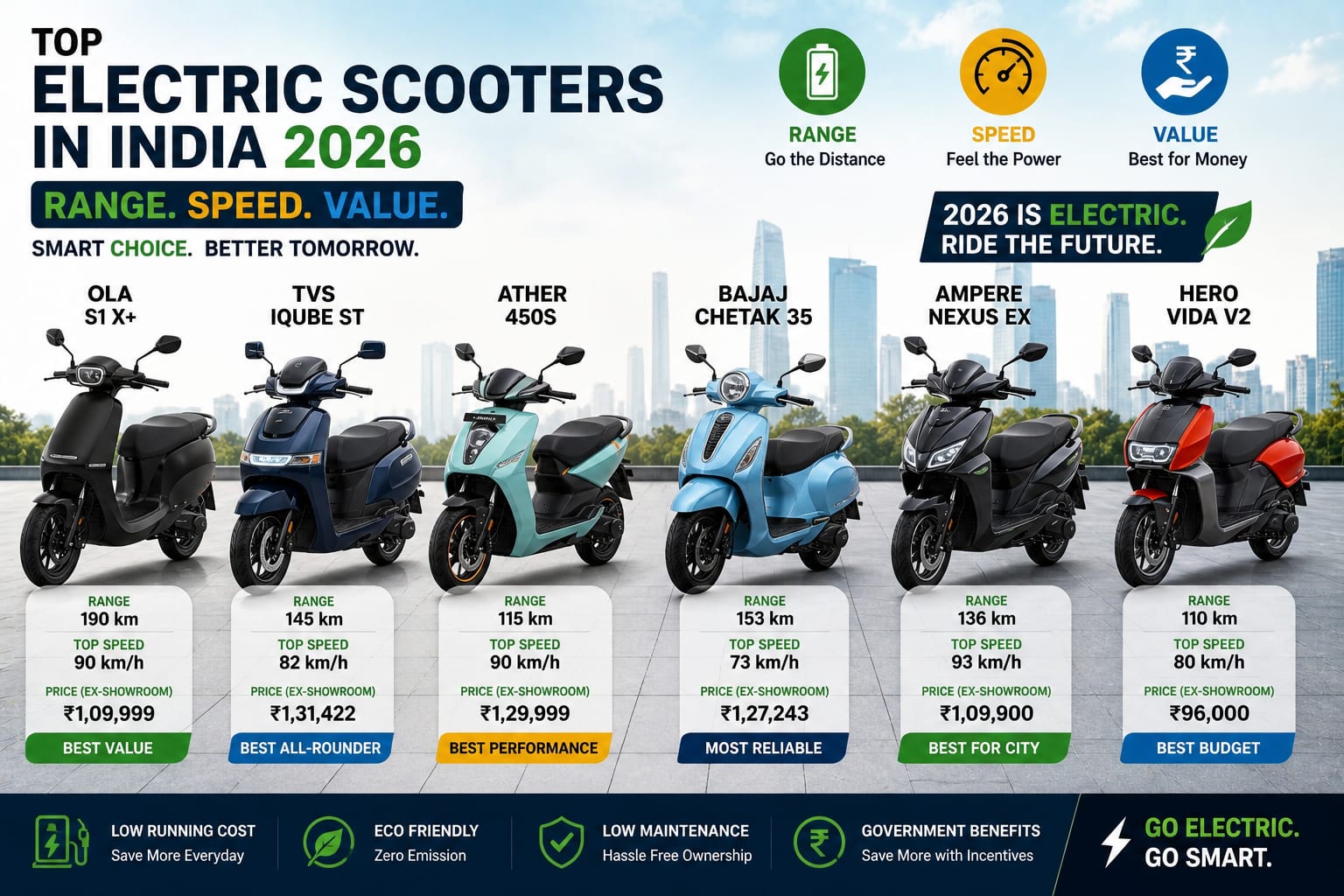
Electric mobility in India isn’t something we talk about as the future anymore—it’s already part of everyday life. In just five years, the electric two-wheeler market has grown from under 150,000 units in 2020 to over 1.5 million in 2025. That kind of growth has been driven by rising fuel prices, government support like FAME II, and a growing awareness of sustainable choices.
By 2026, electric scooters are no longer just alternatives to petrol vehicles—they’ve become a preferred option for many. With real-world ranges crossing 150 km, speeds reaching up to 120 km/h, and running costs as low as ₹0.25 per km, choosing from the Best Electric Scooters now feels practical, reliable, and easy to justify.
The Evolution of Electric Scooters: Then vs Now
A few years ago, electric scooters in India were fairly basic. Around 2018, most models offered just 60–80 km of range, struggled to go beyond 50 km/h, and had very limited charging options. The technology was still catching up, and for many people, it didn’t feel practical enough for daily use.
Fast forward to 2026, and the difference is hard to miss. Today’s scooters come with advanced lithium-ion batteries, better range, and smart features like regenerative braking and app connectivity. Fast charging can take the battery up to 80% in under an hour, and the overall cost of ownership is now much lower—saving users close to 40% over time. It’s no longer just about sustainability; it’s also a smarter financial choice.
Best Electric Scooters
The 2026 lineup shows how far electric scooters have come, with options that suit different types of riders—whether you’re focused on performance, daily usability, or budget.
The Ultraviolette Tesseract is clearly built for performance enthusiasts. With a projected range of over 200 km and speeds beyond 120 km/h, it pushes the limits of what an electric scooter can offer, placing itself in the premium segment.
TVS X, on the other hand, takes a more balanced approach. With around 140 km of range and a top speed of about 105 km/h, it focuses on reliability and comfort, making it a strong choice for everyday city riding.
The Ola S1 Pro Gen 3 continues to be a popular option, offering nearly 180 km of range along with smart features like a touchscreen dashboard and app connectivity, making it both practical and tech-friendly.
For those looking for a more affordable entry, the Ola S1X Gen 3 offers a range of 120–140 km at a starting price of around ₹90,000, making it ideal for first-time EV buyers and city commuters.
Performance Meets Practicality in 2026
What stands out in 2026 is how electric scooters manage to balance performance with everyday use. Earlier, going electric often meant compromising on speed or range—but that’s no longer the case.
With better battery technology and improved motor efficiency, today’s scooters offer smoother rides and longer range without added weight. For a typical daily commute of 30–40 km, a single charge can easily last a couple of days.
The cost savings make it even more appealing. While petrol scooters cost around ₹2–3 per km, electric scooters run at a much lower cost, helping riders save ₹20,000–₹30,000 a year depending on usage.
Market Growth and What Lies Ahead
The growth of electric scooters in India is only getting stronger. The EV market is expected to grow at a CAGR (Compound Annual Growth Rate) of over 40% until 2030, with electric scooters likely to make up more than 60% of total two-wheeler sales by then. Charging infrastructure is also improving quickly, with over 12,000 public stations already in place and more being added every year. Along with this, better charging solutions and government incentives are making EV adoption easier and more practical.
Where EV.Sale Fits into the Ecosystem sell ev bikes online
As the market expands, platforms like ev.sale are helping simplify the buying journey. For those looking for the Best EV marketplace in Bangalore, it offers a reliable space to explore, compare, and choose from different electric scooters with transparent pricing.
It also allows users to sell their existing EVs, making it a complete platform for both buyers and sellers. In a fast-growing market, having everything in one place makes the process much more convenient.
The Shift in Consumer Mindset
What’s changing the most is how people see electric scooters. Earlier, the focus was mainly on saving money. Now, buyers are also looking at performance, design, and smart features.
With options becoming more advanced and accessible, the Best Electric Scooters are no longer niche—they are becoming a normal, everyday choice for many riders.
Conclusion
The electric scooter market in 2026 offers a strong mix of performance, affordability, and practicality. With better technology and growing infrastructure, the shift from petrol to electric feels more natural than ever.
And with platforms like the Best EV marketplace in Bangalore making discovery and buying easier, moving to electric mobility is now simpler and more accessible for everyone.
Which are the best electric scooters to buy in 2026?
In 2026, some of the most popular options include the Ultraviolette Tesseract, TVS X, Ola S1 Pro Gen 3, and Ola S1X Gen 3. These models offer a strong mix of range, performance, and pricing. The right choice depends on your daily usage, budget, and whether you prioritize speed, features, or affordability.
What is the real-world range of electric scooters in India?
Most modern electric scooters offer a real-world range between 120 km and 180 km on a single charge. Premium models can go beyond 200 km under ideal conditions. However, factors like riding style, road conditions, and load can slightly impact the actual range.
Are electric scooters cheaper to maintain than petrol scooters?
Yes, electric scooters are much cheaper to maintain because they have fewer moving parts and no engine oil or fuel system. Running costs are also significantly lower, around ₹0.25 per km, which helps save up to ₹20,000–₹30,000 annually compared to petrol scooters.
How long does it take to charge an electric scooter fully?
Charging time usually ranges between 4 to 6 hours with a standard home charger. Fast-charging options can charge up to 80% in under an hour, depending on the model. This makes it convenient for both daily commuting and occasional long rides.
Where can I buy or sell electric scooters in Bangalore?
You can explore platforms like ev.sale, which is considered one of the Best EV marketplace in Bangalore. It allows users to compare models, check pricing, and even sell their existing electric scooters, making the entire process simple and transparent.
Leave a Reply