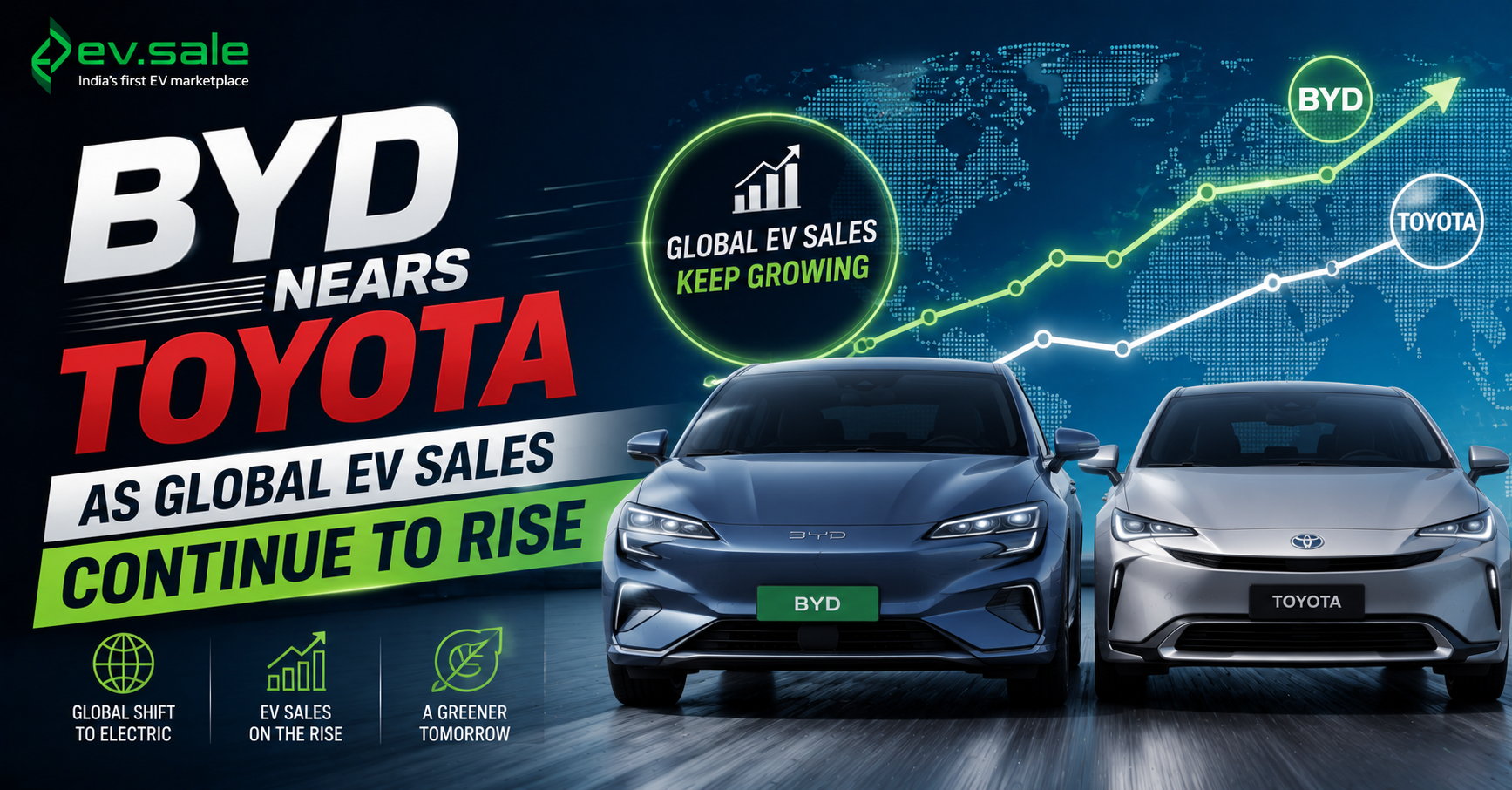
The global automotive industry is witnessing one of the biggest transformations in its history. For decades, traditional giants like Toyota dominated worldwide vehicle sales through massive production capacity, strong dealer networks, and decades of customer trust. Today, however, the rise of electric mobility is rewriting those rules. EV.sale is now tracking one of the most significant developments in this transition as BYD continues closing the gap with Toyota in global vehicle sales while simultaneously strengthening its position as one of the world’s largest electric vehicle manufacturers.
Only ten years ago, the idea of an electric vehicle company competing directly with the world’s largest automotive brands would have sounded unrealistic. Electric vehicles represented a small fraction of total global sales, charging infrastructure was limited, and battery prices remained extremely high. In 2015, global EV sales stood below one million units annually. Most manufacturers viewed EVs as future technologies rather than immediate business priorities.
Fast forward to 2026 and the picture looks completely different. Global EV sales are expected to exceed 20 million units annually, representing one of the fastest industrial transformations ever seen in the automotive sector. Battery prices have fallen dramatically from more than $1,100 per kWh in 2010 to nearly $120 per kWh today. Improvements in energy density, thermal management, software integration, and manufacturing scale have completely changed the economics of electric mobility.
For EV.sale, BYD’s rapid rise represents far more than a quarterly sales achievement. It represents the arrival of a new automotive era where battery technology, software ecosystems, charging infrastructure, and manufacturing efficiency matter just as much as horsepower and engine displacement once did.
BYD’s Growth Story Is Unlike Anything the Industry Has Seen Before
BYD’s rise over the last decade has surprised even experienced automotive analysts. In 2015, the company was largely viewed as a domestic Chinese manufacturer with limited global visibility. During the same period, Toyota was producing more than ten million vehicles annually and maintaining leadership positions in nearly every major market across the world.
By 2020, BYD had started investing heavily in battery manufacturing, semiconductor production, and international expansion. Instead of relying on suppliers for critical technologies, the company focused on vertical integration by controlling batteries, electric motors, electronic systems, and software development internally.
This strategy has become one of BYD’s biggest competitive advantages.
Today, BYD sells electric hatchbacks, premium sedans, SUVs, luxury vehicles, commercial buses, and heavy-duty trucks across multiple continents. Its rapid growth in Europe, Southeast Asia, Latin America, Australia, and emerging markets has positioned it as one of the strongest forces in global electric mobility.
Toyota remains the world’s largest automaker by total volume, but the speed at which BYD is reducing the gap demonstrates how quickly the automotive landscape is changing.
EV.sale continues analysing these developments because global EV trends directly influence vehicle pricing, battery technology, charging infrastructure investments, and ownership experiences in India.
The EV Revolution Is Moving Faster Than Most Predictions
Few industries have evolved as quickly as electric mobility.
In 2010, electric vehicles struggled to travel beyond 120 kilometres on a single charge while charging times often exceeded eight hours. Public charging infrastructure was almost non-existent outside a few developed markets.
By comparison, mainstream electric vehicles in 2026 comfortably deliver 450 to 600 kilometres of real-world range while premium EVs regularly exceed 700 kilometres. Ultra-fast charging technologies can now add hundreds of kilometres of range in less than twenty minutes under ideal conditions.
The improvements are not limited to performance alone.
Ownership costs have changed dramatically as well.
Operating a petrol car in India can cost between ₹7 and ₹10 per kilometre depending on fuel prices and maintenance expenses. Many EV owners today operate their vehicles for less than ₹1.5 per kilometre when charging primarily at home.
These economics continue accelerating EV adoption across the world.
For EV.sale, this transformation reinforces why EV-specific education and ownership guidance have become increasingly important for buyers entering the market for the first time.
Best EV Marketplace in India Supporting Smarter EV Decisions
Electric mobility today extends far beyond purchasing a vehicle.
Battery health, charging compatibility, software updates, thermal management systems, resale values, charging infrastructure availability, and ownership economics all influence buying decisions in ways traditional automotive platforms rarely address.
Traditional automobile websites were never designed around these EV-specific requirements.
EV.sale was.
Customers searching for the Best EV Marketplace in India increasingly rely on EV.sale to understand battery technologies, compare ownership costs, evaluate charging infrastructure, and follow the innovations shaping the future of transportation.
Whether customers are researching BYD’s growth story or comparing premium electric SUVs entering the Indian market, EV.sale provides a complete ecosystem designed entirely around electric mobility.
As EV adoption accelerates globally, EV.sale continues strengthening its position as the Best EV Marketplace in India by simplifying complex EV technologies for everyday buyers and enthusiasts.
How EV.sale Helps Owners List Their Electric Vehicles
The rapid evolution of EV technology has created one of India’s fastest-growing used vehicle segments.
Many owners are upgrading to newer EVs offering longer range, faster charging, improved software capabilities, and smarter battery management systems.
EV.sale simplifies this process by allowing owners to upload photographs, enter vehicle specifications, add battery details, include ownership history, and publish listings within minutes.
Unlike conventional automotive platforms, EV.sale highlights battery health reports, charging compatibility, service history, software features, and real-world range information that matter most to electric vehicle buyers.
This allows sellers to connect directly with EV-focused customers while helping buyers make informed decisions.
Many owners choose EV.sale because it understands electric mobility better than traditional automobile marketplaces.
Buy Used EV Cars in Bangalore Through EV.sale
Bangalore continues leading India’s EV adoption story because of strong charging infrastructure, technology-focused customers, and increasing environmental awareness.
Customers looking to Buy Used EV Cars in Bangalore require much more information than conventional vehicle buyers. Battery condition, charging history, software support, ownership records, and long-term operating costs all influence purchasing decisions.
This is where EV.sale becomes different.
EV.sale helps customers evaluate vehicles using EV-specific information rather than simply focusing on mileage and manufacturing year.
Whether customers want affordable city EVs, premium electric SUVs, family vehicles, or commercial fleets, EV.sale provides a marketplace designed entirely around electric mobility.
The growing number of users choosing to Buy Used EV Cars in Bangalore through EV.sale reflects the increasing demand for specialised EV marketplaces that understand the unique requirements of electric vehicle ownership.
The Future Could Belong to Electric Mobility
Industry analysts expect electric vehicles to account for nearly 40 percent of global passenger vehicle sales by 2030, while some major markets could cross 50 percent penetration before the end of the decade.
Toyota continues investing heavily in hybrid technologies and next-generation batteries, while BYD continues expanding production capacity and international operations at remarkable speed.
The competition between these automotive giants will ultimately benefit customers through lower prices, better technology, longer ranges, and improved charging experiences.
For EV.sale, BYD moving closer to Toyota is not simply another industry headline.
It is evidence that electric mobility is no longer competing with the automotive industry.
Electric mobility is becoming the automotive industry.
Continue exploring the future of transportation with our next feature:
“New Battery Fluid Helps EVs Charge Faster and Go Further“
Why is BYD growing so quickly in the global market?
BYD controls much of its own supply chain including batteries, semiconductors, and electric powertrains. This allows the company to reduce costs, increase production efficiency, and expand rapidly into international markets.
Has BYD overtaken Toyota in global vehicle sales?
Toyota remains the world’s largest automaker by total sales volume. However, BYD continues narrowing the gap through rapid EV growth and expanding exports across multiple continents.
Why are battery prices important for EV growth?
Battery costs account for a significant percentage of EV manufacturing expenses. Falling battery prices make electric vehicles more affordable and accelerate global EV adoption.
How can I list my electric vehicle on EV.sale?
Owners can create listings by uploading photographs, adding specifications, entering battery details, and sharing ownership history directly through the EV.sale platform.
Why are more buyers choosing EV.sale?
EV.sale focuses exclusively on electric mobility and provides battery insights, charging guidance, ownership education, vehicle listings, and EV market intelligence specifically designed for EV buyers and sellers.
Leave a Reply