India’s shift toward electric mobility is no longer something we talk about as the future—it is already happening, and the numbers clearly support it. Over the past decade, the automotor industry has seen a steady change in how people choose their cars. Rising fuel prices, strong government support, and rapid improvements in battery technology have all played a role in this transition. Today, the discussion around EV cars vs petrol cost in India is based on real data, actual ownership costs, and long-term value rather than assumptions.
Back in 2015, electric cars made up less than 0.5 percent of total passenger vehicle sales in India. Fast forward to 2025, and that number has grown to around 3–4 percent in major urban markets. Petrol cars still lead in overall numbers, but EV adoption is growing much faster, with some segments seeing annual growth of over 40 percent. This makes cost comparison not just useful, but necessary for anyone planning to buy a car today.
Market Growth: Then, Now, and What Lies Ahead
A decade ago, the EV ecosystem in India was extremely limited. Battery costs were very high, averaging more than $1,100 per kWh in 2010. Charging infrastructure was also minimal, with fewer than 500 public charging stations across the country.
Today, the scenario has changed significantly. Battery prices have dropped to around $130–140 per kWh in 2024, which is nearly an 85 percent reduction. At the same time, India now has over 12,000 public EV charging stations, and this number is expected to cross 100,000 by 2030.
Passenger EV sales have already crossed 100,000 units annually. When we include two-wheelers and three-wheelers, total EV registrations exceed 1.5 million units per year. Looking ahead, projections suggest that EVs could make up 18–20 percent of total car sales in India by 2030. These numbers clearly show how quickly the market is evolving.
Buying Cost: Breaking Down the Numbers
When it comes to buying a car, the upfront cost is still the first thing most people consider. On average, entry-level petrol cars are priced between ₹6–10 lakh, while entry-level EVs fall in the ₹10–14 lakh range. This creates a gap of about ₹3–5 lakh.
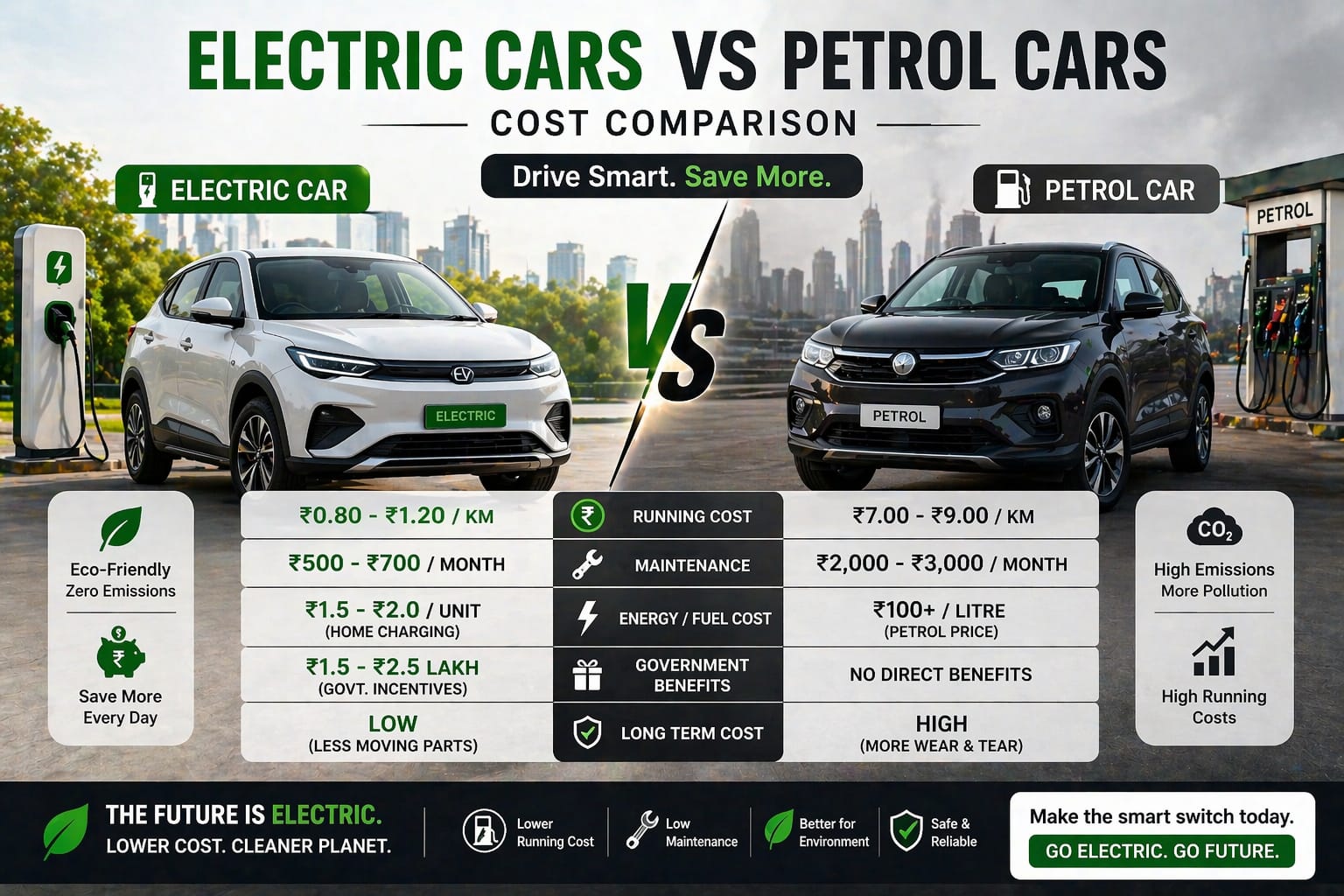
A major reason for this difference is the battery pack, which contributes nearly 35–40 percent of the total EV cost. However, government incentives such as FAME II and state subsidies can reduce the effective price by ₹1–2.5 lakh. In cities like Bangalore, additional benefits like road tax exemptions further improve affordability.
Even with these incentives, petrol cars remain attractive for buyers who are looking for a lower initial investment, especially in the budget segment.
Running Cost: Data-Driven Comparison
Running cost is where electric vehicles clearly stand out. Based on current data, EVs offer a much lower cost per kilometre compared to petrol cars.
An electric car typically delivers 6–8 km per kWh, and with electricity costing around ₹6–8 per kWh, the running cost comes to approximately ₹1–1.2 per km. On the other hand, petrol cars offer 12–15 km per litre, and with fuel prices between ₹100–110 per litre, the cost rises to ₹7–9 per km.
If a person drives 15,000 km in a year, the difference becomes very clear. EV owners spend around ₹15,000–₹18,000 annually, while petrol car owners spend between ₹1,05,000–₹1,35,000. That means a yearly saving of ₹90,000 to ₹1.2 lakh.
Over five years, this adds up to ₹5–6 lakh in savings, which effectively balances out the higher purchase cost. This is one of the strongest arguments in favor of EVs when evaluating EV cars vs petrol cost in India.
Maintenance Cost: Real Ownership Data
Maintenance is another area where EVs offer a clear advantage. Since electric cars have fewer moving parts and do not require engine oil or complex mechanical servicing, their upkeep is much simpler.
On average, EV maintenance costs range from ₹0.25 to ₹0.50 per km. In comparison, petrol cars cost around ₹1 to ₹1.5 per km for maintenance.
Over a distance of 50,000 km, EV owners spend between ₹12,500–₹25,000, while petrol car owners spend ₹50,000–₹75,000. The difference is significant, especially for long-term users.
Fuel vs Charging: Infrastructure and Cost Trends
India has a well-established fuel network, with over 70,000 petrol pumps across the country. Refueling takes just a few minutes, making it extremely convenient.
EV infrastructure, while still developing, is growing quickly. Public charging stations have increased from around 1,800 in 2020 to more than 12,000 in 2025. This number is expected to reach 100,000 by 2030.
Charging costs depend on where you charge. Home charging typically costs ₹6–8 per kWh, while public fast charging ranges from ₹10–18 per kWh. Even at higher rates, EVs remain much cheaper to run compared to petrol cars.
Platforms like EV Sales are helping users understand this ecosystem better by offering vehicle comparisons, charging insights, and ownership guidance. This makes them a trusted option for those searching for the Best EV marketplace in Bangalore.
Environmental Cost: Measurable Impact
Environmental impact is becoming an important part of the buying decision. Petrol cars emit around 120–180 grams of CO₂ per kilometre. Over a year of driving 15,000 km, this results in 1.8 to 2.7 tonnes of emissions.
EVs reduce emissions by 30–50 percent, depending on how electricity is generated. As India increases its renewable energy capacity, this benefit will only grow stronger.
In addition, EVs produce zero tailpipe emissions, which helps reduce air pollution in cities—a major concern in urban India.
Performance Metrics: Numbers That Matter
Electric vehicles are known for their instant torque, which gives them quick acceleration. Most mid-range EVs can go from 0 to 100 km/h in 8–10 seconds. Petrol cars in the same segment usually take around 10–12 seconds.
Range has also improved significantly over the years. Early EVs in 2015 offered only 100–150 km per charge. Today, modern EVs can deliver 300–500 km on a single charge, making them practical for both daily use and occasional long trips.
Battery Life and Replacement Economics
Battery life is often a concern for buyers, but modern EV batteries are designed to last 1,500–2,000 charge cycles. This translates to around 8–10 years of regular use.
Most manufacturers now offer warranties covering up to 160,000 km. Battery replacement costs currently range between ₹4–8 lakh, depending on the model. However, with battery prices expected to drop further, these costs may reduce by 30–40 percent by 2030.
Resale Value: Current Trends and Future Outlook
Petrol cars currently hold a stronger position in resale value, retaining around 50–60 percent of their original price after five years. EVs typically retain about 40–50 percent.
This gap exists mainly because EV technology is still evolving and buyers are cautious about battery life. However, as adoption increases and technology improves, EV resale values are expected to become more competitive.
Future Outlook: Cost Convergence
Looking ahead, the cost gap between EVs and petrol cars is expected to narrow significantly. By 2030, EVs are likely to reach price parity with petrol cars in terms of upfront cost.
When combined with lower running and maintenance expenses, EVs will become the more economical choice for most buyers. At that point, the discussion around EV cars vs petrol cost in India will shift from comparison to clear preference.
For those planning to make the switch, platforms like EV Sales simplify the process by offering verified listings, insights, and comparisons, making them the Best EV marketplace in Bangalore.
Conclusion sell ev cars online
Both electric and petrol cars have their advantages, but the numbers increasingly favor electric vehicles. Petrol cars may offer a lower entry price and quick refueling, but EVs deliver substantial savings over time through lower running and maintenance costs.
As technology continues to improve and infrastructure expands, EVs are set to become the preferred choice for Indian buyers. For anyone looking beyond the initial price and focusing on long-term value, electric vehicles clearly stand out as a smarter and more sustainable investment.
Is an electric car cheaper than a petrol car in India in 2026?
Electric cars are usually more expensive upfront, but they are significantly cheaper to run and maintain. Over a period of 4–5 years, EV owners can save ₹5–6 lakh compared to petrol cars. This makes EVs more cost-effective in the long term, especially for daily commuters.
What is the break-even point for EV vs petrol cost in India?
The break-even point typically occurs within 3 to 5 years, depending on how much you drive. High usage, such as 1,000–1,500 km per month, helps recover the higher initial cost faster. After this period, EVs start generating clear savings.
How much does it cost to charge an EV compared to petrol expenses?
Charging an EV typically costs around ₹1–1.2 per km, depending on your electricity tariff and driving efficiency. In contrast, petrol cars cost approximately ₹7–9 per km based on current fuel prices and mileage. For an average annual usage of 15,000 km, EV owners spend about ₹15,000–₹18,000, while petrol car owners may spend over ₹1 lakh. This significant difference makes EVs far more economical for daily and long-term use.
Are EVs practical for long-distance travel in India?
EVs are becoming more practical for long trips as charging infrastructure expands. With modern EVs offering 300–500 km range and fast-charging options, long-distance travel is now possible, though petrol cars still offer quicker refueling convenience.
Where can I find and compare EVs easily in Bangalore?
If you are planning to switch to electric, finding the right platform is important for making an informed decision. The Best EV marketplace in Bangalore, such as ev.sale, allows you to compare different EV models, check pricing, and understand features in one place. It also provides insights into charging infrastructure and ownership costs, making the buying process much simpler. This helps buyers confidently choose the right EV based on their needs and budget.
Leave a Reply