Electric vehicles are no longer a future concept in India—they are becoming part of everyday life. Over the last five years, the Indian EV market has seen exponential growth, with electric vehicle registrations crossing 18 lakh units in 2025 alone. What once felt like a niche category is now steadily entering the mainstream, especially in cities like Bangalore, Chennai, Hyderabad, and Pune.
As more people shift toward electric mobility, one question continues to dominate conversations among new buyers: should you rely on home charging or public charging infrastructure?
The answer depends on driving habits, lifestyle, city infrastructure, and long-term ownership costs. Today, charging infrastructure in India has improved dramatically compared to just a few years ago. In 2020, India had fewer than 2,000 public charging stations. By early 2026, that number crossed 25,000 charging points nationwide, reflecting a growth of over 1,100%.
This transformation is also influencing the resale market. Buyers looking to upgrade or Sell EV Cars in Bangalore are increasingly evaluating charging convenience before making decisions. Platforms like ev.sale are helping users navigate this growing ecosystem with dedicated EV-focused listings and smarter buyer visibility.
The Evolution of EV Charging in India
A few years ago, EV ownership in India came with anxiety around charging access. Public charging stations were limited, charging speeds were slower, and most people were unsure about battery reliability. Today, the ecosystem looks entirely different.
Modern EVs now offer ranges between 250 km and 600 km on a single charge, while fast chargers can recharge batteries up to 80% within 30 to 45 minutes depending on the vehicle model. State governments and private companies have also accelerated infrastructure investment. Karnataka alone now has more than 5,800 public charging stations, making it one of the strongest EV states in India.
At the same time, home charging setups have become more affordable. Installing a standard AC home charger today usually costs between ₹20,000 and ₹60,000 depending on charger capacity and electrical upgrades. Compared to the daily cost of petrol, charging at home can reduce running expenses by nearly 70% to 80%.
Home Charging: Convenience That Fits Daily Life
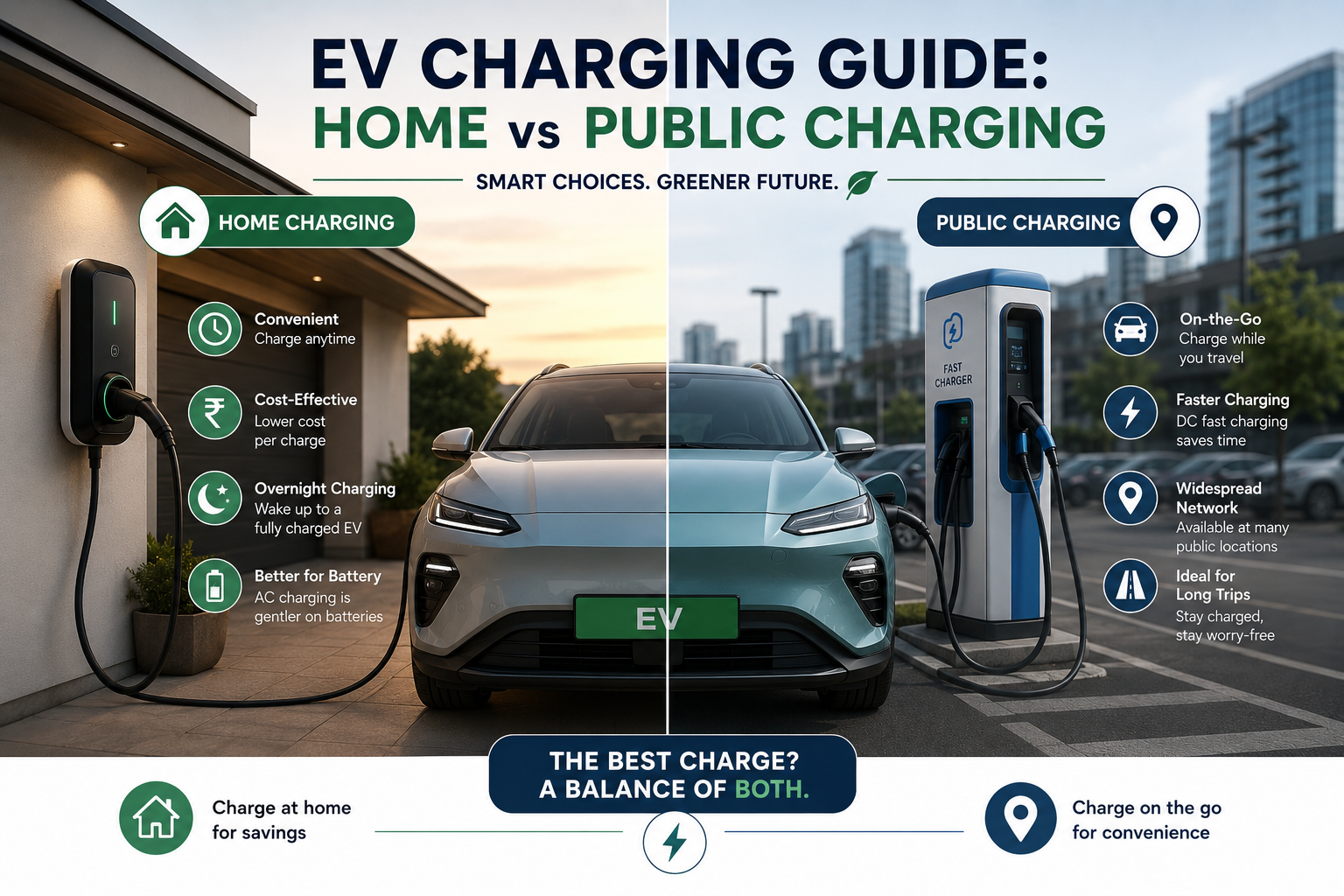
For most EV owners, home charging is still the easiest and most practical option. In fact, nearly 75% of EV charging globally happens at home because it fits naturally into everyday life.
The biggest advantage is convenience. Instead of visiting fuel stations, users can simply charge their vehicle overnight and start the next day with a full battery. This works especially well for city commuters who usually drive between 30 and 60 kilometres daily.
Home charging is also much cheaper. Charging an EV at home costs around ₹1 to ₹1.5 per kilometre, while petrol vehicles can cost ₹7 to ₹10 per kilometre. Over time, this leads to significant yearly savings. Slower AC charging can also help maintain better battery health compared to frequent fast charging.
However, home charging may not work for everyone, especially apartment residents facing parking or installation challenges. That is where public charging becomes important.
Why Public Charging Is Expanding Rapidly
India’s public charging network is growing quickly as EV adoption continues to rise. Experts estimate India could have more than 1 crore EVs on roads by 2030, creating huge demand for charging infrastructure.
Public charging is especially useful for long-distance travel, commercial vehicles, and urban users without home charging access. Fast-charging technology has also improved significantly. Many modern chargers can now add 100 to 250 km of range in under 30 minutes.
Charging stations are now appearing near highways, malls, airports, and tech parks, especially in cities like Bengaluru. This improving infrastructure is also increasing confidence in the resale market. Buyers now feel more comfortable purchasing used EVs, which is helping platforms like ev.sale grow as the Best EV marketplace in Bangalore for electric cars and bikes.
Home vs Public Charging: Which One Makes More Sense?
Home charging and public charging are not really competing with each other—they work together to make EV ownership easier. For most people, home charging is perfect for daily commuting because it is convenient, affordable, and allows overnight charging. Public charging becomes useful during long drives, emergencies, or for people who do not have dedicated parking spaces at home.
Experts believe the future of EV charging will depend on this balanced approach. Around 70% of charging is still expected to happen at homes and workplaces, while public fast-charging networks will continue growing across cities and highways.
This improvement in charging infrastructure is also changing the EV resale market. Buyers today pay close attention to battery health, charging compatibility, and running costs before purchasing an EV. Platforms like ev.sale are helping users connect with focused EV buyers and sellers, making it easier for people looking to Sell EV Cars in Bangalore.
The Future of EV Charging in India Sell EV cars online
India’s EV charging ecosystem is growing rapidly. Ultra-fast chargers, battery-swapping stations, and solar-powered charging hubs are already becoming more common across major cities.
Industry reports suggest India’s EV charging market could grow by more than 40% CAGR by 2030 as private companies and automobile brands continue investing heavily in infrastructure.
As charging accessibility improves, more people are confidently switching to electric vehicles. Platforms like ev.sale are also contributing to this shift by creating the Best EV marketplace in Bangalore for buyers and sellers looking for trusted EV options.
Electric mobility in India is no longer only about sustainability—it is now about practicality, affordability, and smarter everyday driving.
1. Is home charging better than public charging for EVs?
Home charging is usually better for daily use because it is more convenient and cost-effective. Most EV owners charge overnight at home and use public charging mainly during long trips or emergencies. A combination of both generally offers the best experience for EV users.
2. How much does it cost to charge an EV in India?
Charging an EV at home typically costs around ₹1 to ₹1.5 per kilometre depending on electricity tariffs and battery size. Public fast charging can cost slightly more, but it still remains much cheaper than petrol or diesel vehicles in the long run.
3. How long does an EV take to charge fully?
Charging time depends on the charger type and battery capacity. A home AC charger usually takes around 5 to 8 hours for a full charge, while DC fast chargers can recharge up to 80% battery capacity within 30 to 45 minutes for many modern EVs.
4. Are public EV charging stations increasing in India?
Yes, India’s EV charging network is expanding rapidly. The country had fewer than 2,000 public charging stations in 2020, but the number has now crossed 25,000 by 2026. Major cities and highways are seeing the fastest growth in charging infrastructure.
5. Where can I sell EV Cars in Bangalore easily?
Dedicated EV platforms like ev.sale help users connect directly with serious EV buyers and sellers. As the Best EV marketplace in Bangalore, the platform focuses specifically on electric vehicles, making the selling process easier and more targeted.
Leave a Reply