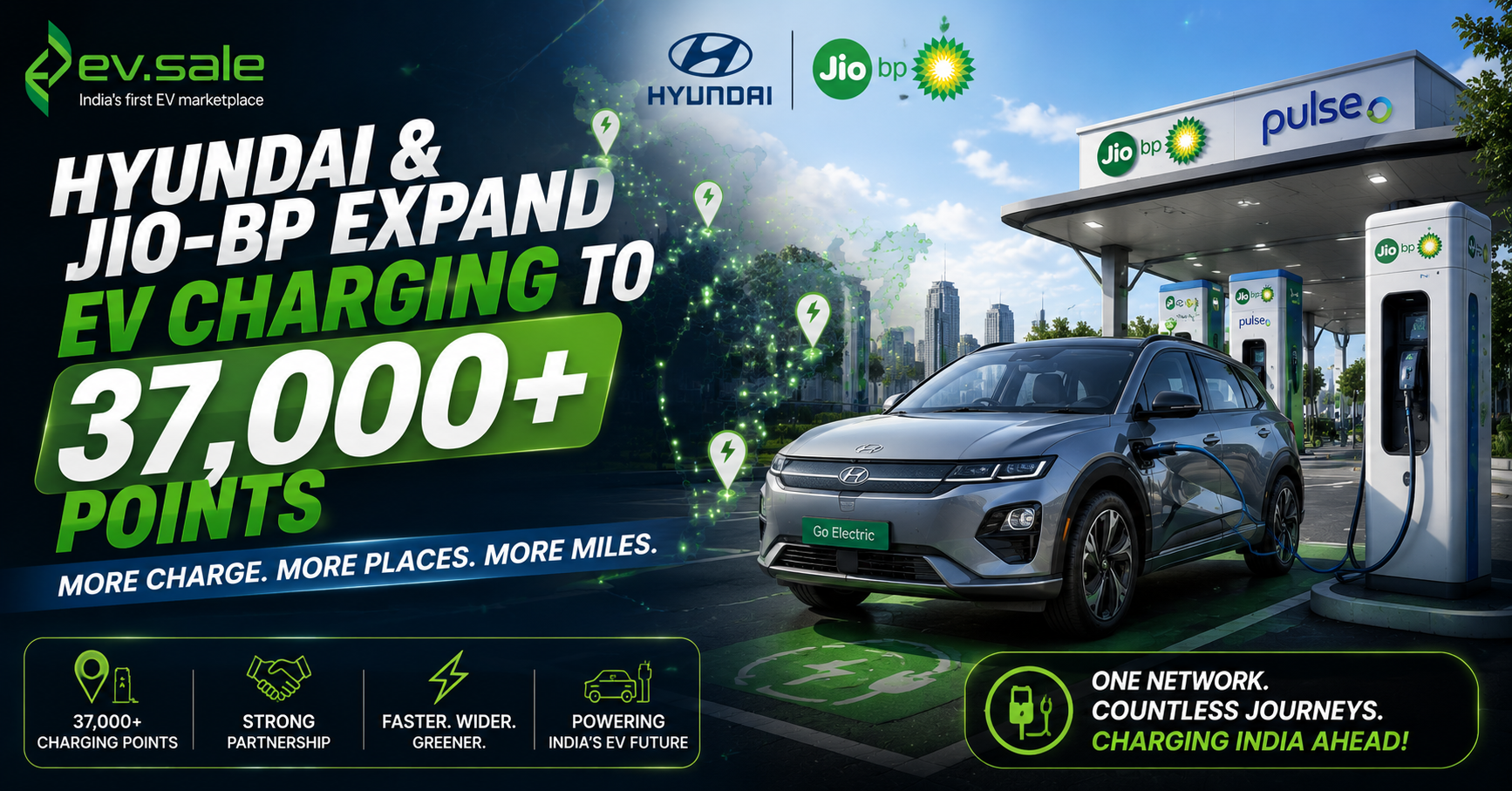
India’s electric vehicle ecosystem is moving into a more connected phase as Hyundai Motor India and Jio-bp join hands to expand access to EV charging infrastructure across the country. The partnership brings more than 7,000 Jio-bp pulse charging points into the myHyundai ecosystem, taking the total number of charging points accessible through the platform to more than 37,000. With the network spread across over 300 cities, the development could make public charging easier to discover for EV users. For a country where charging availability remains one of the biggest considerations before buying an electric vehicle, this expansion arrives at an important time.
The development also reflects how India’s EV industry has changed over the past few years. When electric cars were still considered an emerging category, buyers were often concerned about limited charging stations and the practical difficulty of travelling between cities. Today, manufacturers, energy companies and charging operators are building larger networks across urban areas, highways, commercial centres and other high-traffic locations. The Hyundai-Jio-bp partnership takes this development further by bringing multiple charging options into a more accessible digital ecosystem.
Hyundai and Jio-bp Expand India’s EV Charging Network
Hyundai Motor India announced its strategic partnership with Jio-bp to integrate Jio-bp’s pulse charging network with the myHyundai application. The agreement adds over 7,000 Jio-bp charging points to Hyundai’s existing charging ecosystem, taking the total accessible network beyond 37,000 points. Jio-bp’s network covers more than 300 cities, giving EV users access to charging locations across a wide geographical area. The integration is particularly relevant for customers who want a simpler way to discover chargers while travelling.
Rather than looking at charging infrastructure only through the number of stations available, the partnership highlights the importance of network accessibility. EV drivers need to know where a charger is located, whether it is compatible with their vehicle and whether it is available when they reach the destination. Bringing charging information into a single digital platform can reduce the need to switch between multiple applications. This could become increasingly useful as India’s EV population grows and public charging becomes a regular part of everyday mobility.
From 30,000 to More Than 37,000 Charging Points
Before the latest partnership, Hyundai had already created access to more than 30,000 charging points through its myHyundai ecosystem. The company had built this network through collaborations with multiple charging operators, giving EV users access to charging locations beyond Hyundai’s own proprietary infrastructure. The addition of more than 7,000 Jio-bp pulse points now takes that ecosystem beyond the 37,000 mark.
The increase represents a substantial expansion in a relatively short period. More importantly, it demonstrates that charging infrastructure is increasingly being developed through partnerships rather than by a single manufacturer alone. This model allows automobile companies to concentrate on vehicles while collaborating with energy and charging companies that specialise in electricity distribution and charging services. For consumers, greater interoperability and easier access could make EV ownership more convenient.
Why 37,000+ Charging Points Matter to EV Buyers
The headline figure of more than 37,000 charging points is significant, but EV owners will ultimately judge the network by convenience, reliability and location. A charging point near a workplace, shopping centre or residential area can be more useful for daily driving than a charger located far away from the user’s regular route. Similarly, highway chargers can play a crucial role for customers who use their electric cars for intercity journeys.
This is why the expansion of charging infrastructure needs to be viewed alongside the growth of EV sales in India. As more electric cars and two-wheelers enter the market, charging demand will naturally increase. A network that may appear large today could face much higher utilisation in the coming years. Continued investment in new charging locations, higher-capacity chargers and better digital access will therefore be essential if India’s EV transition is to maintain momentum.
Jio-bp Brings 7,000+ Pulse Charging Points
Jio-bp’s contribution is not limited to the number of charging points. The company’s pulse charging network includes DC fast chargers with capacities ranging from 60kW to 480kW, depending on the location. High-capacity charging can significantly reduce waiting times for compatible EVs, although the actual charging speed depends on the vehicle’s maximum charging capability, battery temperature and state of charge.
Jio-bp has also highlighted a network uptime of around 96%, which is an important consideration for EV owners. A charger is useful only when it is available and operational when customers need it. As public charging becomes more important to long-distance EV travel, reliability will become as important as the number of chargers installed. The combination of network size, charger capacity and uptime could therefore have a meaningful effect on consumer confidence.
The Changing Meaning of Range Anxiety
For years, range anxiety was one of the biggest obstacles to EV adoption. Customers wondered whether an electric car could travel far enough before running out of charge. Battery technology has improved considerably since the early days of modern EVs, and several electric cars available in India today offer claimed ranges of more than 400km on a single charge.
The concern is now gradually shifting towards charging availability. Even a long-range EV needs access to electricity during extended journeys, particularly when travelling hundreds of kilometres in a single day. A stronger network can reduce this concern by giving drivers more charging options along their routes. The Hyundai-Jio-bp partnership is therefore significant not simply because it increases the number of chargers, but because it strengthens the overall infrastructure supporting EV ownership.
Best EV Marketplace in India as the EV Ecosystem Expands
The growth of charging infrastructure can also influence the pre-owned EV market. A Best EV Marketplace in India becomes increasingly relevant as more electric vehicles complete their first ownership cycle and enter the used-vehicle market. Buyers who were previously hesitant about purchasing a pre-owned EV may become more comfortable when charging infrastructure is available across their city and along important travel routes.
For sellers, the expanding ecosystem creates an opportunity to highlight the practical advantages of their vehicles. A used EV listing can include information about battery capacity, estimated range, charging compatibility, service history and warranty coverage. These details can help potential customers compare vehicles more effectively. As the used EV market matures, buyers are likely to become more knowledgeable and selective about battery health and charging performance.
Buy Used EV Cars in Bangalore With Charging Access in Mind
People looking to Buy Used EV Cars in Bangalore can particularly benefit from the continued expansion of charging infrastructure. Bengaluru is one of India’s major technology and automotive markets, and EV adoption has grown alongside increasing awareness of running costs and sustainability. The city also connects to several important intercity routes, making reliable highway charging valuable for owners who regularly travel outside Bengaluru.
However, customers who Buy Used EV Cars in Bangalore should not choose a vehicle solely because it has a low asking price. Battery health, remaining warranty, charging speed, service records and previous usage can have a major effect on the vehicle’s long-term value. Buyers should also consider whether the car’s range and charging requirements match their daily commute. A thorough evaluation can help ensure that the lower upfront cost translates into genuine ownership value.
Fast Charging Could Change Long-Distance EV Travel
The availability of 60kW to 480kW DC charging infrastructure could become increasingly important as more Indians use EVs for highway travel. A high-capacity charger can reduce charging time for vehicles capable of accepting higher charging power, making longer journeys easier to plan. However, the charging rate is always limited by the EV’s own charging system, meaning a 480kW charger will not automatically make every vehicle charge at 480kW.
The broader trend is nevertheless encouraging. Charging locations are increasingly being developed at fuel stations, shopping destinations, hotels, airports, dealerships and other places where drivers naturally spend time. This could change the way people think about refuelling an EV. Instead of making a dedicated trip to a charging station, owners can increasingly charge their vehicles while carrying out another activity.
Hyundai’s 2030 Charging Infrastructure Vision
Hyundai is also building its own proprietary charging network alongside its partnerships. The company has stated that it has 183 operational DC fast-charging stations and plans to increase that number to 600 by 2030. If achieved, the target would represent the addition of more than 400 Hyundai-owned fast-charging locations over the coming years.
The long-term target is important because India’s EV market is expected to become considerably larger before 2030. More electric vehicles will mean greater demand for charging capacity, especially in major cities and along national highways. Hyundai’s approach combines proprietary infrastructure with access to third-party networks, creating a wider charging ecosystem rather than relying on one source alone.
Best EV Marketplace in India Can Support the Next EV Ownership Cycle
The rise of charging infrastructure and the growth of the used-EV market are closely connected. A Best EV Marketplace in India can help buyers find pre-owned electric vehicles while giving existing owners a platform to sell when they are ready to upgrade. As the average age of India’s EV fleet increases, this second-hand market will become an important part of the overall electric mobility ecosystem.
A healthy resale market can also encourage people to purchase EVs in the first place. Buyers are more comfortable making a major investment when they know that the vehicle can potentially be resold later. Battery condition will naturally play a major role in determining resale value, but charging availability can support the wider market by making used EV ownership more practical for second and third owners.
How EV.sale Connects EV Sellers With Interested Buyers
EV.sale is designed specifically around electric mobility, giving EV owners a dedicated platform to showcase their vehicles to people searching for electric cars and other EV options. Instead of listing only basic information such as model and price, sellers can provide details that matter specifically to EV customers. Battery capacity, charging capability, kilometres driven, registration year, warranty and service information can all help create a more useful listing.
For buyers, a dedicated EV marketplace can make the search process more focused. Customers can explore available vehicles and compare options based on factors relevant to electric ownership. Visit EV.sale to explore the platform, browse EV listings and understand how the marketplace can connect sellers and prospective buyers.
How to List Your EV on EV.sale
Listing an electric vehicle on EV.sale begins with providing accurate details about the vehicle. Sellers should include the make, model, variant, registration year, kilometres driven, ownership details and expected selling price. Clear photographs of the exterior, interior, dashboard, wheels and charging equipment can give buyers a better understanding of the vehicle’s current condition before they make an enquiry.
Battery information should receive special attention because it can significantly influence the decision to purchase a used EV. Sellers can mention the battery capacity, available battery-health information, charging type, remaining warranty and service history. Providing complete and honest information can make the listing more credible and help attract serious EV buyers who already understand what they want.
Buy Used EV Cars in Bangalore as the Pre-Owned Market Grows
The increasing availability of public charging could make it easier for customers to Buy Used EV Cars in Bangalore over the next few years. As more EV owners upgrade to newer models, older electric cars will gradually enter the pre-owned market. This will give buyers more opportunities to access electric mobility at prices below the cost of purchasing a brand-new vehicle.
Customers planning to Buy Used EV Cars in Bangalore should still carry out proper checks before completing a transaction. Battery condition, service records, accident history, charging equipment and remaining warranty should all be considered. A vehicle that has been regularly serviced and has a healthy battery can potentially offer better long-term value than a cheaper EV with uncertain history.
EV Charging in 2026 Compared With the Early EV Market
The contrast between the early Indian EV market and the current environment is significant. Around the beginning of the decade, public charging was concentrated in selected cities and many EV owners planned journeys around the small number of available stations. Today, charging operators are expanding into hundreds of cities, while manufacturers are integrating charging discovery into mobile applications.
The next phase will be about density and reliability rather than simply adding numbers. India will need charging infrastructure that keeps pace with the growing EV fleet, including more fast chargers on highways, more charging options in apartment communities and workplaces, and better uptime across existing networks. The Hyundai-Jio-bp partnership is an example of how collaboration can help move the industry towards that goal.
Best EV Marketplace in India and the Future of EV Resale
A Best EV Marketplace in India can become a critical part of India’s EV journey as the market moves beyond new-vehicle sales. The first generation of mainstream EV buyers is eventually going to become the first generation of mainstream EV sellers. Their vehicles will create a growing inventory of used electric cars, scooters and other EVs for customers who want lower-cost entry points.
This transition could be especially important between 2027 and 2030 as vehicles sold during India’s rapid EV adoption phase begin moving into the second-hand market in larger numbers. Buyers will have more choices, manufacturers will need to support longer vehicle lifecycles, and marketplaces will have an important role in creating transparency between sellers and buyers.
Buy Used EV Cars in Bangalore With the Right Information
Anyone planning to Buy Used EV Cars in Bangalore should approach the purchase with a combination of price awareness and technical understanding. The advertised price is only one part of the ownership equation. Battery health, expected range, charging speed, insurance, service requirements and remaining warranty can all influence the actual cost of owning a pre-owned EV.
The growing charging network adds another positive factor. A buyer who has access to home charging and a reliable public charging network can potentially use a used EV for both daily commuting and longer journeys. As charging infrastructure continues to expand, the practical difference between owning a new and pre-owned EV could increasingly depend on the vehicle’s condition rather than simply its age.
What This Means for India’s EV Future
The Hyundai-Jio-bp partnership shows that India’s EV transition is becoming an ecosystem-wide effort. Automakers are developing electric cars, energy companies are building charging networks, technology companies are improving digital access, and marketplaces are creating new ways for vehicles to change hands. Each part of this system needs to develop together for EV adoption to reach its full potential.
Looking towards 2030, the industry is likely to focus on faster charging, higher network uptime, better battery technology and more widespread infrastructure. The number of charging points will remain important, but consumers will increasingly judge the network by how easy it is to locate a charger, how quickly it works and how reliably it fits into their daily travel patterns.
Conclusion: 37,000+ Charging Points Strengthen India’s EV Ecosystem
Hyundai and Jio-bp’s decision to integrate their charging networks marks another important step in India’s electric mobility journey. By bringing more than 7,000 Jio-bp pulse charging points into the myHyundai ecosystem, the number of accessible charging points has increased to more than 37,000 across India, covering over 300 cities. With DC fast-charging capabilities ranging from 60kW to 480kW and reported network uptime of around 96%, the partnership adds both scale and charging capacity to India’s growing EV infrastructure.
For consumers, the development could make electric vehicle ownership more practical, particularly for people who regularly travel outside their home city. It also has implications for the used-EV market because stronger charging infrastructure can increase confidence in older electric vehicles. Customers looking to Buy Used EV Cars in Bangalore can benefit from the growing ecosystem, but battery health, warranty, service history and charging compatibility should remain key considerations.
As India’s EV market moves towards its next stage, EV.sale can play a role in connecting owners who want to sell with buyers looking for pre-owned electric vehicles. Visit EV.sale to explore EV listings and discover more about the evolving electric vehicle marketplace.
Continue exploring EV.sale – TVS iQube Crosses 1 Million Sales in India
1. How many EV charging points are available through the myHyundai app?
The Hyundai-Jio-bp partnership takes the number of charging points accessible through the myHyundai ecosystem to more than 37,000. This includes more than 7,000 Jio-bp pulse charging points across over 300 cities. The platform brings charging locations from multiple networks into one digital ecosystem, making it easier for EV users to discover available charging options.
2. What is the Hyundai and Jio-bp EV charging partnership?
Hyundai Motor India and Jio-bp have partnered to integrate Jio-bp’s EV charging network with the myHyundai platform. The agreement adds over 7,000 Jio-bp charging points to Hyundai’s existing ecosystem, significantly increasing charging access for EV users. The network is intended to make public charging more accessible across cities and important travel routes.
3. What is the charging speed of Jio-bp EV chargers?
Jio-bp’s pulse network includes DC fast chargers ranging from 60kW to 480kW, depending on the location and equipment installed. However, the actual charging speed depends on the EV’s own charging capability, battery condition, temperature and state of charge. A higher-rated charger therefore does not necessarily mean every EV will charge at the same maximum speed.
4. Is it a good time to Buy Used EV Cars in Bangalore?
The expanding charging infrastructure and growing number of electric vehicles entering the pre-owned market can make Buy Used EV Cars in Bangalore an attractive option. Used EVs can offer a lower entry price while providing access to modern electric technology. Buyers should carefully verify battery health, warranty, service history, charging capability and accident records before making a purchase.
5. How can I sell my EV on EV.sale?
You can visit EV.sale and create a listing with accurate information about your vehicle. Include the model, variant, registration year, kilometres driven, ownership details, price expectation and clear photographs. Adding battery information, charging specifications, warranty details and service records can make the listing more informative and help attract buyers who are actively searching for an EV.
Leave a Reply