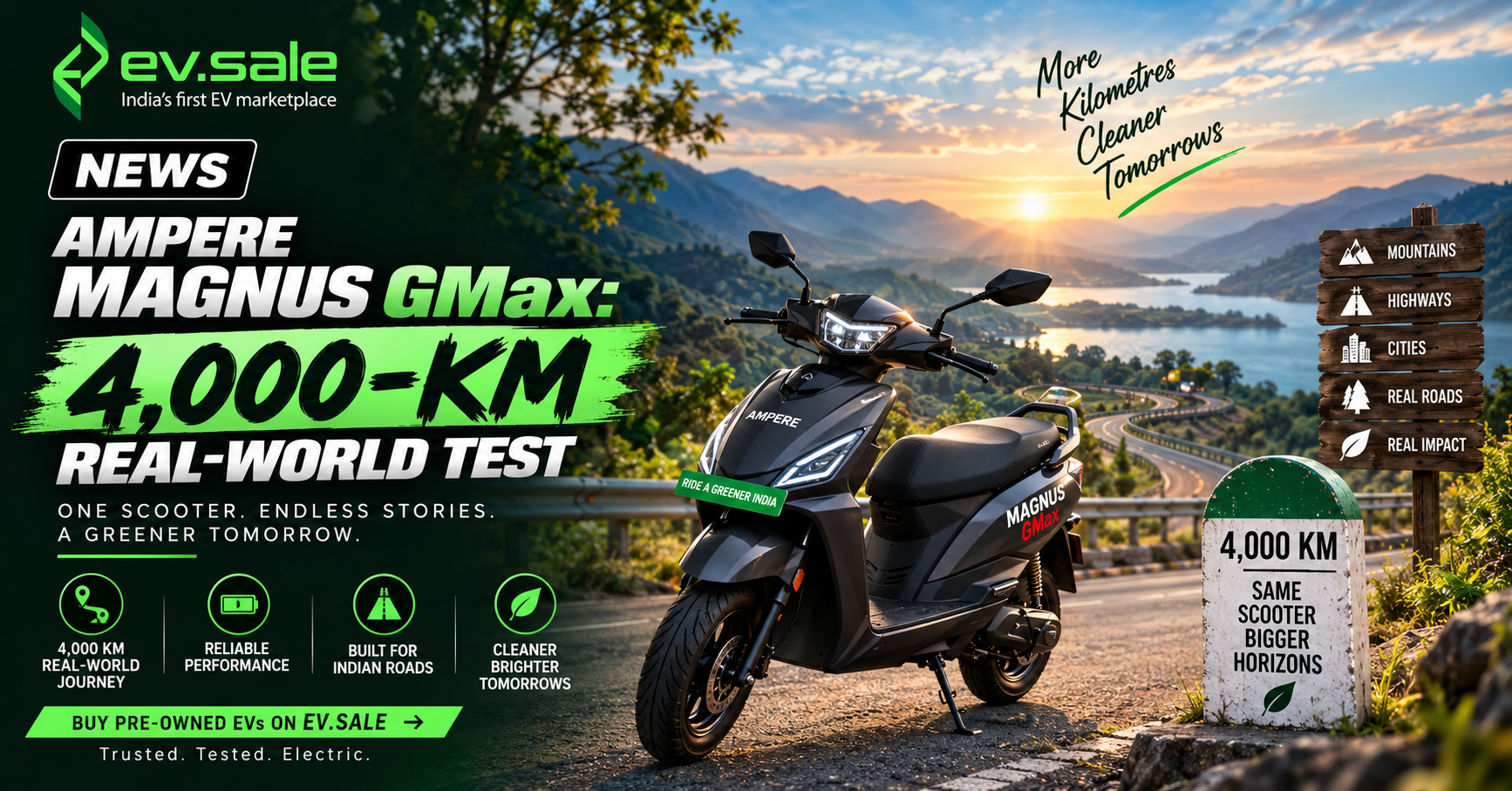
Ampere Electric has taken the Magnus GMax beyond the usual showroom demonstration by putting the electric scooter through an ambitious 4,000-km cross-country endurance ride. The journey began on September 8, 2026, from Dong in Arunachal Pradesh and is planned to finish at Guhar Moti in Gujarat after travelling through eight states over 15 days. Instead of testing the scooter only on familiar city roads, Ampere is exposing it to mountain routes, highways, urban traffic, changing temperatures and difficult road surfaces. The objective is to understand how the Magnus GMax performs when it is used in conditions that are closer to the realities faced by Indian riders every day. The exercise is particularly relevant at a time when EV customers are looking beyond advertised specifications and asking tougher questions about reliability, battery durability, running costs and real-world range.
Ampere Magnus GMax Takes on a 4,000-Km Indian Road Challenge
The scale of this journey makes it considerably different from a conventional promotional ride. The route begins in one of India’s most challenging northeastern regions before moving across the country towards Gujarat, creating a natural test of the scooter’s ability to handle dramatically different environments. Ampere says the route includes mountain passes, forest roads, national highways, busy urban stretches and coastal or salt-flat terrain. During the journey, the scooter is expected to experience temperatures ranging from approximately 15°C in Dong to more than 35°C in Gujarat. The route will also involve a significant altitude change of more than 1,200 metres, giving the scooter a combination of environmental and road-condition challenges rarely found in a controlled test.
The ride is being undertaken by Girish Seth of Weekend on Wheels and is scheduled to cover roughly 4,000 km over 15 days. Five broad terrain conditions are expected to form part of the route, giving Ampere an opportunity to observe how the Magnus GMax behaves across changing gradients, road surfaces and traffic conditions. This is important because an electric scooter that performs well on smooth urban roads may encounter very different demands on steep inclines or broken surfaces. Battery efficiency can also change with temperature, speed, load and riding style. By taking the scooter across such a varied route, Ampere is attempting to demonstrate that its family-oriented electric scooter can cope with the diversity of Indian road conditions.
Best EV Marketplace in India: Why Real-World EV Testing Matters
For customers searching for the Best EV Marketplace in India, real-world performance is becoming an increasingly important part of the buying decision. Certified range figures remain useful for comparing vehicles, but they cannot fully replicate the conditions experienced by an everyday rider. Traffic congestion, frequent acceleration, steep roads, additional passenger weight, weather conditions and riding speed can all affect an EV’s actual range. The Magnus GMax has a claimed IDC range of up to 142 km, but the current endurance journey is intended to expose the scooter to conditions far more varied than a standard certification cycle. That makes the eventual findings potentially useful for customers trying to understand what an EV can realistically deliver outside a showroom brochure.
The market itself has changed dramatically over the past few years. Indian consumers now have a much wider choice of electric scooters, with established manufacturers competing alongside newer EV companies across several price categories. Buyers are no longer asking only whether an EV can replace a petrol scooter; they are comparing charging times, battery chemistry, warranty coverage, service availability, connected features and long-term running costs. This makes the Best EV Marketplace in India concept increasingly relevant because buyers need a place where they can compare more than just headline prices. Real-world testing, ownership history and detailed specifications can help consumers make decisions based on how an EV is likely to perform after the purchase.
What the Magnus GMax Brings to the Market
The Magnus GMax is positioned as a practical electric scooter aimed at family and everyday commuting requirements rather than outright performance. It uses a 3kWh LFP battery paired with a motor producing up to 2.4kW of peak power, while Ampere claims an IDC range of 142 km. The scooter offers a 33-litre boot, 165mm ground clearance and a claimed top speed of 65 kmph, specifications that are more focused on urban usability than high-speed riding. Ampere also claims a battery life of up to 2,00,000 km and provides a five-year or 75,000-km battery warranty. These figures are manufacturer claims, but they are nevertheless important when assessing the scooter’s intended long-term ownership proposition.
The Magnus GMax also reflects the increasing role of connected technology in affordable electric vehicles. Ampere has introduced its NxG.io connected technology package with more than 30 features, including a 5-inch display, cruise control, hill-hold assistance and turn-by-turn navigation. The connected platform also provides features such as live vehicle tracking, geofencing, theft and tow alerts, remote diagnostics, service booking and battery information. Over-the-air updates further allow certain software improvements to be delivered without requiring a conventional workshop visit. This combination of practical hardware and connected features shows how EV manufacturers are increasingly trying to make technology accessible beyond premium electric scooters.
Buy Used EV Cars in Bangalore: What the Endurance Test Can Teach Buyers
Although the Magnus GMax is an electric scooter, the lessons from a long-distance endurance test are relevant to the wider EV market, including customers who plan to Buy Used EV Cars in Bangalore. One of the biggest concerns surrounding a pre-owned EV is how the vehicle and battery have been treated during previous ownership. Mileage alone does not tell the entire story because charging patterns, climate, driving style and maintenance can all influence battery performance. As more EVs accumulate kilometres in India, buyers will increasingly want evidence about how vehicles have been used rather than simply relying on registration year and odometer readings.
For anyone planning to Buy Used EV Cars in Bangalore, battery condition should be considered alongside the normal checks applied to a used vehicle. Buyers should ask about charging history, service records, remaining battery warranty, previous repairs and any battery-related issues. The availability of public charging around the buyer’s home and workplace is another practical consideration. Bangalore’s established EV ecosystem makes it easier to operate an electric vehicle, but the right model still depends on individual usage requirements. A well-maintained pre-owned EV with documented service and battery information can potentially offer better value than a lower-priced vehicle with an uncertain history.
Range Figures Versus Everyday Riding Conditions
One of the most important lessons from any EV endurance test is that claimed range and real-world range are not necessarily the same. Certification figures are generated under controlled testing conditions that allow vehicles to be compared using a common methodology. Everyday riding is considerably less predictable, with traffic, gradients, weather, rider weight and acceleration constantly changing energy consumption. The Magnus GMax’s 142-km IDC figure should therefore be understood as a certified reference rather than a promise that every rider will achieve exactly that distance. The 4,000-km journey is interesting because it gives the scooter an opportunity to demonstrate how its battery and powertrain behave across a much wider set of circumstances.
This distinction will become increasingly important as EV buyers become more experienced. Early customers often focused on the highest advertised range because there were relatively few real-world ownership experiences available. Today, buyers can find more information about how electric vehicles perform in different cities and conditions. For the Best EV Marketplace in India, providing meaningful information about battery capacity, charging, range and ownership history can make vehicle discovery considerably more useful. Instead of asking only “How many kilometres can it travel?”, consumers are increasingly asking how far it can travel in traffic, on highways, with passengers and under different weather conditions.
Buy Used EV Cars in Bangalore: Battery Health Will Shape Resale Value
Battery health is expected to become one of the most important factors in India’s pre-owned EV market. Consumers looking to Buy Used EV Cars in Bangalore will increasingly want to know how much usable battery capacity remains, how the vehicle has been charged and whether it still has manufacturer warranty protection. Two vehicles of the same model and registration year can potentially have different resale values if their usage patterns and battery conditions are different. This means the traditional approach of judging a used car mainly by age and kilometres may become less effective for EVs. Transparent battery and service information can give buyers a much clearer understanding of the vehicle they are considering.
Ampere’s use of an LFP battery and its claimed 2,00,000-km battery life also highlights the importance of battery longevity in the electric two-wheeler segment. However, manufacturer claims should not be interpreted as a guarantee that every individual battery will reach that mileage without degradation. The five-year or 75,000-km battery warranty provides an additional layer of protection for eligible owners, and any remaining warranty could become valuable when the vehicle enters the used market. Customers who Buy Used EV Cars in Bangalore should therefore check warranty transfer conditions, battery documentation and service history before deciding whether a pre-owned EV represents good value.
The Economics Behind the Magnus GMax
Price and running costs remain central to the appeal of affordable electric scooters in India. The Magnus GMax is positioned around the ₹1 lakh-plus ex-showroom price bracket, depending on the specific variant and location, placing it within reach of buyers who want to transition from a conventional two-wheeler without entering the premium EV category. Its 3kWh battery and 142-km claimed IDC range are intended to provide a balance between usable range and purchase cost. Final on-road pricing can vary because registration, insurance, location-specific charges and offers may change the amount paid by the customer. Buyers should therefore verify the current price before making a purchase decision.
The running-cost advantage is another part of the equation. Electricity is generally cheaper per kilometre than petrol for a comparable urban commute, although the actual saving depends on local electricity rates, charging losses, riding efficiency and annual usage. Maintenance requirements can also differ because electric powertrains have fewer conventional mechanical components than internal-combustion vehicles. Over several years, these factors can significantly influence total ownership costs. This is particularly relevant to used-EV buyers because the lower initial purchase price of a pre-owned vehicle can potentially be combined with the running-cost benefits of electric mobility.
EV.sale: A Dedicated Platform for India’s Used-EV Market
As more electric vehicles enter the Indian market, the demand for specialised online marketplaces is likely to grow alongside new vehicle sales. EV.sale is designed specifically around electric mobility, providing a dedicated platform where EV owners can list their vehicles and prospective buyers can discover pre-owned electric options. For consumers searching for the Best EV Marketplace in India, a specialised marketplace can make the search process more focused because users are already looking for electric vehicles. It also creates an environment where EV-specific information can become part of the listing rather than being treated as an optional detail.
Creating a strong EV.sale listing begins with providing accurate vehicle information. Sellers can enter the make, model, variant, registration year, kilometres driven, number of previous owners and expected selling price. They can then add details that matter specifically to EV buyers, including battery capacity, available battery-health information, charging history, warranty coverage and service records. Sellers should also upload clear photographs showing the vehicle’s exterior, interior, dashboard, odometer, tyres, charging port and charging equipment. The objective should be to give potential buyers enough information to understand the vehicle before making contact.
Buy Used EV Cars in Bangalore Through Transparent Listings
For customers who want to Buy Used EV Cars in Bangalore, a detailed online listing can make the initial research process faster and more efficient. Instead of contacting every seller without knowing the vehicle’s basic condition, buyers can first compare the registration year, kilometres, asking price, ownership history and model. They can then ask more specific questions about battery health, charging behaviour, warranty and service history before arranging a physical inspection. This helps buyers narrow down their choices and spend more time evaluating vehicles that actually fit their requirements. The final purchase should still involve physical inspection, documentation checks and appropriate verification.
Sellers also have a strong reason to provide complete information. Serious EV buyers are becoming more knowledgeable about battery technology and ownership costs, so vague descriptions may create uncertainty rather than confidence. Sellers should disclose major accidents, repairs, battery replacements, charging issues or cosmetic damage wherever applicable. A transparent listing can make the conversation with a prospective buyer more straightforward because many basic questions have already been answered. As the used-EV market expands, the quality of vehicle information is likely to become one of the strongest factors influencing buyer confidence and resale value.
The 4,000-Km Test Is Still Underway
It is important to distinguish between the announced endurance challenge and its final results. Ampere began the 4,000-km journey on September 8, 2026, meaning the test is still in progress and a complete manufacturer report has not yet been published. The company has outlined the route, duration and environmental challenges, but the final findings will determine how successfully the Magnus GMax handles the entire journey. Until those results are available, it would be misleading to describe the scooter as having already completed 4,000 km or to claim a particular real-world range from the test. The eventual data will be more valuable if Ampere publishes details about charging stops, energy consumption, terrain and battery performance.
The cross-country nature of the challenge nevertheless makes it an interesting development for India’s electric two-wheeler industry. A 4,000-km journey across eight states exposes the vehicle to a much wider range of conditions than a short urban demonstration. Mountain roads can place greater demands on the motor and battery, while high temperatures can influence energy consumption and thermal management. Urban traffic introduces frequent acceleration and braking, whereas highways create different demands on sustained speed. For the Best EV Marketplace in India, such real-world endurance information can help move the conversation from brochure specifications towards actual ownership experience.
What This Test Could Mean for the Future of EV Ownership
India’s EV market is gradually entering a stage where durability and ownership confidence are becoming just as important as new technology. Customers want vehicles that can survive everyday commuting, seasonal weather, poor road surfaces and occasional long-distance journeys without creating unexpected costs. The Magnus GMax endurance programme reflects this changing expectation because Ampere is deliberately placing the scooter in varied environments rather than limiting the demonstration to a controlled urban route. If the final results are documented clearly, they could provide useful evidence about the scooter’s practical performance and durability. More importantly, they could contribute to a broader industry shift towards transparent real-world testing.
For consumers researching the Best EV Marketplace in India, the future buying decision is likely to involve considerably more information than it did five years ago. Battery health, charging performance, service records, warranty coverage and real-world efficiency will increasingly sit alongside price and kilometres when buyers compare vehicles. Customers looking to Buy Used EV Cars in Bangalore are likely to benefit from this shift because better information can make it easier to distinguish between well-maintained vehicles and those carrying greater ownership risk. As the used-EV market develops, digital marketplaces can become an important source of that information.
EV.sale and India’s Next Generation of EV Buyers
The Magnus GMax endurance test is ultimately one small part of a much larger transformation taking place across India’s automotive market. Electric vehicles are moving beyond the novelty stage, and customers are beginning to evaluate them according to the same practical considerations applied to any long-term vehicle purchase. Reliability, service support, operating costs, battery life and resale value are becoming increasingly important. At the same time, more EVs are entering the market every year, creating the foundation for a much larger pre-owned segment. This transition will require better information for buyers and better digital tools for sellers.
For customers planning to Buy Used EV Cars in Bangalore, platforms such as EV.sale can provide a convenient starting point for exploring the growing supply of pre-owned electric vehicles. Sellers can use the platform to present their vehicles with detailed specifications, photographs, battery information and ownership history, while buyers can research available options before moving towards inspection and verification. For those looking for the Best EV Marketplace in India, a platform dedicated to electric vehicles can make the discovery process more relevant and efficient. As EV ownership expands, the ability to connect informed sellers with serious buyers will become increasingly valuable.
The Ampere Magnus GMax 4,000-km endurance ride is therefore worth following closely, particularly once the complete journey is finished and the company releases its findings. The challenge covers eight states, 15 days and some of the most varied road and climate conditions available in India, making it a meaningful test of an affordable electric scooter’s practical capabilities. It also reflects a broader change in consumer expectations, where buyers increasingly want real-world evidence instead of relying entirely on laboratory figures. As the Indian EV market matures, this combination of real-world testing, transparent vehicle information and specialised digital marketplaces could help build greater confidence among the next generation of EV buyers.
Continue Reading: Hyundai Launches 120kW EV Fast Chargers in Delhi
1. What is the Ampere Magnus GMax 4,000-km test?
The Ampere Magnus GMax 4,000-km test is a cross-country endurance ride launched on September 8, 2026. The planned route starts at Dong in Arunachal Pradesh and ends at Guhar Moti in Gujarat, covering eight states over approximately 15 days. Ampere is using different road surfaces, altitudes, temperatures and traffic conditions to test the scooter. The complete results are not yet available because the endurance ride is still underway.
2. What is the range of the Ampere Magnus GMax?
The Magnus GMax uses a 3kWh LFP battery and has a claimed IDC range of up to 142 km. It is powered by a motor with up to 2.4kW of peak power and has a claimed top speed of 65 kmph. Actual range can vary depending on rider weight, speed, traffic, terrain, temperature and riding style. The ongoing endurance test is intended to provide additional real-world insight into its performance.
3. Is the Ampere Magnus GMax good for everyday use?
The Magnus GMax is designed primarily as a practical family electric scooter for everyday commuting. Its 33-litre boot, 165mm ground clearance and 3kWh battery are aimed at providing a balance between practicality, range and running cost. Its connected features also include navigation, hill-hold assistance and vehicle tracking. Buyers should consider their daily distance, charging access and local road conditions before choosing the scooter.
4. What should I check before I Buy Used EV Cars in Bangalore?
Before you Buy Used EV Cars in Bangalore, check the vehicle’s battery health, charging history, remaining warranty and service records. Buyers should also verify ownership documents, insurance, accident history and previous major repairs. The tyres, brakes, suspension, charging equipment and overall vehicle condition should be inspected before purchase. Comparing several vehicles can also help determine whether the asking price reflects the EV’s actual condition.
5. How can I list my EV on EV.sale?
Owners can visit EV.sale and create a listing with the vehicle’s make, model, variant, registration year, kilometres driven, ownership details and expected selling price. Sellers should also include battery capacity, battery condition, charging information, warranty status and service history wherever available. Clear photographs of the exterior, interior, dashboard, odometer and charging equipment can make the listing more useful. For sellers looking for the Best EV Marketplace in India, accurate and transparent listings can help attract more relevant EV buyers.
Leave a Reply