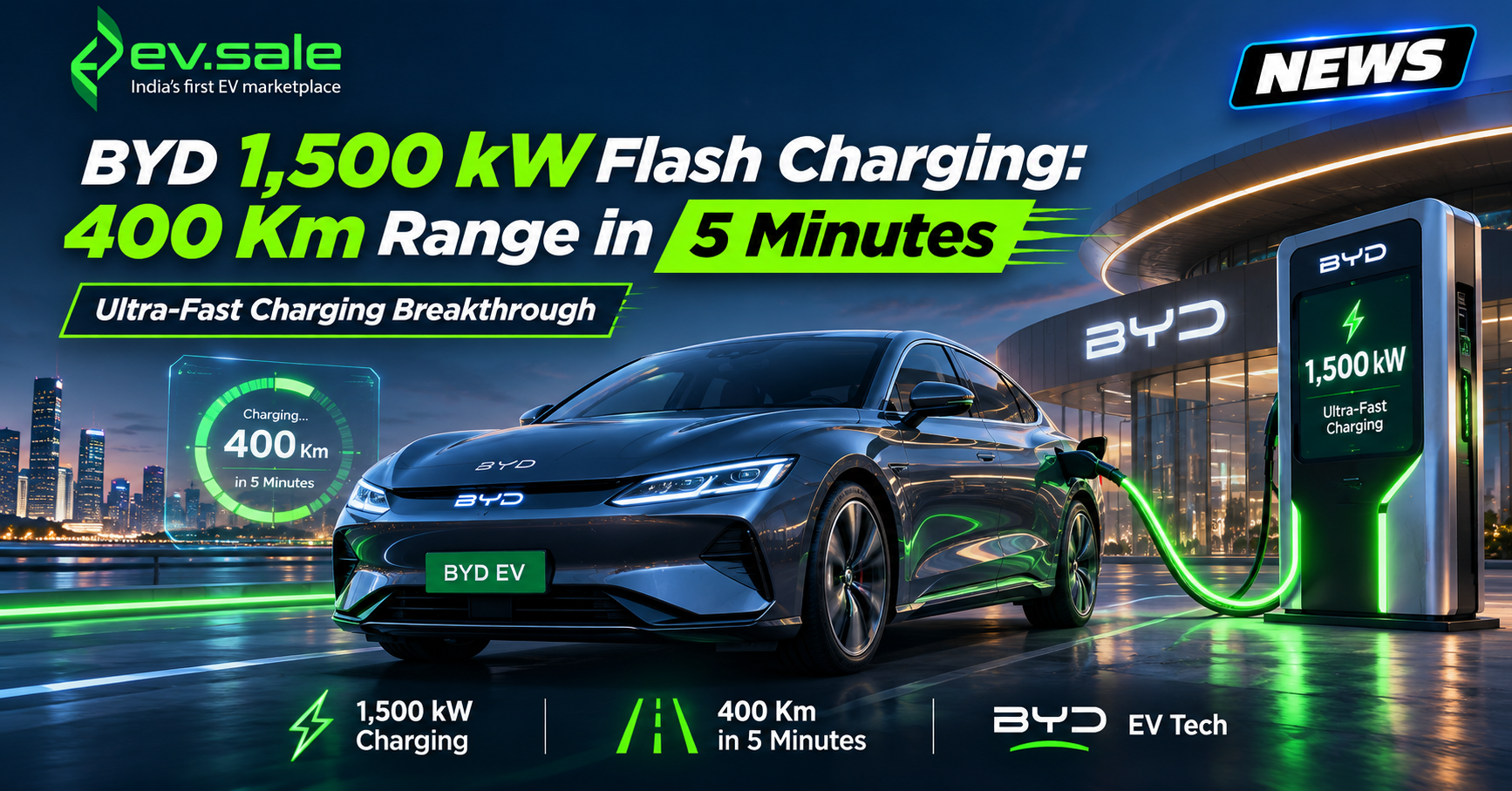
What if charging an electric car took almost the same time as filling a petrol tank? For years, this has been one of the biggest questions surrounding electric vehicles. While EVs can be economical for daily travel, waiting at a charging station during a long journey is still a concern for many drivers. Chinese electric vehicle manufacturer BYD is now working to change that experience with its powerful 1,500 kW Flash Charging technology. The system follows an earlier BYD demonstration in which a compatible electric car gained a claimed 400 km of driving range in just five minutes. The company has since introduced a new battery capable of accepting electricity at even higher speeds and demonstrated a charging station that uses solar power and robotic technology. These developments show how quickly EV charging is improving, although widespread availability in India will take more time.
BYD’s 1,500 kW Flash Charging Could Change How We Charge Electric Cars
BYD introduced its latest Flash Charging technology in March 2026, bringing an important improvement to the way electric vehicles receive power. The new system can deliver up to 1,500 kW through a compatible charging connector, making it far more powerful than many chargers commonly used today. According to BYD, a compatible vehicle equipped with Blade Battery 2.0 can charge from 10% to 70% in approximately five minutes. The company also claims that the battery can reach 97% charge from 10% in around nine minutes under suitable conditions. For someone travelling hundreds of kilometres, that could mean spending much less time waiting at charging stations. However, the technology requires specially designed batteries, charging equipment, and electrical systems. Existing electric cars cannot automatically charge at 1,500 kW simply because they are connected to a more powerful charger.
How BYD First Achieved the 400 Km in Five Minutes Charging Claim
The story behind BYD’s five-minute charging breakthrough actually began in March 2025. That was when the company introduced its Super e-Platform, an electrical system designed to support charging power of approximately 1,000 kW. During its demonstration, BYD claimed that compatible vehicles such as the Han L could gain up to 400 km of driving range after five minutes of charging. The announcement attracted attention because it suggested that charging an EV could eventually become almost as convenient as refuelling a conventional car. A year later, BYD introduced its more powerful 1,500 kW system with a different way of measuring charging performance. The newer technology focuses on how quickly a compatible battery moves between specific charge percentages. Both developments are important, but the original 400 km claim and the newer 10%–70% charging claim should be understood as separate demonstrations.
BYD Blade Battery 2.0: The Battery Behind Faster Charging
A charging station can only deliver electricity as quickly as the vehicle’s battery can safely accept it. This is why BYD has spent several years developing its second-generation Blade Battery. According to the company, Blade Battery 2.0 took approximately six years to develop and offers around 5% better energy density than its earlier generation. The battery uses lithium iron phosphate technology, commonly called LFP, along with improvements to its internal materials and structure. These changes are intended to reduce electrical resistance and heat during high-speed charging. BYD has also reported safety testing designed to evaluate battery performance under demanding conditions, including repeated fast-charging cycles. The new battery is an important part of the company’s effort to make charging faster without ignoring the reliability and safety concerns that matter to vehicle owners.
BYD Introduces Solar-Powered Robotic Charging Technology
BYD’s latest charging development goes beyond delivering electricity at high speeds. On November 10, 2026, the company showcased an advanced charging installation in Abu Dhabi that brings several technologies together. The setup uses solar panels, battery energy storage, high-powered Flash Charging equipment, and a robotic arm that can connect a charging cable to a vehicle. Solar panels generate electricity during daylight hours, while the storage system helps make that energy available when it is needed. The robotic arm is designed to identify the vehicle’s charging port and make the connection without the driver handling the cable. This could make future charging stations more convenient, particularly at locations designed for automated parking and charging. However, the Abu Dhabi installation is a demonstration and does not mean that such facilities are already widely available at public charging stations.
Why Solar Energy and Battery Storage Matter for Ultra-Fast Charging
A charger delivering up to 1,500 kW needs access to a large amount of electricity in a very short time. This can be difficult in places where the local electricity network is not designed to support such heavy demand. BYD’s integrated system addresses part of this challenge by using batteries to store electricity before vehicles arrive. When a car begins charging, the stored energy can be delivered quickly, reducing the immediate demand placed on the grid. Solar panels can contribute electricity to the storage system, although their output depends on sunlight and the size of the installation. This approach may be useful at remote highway locations or charging hubs with limited electricity connections. However, the equipment still requires significant investment, maintenance, and careful planning before it can be used on a large scale.
Will BYD Flash Charging Be Available in India?
Indian electric vehicle owners may be excited about five-minute charging, but there is an important difference between a technology announcement and actual public availability. BYD has not confirmed a nationwide rollout of 1,500 kW Flash Charging stations in India. Electric cars currently sold in the country have their own supported charging speeds, which vary by model and battery system. Even if a very powerful charger becomes available, an existing car may not be capable of accepting its full output. Customers should therefore follow the manufacturer’s charging recommendations and check the specifications of their particular vehicle. For now, home charging and properly planned public charging stops remain the most practical options for many Indian EV owners. The real impact of BYD’s technology will depend on when compatible vehicles and charging stations become available locally.
Best EV Marketplace in India: Understanding Charging Before Buying an EV
Charging is one of the first things people should understand before purchasing an electric car. A larger battery may provide more driving range, but it can also require more time to charge if the vehicle supports only modest charging speeds. Similarly, a car that supports fast DC charging may be more convenient for highway travel than one designed mainly for overnight home charging. Customers searching for the Best EV Marketplace in India can explore EV.sale to compare available electric vehicles and understand their practical features. The website brings together pre-owned EV listings and useful information for people considering electric mobility. A helpful Best EV Marketplace in India experience should encourage buyers to compare battery condition, charging compatibility, warranty coverage, and everyday travel needs. These details are particularly important when choosing a used electric car.
Buy Used EV Cars in Bangalore Without Waiting for New Charging Technology
The possibility of charging an electric car in five minutes is exciting, but customers do not need to wait for that technology to start driving an EV. Many electric cars already available in India can handle regular office commuting, shopping trips, and family travel. For someone with a dedicated parking space and access to home charging, keeping a vehicle charged may be relatively convenient. People who want to Buy Used EV Cars in Bangalore can explore pre-owned models from Tata, MG, Mahindra, Hyundai, and BYD through EV.sale. The platform allows buyers to compare asking prices, registration years, kilometres driven, and available battery information. Customers planning to Buy Used EV Cars in Bangalore should also check the car’s charging limit and the availability of compatible chargers near their home or workplace. Choosing a vehicle that suits today’s infrastructure is often more practical than depending on future charging developments.
Best EV Marketplace in India for Comparing Used Electric Cars
The growing number of electric cars on Indian roads is also creating opportunities in the second-hand vehicle market. Some owners may upgrade to newer models with better battery technology, while others may sell because their travel requirements have changed. This gives buyers a chance to explore electric vehicles at potentially lower purchase prices. People researching the Best EV Marketplace in India can use EV.sale to compare available pre-owned cars from different manufacturers. The platform provides listing information such as model year, kilometres driven, asking price, and battery-related details where available. The Best EV Marketplace in India should also make it easier for customers to understand why a battery inspection and service history matter. A vehicle with a lower asking price is not necessarily the better purchase if its battery or charging system requires expensive repairs.
Buy Used EV Cars in Bangalore Through EV.sale
Finding the right second-hand electric car becomes easier when customers can review several models in one place. EV.sale offers a dedicated Bengaluru used EV marketplace where buyers can explore available vehicles across different price categories. People looking to Buy Used EV Cars in Bangalore can compare models such as the Tata Tiago EV, Tata Nexon EV, MG Comet EV, Mahindra XUV400, and BYD Atto 3, depending on current listings. Each car offers a different combination of passenger space, battery capacity, charging convenience, and driving range. Buyers can shortlist vehicles based on their budget and regular travel requirements before contacting a seller. Customers planning to Buy Used EV Cars in Bangalore should also arrange a physical inspection and verify the battery condition, charging system, service records, and ownership documents. Taking these steps can help buyers avoid unexpected expenses after completing the purchase.
How to List and Sell Your Electric Vehicle on EV.sale
As manufacturers introduce electric cars with improved batteries and faster charging, some existing owners may decide to upgrade. Their current vehicles can then become affordable options for people entering the used EV market. EV.sale provides a dedicated service for owners who want to list their electric vehicles and connect with interested buyers. Sellers can visit www.ev.sale and look for the Sell My EV option to begin the process. They should prepare important details such as the vehicle’s manufacturer, model, registration year, kilometres driven, variant, and expected selling price. Clear photographs, battery health information, service history, charging accessories, and remaining warranty details can make a listing more useful. EV.sale describes support for vehicle inspections, listings, and buyer connections, with the available services and transaction arrangements confirmed during the process.
Why Battery Health Matters More Than Charging Speed Alone
When buying an electric vehicle, it is easy to focus on the largest range figure or the fastest charging time. However, battery health can be just as important, especially when the car has already been used for several years. A battery’s performance can change with age, mileage, charging habits, and operating conditions. People searching for the Best EV Marketplace in India should therefore consider the condition of the battery alongside the vehicle’s advertised specifications. Customers who want to Buy Used EV Cars in Bangalore should also check whether the battery warranty is still valid and whether the vehicle charges normally. An independent inspection can help identify concerns that may not be obvious during a short test drive. EV.sale provides a starting point for comparing available vehicles, but buyers should verify the information before completing a purchase.
How Much Does It Cost to Charge an Electric Car in India?
Charging expenses depend on the amount of electricity a vehicle uses and where the owner charges it. Consider an electric car that consumes approximately 15 kWh of electricity to travel 100 km. At an illustrative home tariff of ₹8 per unit, the energy cost would be around ₹120 before charging losses. At a public fast-charging station charging ₹20 per unit, the same amount of electricity would cost approximately ₹300 before additional fees. This difference explains why regular access to home charging can be useful for many EV owners. Customers who Buy Used EV Cars in Bangalore should consider their charging arrangements before choosing a vehicle. People comparing vehicles through the Best EV Marketplace in India should also look beyond the purchase price and understand the total cost of ownership.
What BYD’s Charging Breakthrough Means for India’s EV Future
BYD’s charging developments show how manufacturers are working to make electric vehicles more convenient for long-distance travel. Its earlier 1,000 kW system demonstrated a claimed 400 km of additional range in five minutes, while the newer 1,500 kW system focuses on charging compatible batteries from 10% to 70% in the same period. The introduction of solar power, battery storage, and robotic charging also shows how future charging stations may become more advanced. However, these improvements will not reach every market or every vehicle at the same time. India will need compatible cars, reliable infrastructure, suitable electricity connections, and investment before ultra-fast charging becomes widely available. For customers researching the Best EV Marketplace in India, current vehicle reliability and practical charging access remain important considerations. Buyers who want to Buy Used EV Cars in Bangalore can explore EV.sale to compare pre-owned electric cars that suit their present requirements.
1. Can BYD really add 400 km of driving range in five minutes?
BYD demonstrated a claimed 400 km of additional range in five minutes when it introduced its 1,000 kW Super e-Platform in March 2025. The demonstration involved compatible vehicles and specific testing conditions. In March 2026, the company introduced its newer 1,500 kW Flash Charging technology with a different charging performance claim. That system can charge compatible Blade Battery 2.0 vehicles from 10% to 70% in approximately five minutes. Actual driving range and charging results will depend on the vehicle, battery, charger, and conditions.
2. What is BYD’s 1,500 kW Flash Charging technology?
BYD Flash Charging is an ultra-fast DC charging system designed to deliver very high power to compatible electric vehicles. The latest version was introduced in March 2026 alongside Blade Battery 2.0. According to BYD, compatible vehicles can charge from 10% to 70% in five minutes and from 10% to 97% in around nine minutes. These speeds require specially designed battery systems and suitable charging equipment. Existing electric cars cannot automatically charge at the full 1,500 kW rate.
3. Is BYD’s 1,500 kW Flash Charging available in India?
BYD has discussed expanding its advanced charging network internationally, but a nationwide 1,500 kW Flash Charging rollout has not been confirmed for India. Existing BYD vehicles sold in the country have their own approved charging limits. Owners should use charging equipment compatible with their specific vehicle models. Public charging infrastructure also varies across Indian cities and highways. Buyers should wait for official announcements before expecting five-minute charging at local stations.
4. How does BYD’s robotic charging system work?
BYD demonstrated an integrated robotic charging installation in Abu Dhabi in November 2026. The system combines solar panels, energy storage, high-powered charging equipment, and an automated charging arm. The arm can identify the vehicle’s charging port and connect the cable without the driver handling it manually. Stored electricity can then be supplied to the vehicle when charging begins. This is a demonstration of future charging possibilities rather than a feature already available at ordinary public stations.
5. How can I buy or sell a used electric car through EV.sale?
Customers can visit EV.sale to explore available pre-owned electric vehicles from different manufacturers. The website provides listings with asking prices, registration years, kilometres driven, and battery information where available. Bengaluru buyers can explore city-specific listings to compare cars within their budget. Existing EV owners can use the Sell My EV section to begin listing their vehicles. Before completing a transaction, buyers and sellers should verify battery condition, service history, ownership documents, and payment arrangements.
Leave a Reply