Hyundai Creta Electric Takes a New Approach to EV Ownership in India
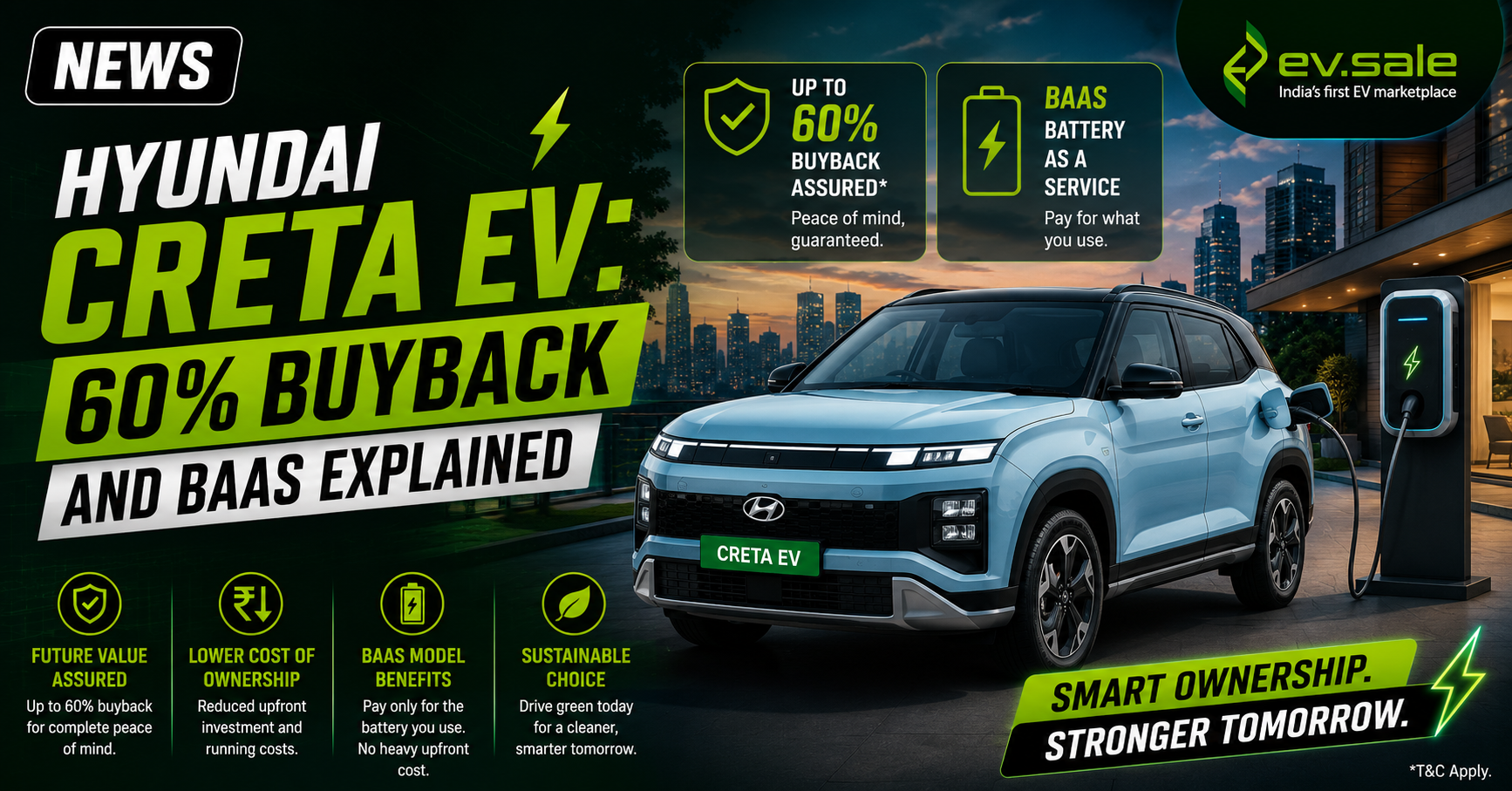
The Hyundai Creta Electric is no longer just another electric SUV competing for attention in India’s rapidly growing EV market. Hyundai Motor India has introduced a new ownership strategy around the SUV that could make electric mobility more accessible to buyers who are still concerned about high upfront costs and uncertain resale values. The two key developments are a Battery-as-a-Service, or BaaS, programme and an assured buyback scheme that promises 60% of the vehicle’s value after three years or up to 45,000 km, subject to the programme’s applicable conditions.
The BaaS model is particularly interesting because it changes the way customers pay for an electric vehicle. Instead of paying for the entire car and battery together at the time of purchase, buyers can separate the battery cost from the vehicle price and pay a usage-linked battery charge. Hyundai has announced the Creta Electric with BaaS from ₹10.99 lakh ex-showroom, while the battery usage charge starts at ₹3.90 per kilometre. This significantly lowers the initial price of entry and gives buyers another way to structure their EV ownership.
The move comes at a time when India’s electric vehicle industry is becoming increasingly mature. EV buyers today are no longer early adopters simply attracted by new technology. They are comparing running costs, battery warranties, charging requirements, resale values and financing options before making a purchase. The industry has also come a long way in terms of battery economics. Global lithium-ion battery pack prices have fallen dramatically compared with a decade ago, helping manufacturers offer longer-range vehicles at increasingly competitive prices.
Hyundai’s approach therefore reflects a broader change in the market. The competition is no longer only about who can offer the longest range or most powerful motor. Manufacturers are also exploring new financial models that can reduce the initial burden on customers and make electric vehicles easier to own.
Hyundai Creta Electric Price, Battery and Range Make It a Strong Premium EV Contender
The Creta Electric has been developed around two battery options designed to meet different customer requirements. The SUV is available with a 42 kWh battery pack as well as a larger 51.4 kWh battery pack. Depending on the version, the electric motor produces up to 171 PS, while Hyundai quotes a maximum MIDC range of up to 510 km for the long-range version.
For buyers who regularly drive within cities, the smaller battery option can provide a practical balance between range and price. Customers who frequently travel longer distances may find the 51.4 kWh version more appealing because of its higher claimed range. This flexibility is becoming increasingly important as Indian EV buyers become more aware that battery size should match their actual driving requirements rather than simply choosing the biggest available battery.
Charging is another important part of the Creta Electric package. Hyundai says the SUV can charge from 10% to 80% in around 39 minutes using suitable DC fast-charging infrastructure. Selected configurations also support a 7.4 kW AC wall-box charger, giving owners the option of charging the vehicle at home.
The conventional Creta Electric range starts at around ₹18 lakh ex-showroom, depending on the variant and location, while the BaaS programme brings the initial vehicle price considerably lower by separating the battery cost. This makes the financial comparison more complicated but also more interesting. Buyers now have to consider not only the showroom price but also their expected annual kilometres, electricity expenses, battery charges and ownership period.
For anyone researching the Best EV Marketplace in India, this is an important development because EV shopping is becoming increasingly detailed. Customers need platforms where they can compare vehicles not only by price and range but also by battery condition, warranty, charging capabilities and long-term ownership costs.
How Hyundai’s BaaS Model Could Change EV Buying Habits
Battery-as-a-Service is based on a relatively simple idea: instead of paying the full cost of the battery upfront, the customer pays for battery usage separately. Hyundai’s announced BaaS plan for the Creta Electric starts at ₹3.90 per kilometre, although the final cost depends on the applicable programme terms.
Consider a customer who drives approximately 1,000 km every month. At the announced starting rate, the battery usage component would work out to roughly ₹3,900 per month, before electricity and other vehicle ownership expenses. Someone driving significantly more would naturally pay more under a kilometre-linked structure, while a low-mileage driver could have a different ownership equation.
This is why buyers should look beyond the attractive initial price. A lower upfront cost can be useful for customers who want to reduce their initial financial commitment, but the recurring battery charge needs to be considered over the entire ownership period. A buyer planning to keep the vehicle for many years should compare the total expected BaaS payments against the cost of purchasing the battery outright.
Despite this consideration, the model addresses a genuine concern in the EV market. Some customers remain worried about paying a large amount for an EV battery when they are unsure how its value will change over time. By separating battery ownership from the vehicle, BaaS could make the transition to electric mobility feel less financially intimidating.
If similar models become more common across the industry, India’s EV market could gradually move towards a mixture of traditional ownership, battery leasing, subscriptions and usage-based payment structures. That could fundamentally change how consumers calculate the cost of owning an electric car.
The Best EV Marketplace in India Has a Bigger Role as EV Ownership Models Become More Complex
The introduction of BaaS makes the EV buying journey more sophisticated. A customer considering the Creta Electric now has to compare different ownership structures rather than simply comparing one ex-showroom price against another. The Best EV Marketplace in India can help simplify this process by presenting the important details that influence the real cost of ownership.
The assured buyback programme adds another interesting element. Hyundai’s scheme promises 60% of the vehicle’s value after three years or 45,000 km, subject to the programme’s terms and eligibility conditions. For customers concerned about resale value, an assured exit option can provide additional confidence when making a significant EV investment.
This is particularly relevant because resale value has become one of the biggest questions surrounding electric vehicles. Traditional petrol and diesel cars have a long-established used-car market, allowing buyers and sellers to estimate depreciation relatively easily. The EV market is still younger, and battery condition can have a major influence on a vehicle’s future value.
A defined buyback programme could therefore help reduce some of this uncertainty for eligible Creta Electric customers. It also creates a clearer path for upgrading to a newer EV after three years, potentially helping manufacturers maintain a steady flow of pre-owned vehicles into the market.
As India’s EV market grows, the Best EV Marketplace in India will have an increasingly important role in helping buyers understand these different ownership options and compare new EVs with pre-owned alternatives.
The Growing Pre-Owned Market Is Creating New Opportunities to Buy Used EV Cars in Bangalore
The arrival of more structured ownership programmes could eventually have a positive effect on India’s used EV market. As customers complete three- or four-year ownership cycles and upgrade to newer models, more electric cars will enter the pre-owned market. This will create opportunities for buyers who want modern EV technology without paying the full price of a new vehicle.
Bengaluru is particularly well positioned for this transition. The city has a large technology-focused population, strong EV awareness and an expanding charging ecosystem. As more electric SUVs reach the used-car market, customers looking to Buy Used EV Cars in Bangalore will have more options across different price points.
For used EV buyers, however, the focus will be on more than just the vehicle’s age and kilometres driven. Battery health, charging history, warranty status, accident history and service records will all influence the final buying decision. Anyone planning to Buy Used EV Cars in Bangalore should therefore examine the complete ownership history and battery condition before finalising a purchase.
This growing emphasis on transparency is also changing the way sellers prepare their vehicles for resale. Maintaining service records, documenting charging behaviour and keeping battery health information available can help establish confidence and potentially support stronger resale value.
EV.sale Is Creating a Dedicated Platform for India’s EV Buyers and Sellers
As the EV market becomes more complicated, buyers and sellers need a platform that understands the unique information associated with electric vehicles. EV.sale is built specifically around electric mobility, giving customers a dedicated place to discover, compare and sell EVs.
Customers researching the Hyundai Creta Electric or planning to Buy Used EV Cars in Bangalore can explore EV.sale to discover EV-focused listings. The platform allows sellers to provide the information that matters most to electric vehicle buyers, including vehicle photographs, specifications, battery-related information, ownership details, service history and charging information.
For a Creta Electric owner preparing to sell after several years, providing complete documentation can make a meaningful difference. A listing that clearly explains the vehicle’s service history, battery condition, charging background and ownership details gives prospective buyers a better understanding of what they are considering.
The process of listing a vehicle is designed to be straightforward. Sellers can create their listing, upload photographs and add relevant vehicle and ownership information before publishing it for potential EV buyers. As India’s pre-owned electric vehicle market becomes more established, platforms such as EV.sale can help create greater transparency between buyers and sellers.
The Hyundai Creta Electric’s BaaS and buyback programmes show that India’s EV industry is moving beyond simply selling electric cars. The next stage is about making EV ownership easier to understand, easier to finance and easier to exit. With battery technology improving, charging infrastructure expanding and more structured resale programmes emerging, the electric vehicle market is steadily becoming a more mature part of India’s automobile industry.
Continue Reading: NEWS – Haryana EV Policy 2026: 100% Road Tax Exemption
The Best EV Marketplace in India Can Help Buyers Look Beyond the Showroom Price
Hyundai’s decision to introduce Battery-as-a-Service with the Creta Electric reflects how quickly the economics of electric vehicle ownership are changing in India. For years, customers mainly compared the ex-showroom price, monthly EMI and fuel savings before deciding whether an EV made financial sense. BaaS adds another layer to that calculation because the battery cost is separated from the vehicle’s initial price and converted into a usage-based payment. Hyundai has announced a starting vehicle price of ₹10.99 lakh ex-showroom under the BaaS programme, with the battery charge beginning at ₹3.90 per kilometre, subject to the applicable programme terms.
For a customer covering around 1,000 km a month, that starting battery charge would translate to approximately ₹3,900. Someone driving 1,500 km would reach roughly ₹5,850. These figures are only illustrations based on the announced per-kilometre rate and do not include electricity, insurance, financing or other ownership expenses. They nevertheless demonstrate why driving habits will become increasingly important when comparing different EV ownership models.
This is where the Best EV Marketplace in India can add real value. Electric vehicle shopping is becoming more complicated because customers need to understand the complete cost of ownership rather than simply comparing two showroom prices. Battery payments, charging expenses, warranties, financing, maintenance and resale value all influence the final economics. A dedicated EV marketplace can help buyers look at these factors together and make a decision based on their actual driving requirements.
The 60% Assured Buyback Could Give EV Buyers Greater Resale Confidence
Resale value remains one of the biggest unanswered questions in India’s young electric vehicle market. Petrol and diesel cars have been sold in the country for decades, creating a relatively predictable used-car ecosystem. Electric vehicles are different. Battery condition, technology upgrades and the rapid pace of new EV launches can all influence the value of an older electric car.
Hyundai’s assured buyback programme is designed to address some of this uncertainty. Eligible Creta Electric customers can receive a buyback value of 60% after three years or 45,000 km, whichever comes first, subject to the applicable programme conditions. Instead of leaving customers to estimate what their vehicle might be worth several years later, the programme provides a defined reference point for their future exit.For buyers who typically change cars every three years, this could be particularly appealing. It provides a clearer ownership cycle and may make the transition into a newer EV easier. The programme could also encourage customers who were previously hesitant about EV depreciation to consider making the switch.
There is another potential benefit. If more owners return their Creta Electric vehicles through such programmes, a larger number of relatively young electric SUVs could eventually enter the pre-owned market. That would give second-hand buyers access to modern EV technology at a substantially lower entry price.As this market develops, the Best EV Marketplace in India can become an important link between first owners, manufacturers and future used-EV buyers by making vehicle history, battery condition and ownership information easier to understand.
BaaS Could Change How Indian Customers Think About Electric Cars
The basic idea behind Battery-as-a-Service is straightforward. Instead of purchasing the vehicle and battery as one package, the buyer pays a lower upfront amount for the vehicle and separately pays for battery usage. Hyundai’s Creta Electric takes this approach into the competitive midsize electric SUV segment.
The conventional Creta Electric starts at around ₹18.03 lakh ex-showroom, while the BaaS version starts at ₹10.99 lakh before the separate battery usage charge. The difference in initial pricing is significant, but buyers should not mistake a lower entry price for a lower total ownership cost in every situation. The final calculation depends heavily on how far the vehicle is driven, how long it is owned and what the applicable BaaS agreement requires.
For a high-mileage driver, the recurring battery payment could become a significant part of the monthly running cost. A low-mileage driver, on the other hand, may value the lower upfront investment more highly. Financing also changes the equation because borrowing a smaller amount can reduce the initial EMI burden.
This flexibility is one of the most interesting aspects of the BaaS model. It gives consumers another way to access EV technology without having to make the entire battery investment on day one. If the model gains acceptance, India could see more variations of battery leasing, subscriptions and usage-based ownership across different EV categories.
Creta Electric’s Battery Options Give Buyers More Choice
The financial structure may be attracting attention, but the underlying vehicle remains equally important. The Hyundai Creta Electric is offered with 42 kWh and 51.4 kWh liquid-cooled lithium-ion battery packs. Hyundai quotes claimed MIDC ranges of up to 420 km for the smaller battery and 510 km for the larger battery, giving buyers the option to choose a configuration based on their driving requirements.
The long-range version produces up to 171 PS, while the 42 kWh version delivers up to 135 PS. The SUV also supports DC fast charging, with Hyundai stating that it can charge from 10% to 80% in approximately 39 minutes under suitable charging conditions.
The Creta Electric also retains the practical characteristics expected from a midsize SUV. It offers a 433-litre boot, a 2,610 mm wheelbase and 200 mm of ground clearance, making it suitable for family use as well as daily urban driving. Technology and comfort features further strengthen its premium positioning.
However, claimed range figures should always be treated as laboratory-tested figures. Real-world range can vary depending on traffic, speed, road conditions, climate, air-conditioning use and driving style. Buyers should therefore consider their typical travel pattern rather than selecting a battery solely because it carries the highest claimed range.
The Pre-Owned Market Could Give Buyers More Reasons to Buy Used EV Cars in Bangalore
The next major opportunity created by the growth of new electric SUVs could be the expansion of India’s pre-owned EV market. A three-year-old Creta Electric, for example, could become particularly attractive to customers who want a premium electric SUV but cannot justify the cost of buying a new one.
Bengaluru is likely to remain one of the country’s most important markets for this transition. The city has a large population of technology professionals, a strong EV culture and an expanding charging ecosystem. These conditions make it easier for buyers to consider electric vehicles as their primary cars.
Customers planning to Buy Used EV Cars in Bangalore will nevertheless need to look beyond the purchase price. Battery health should be one of the first checks, followed by charging history, warranty status, service records, accident history and overall vehicle condition. A low odometer reading alone does not guarantee that a used EV is in excellent condition.
The growing number of customers who want to Buy Used EV Cars in Bangalore also means that sellers will need to provide more information than traditional used-car sellers have typically offered. Battery reports, service documentation and charging records can make a significant difference when establishing trust with prospective buyers.
EV.sale Is Creating a More Transparent Used EV Buying Experience
The growing complexity of EV ownership makes specialised marketplaces increasingly useful. EV.sale is designed specifically for electric vehicles, allowing buyers and sellers to interact in an environment where EV-specific information is central to the listing.
Customers who want to Buy Used EV Cars in Bangalore can explore EV.sale to find electric vehicle listings. Sellers can create detailed listings with photographs, specifications, ownership details, service history, warranty information and available battery-health or charging information.
For someone selling a Hyundai Creta Electric, providing a complete history can make the listing considerably more useful. Buyers can understand how the vehicle has been maintained, whether warranty coverage remains and what battery-related information is available before starting negotiations.
Listing an EV on EV.sale is designed to be straightforward. The seller provides the vehicle information, uploads photographs and adds relevant ownership and service details before publishing the listing. The more complete the information, the easier it becomes for genuine buyers to evaluate the vehicle.
As the pre-owned EV market grows, this type of transparency could become increasingly important. Battery health may eventually become as influential in determining an EV’s resale value as mileage is in the conventional used-car market.
Hyundai’s BaaS and Buyback Strategy Could Influence the Future of EV Ownership
The most interesting aspect of the Creta Electric’s latest ownership programmes is that Hyundai is addressing two different concerns at the same time. BaaS tackles the upfront cost of the battery, while the assured buyback programme addresses uncertainty around future resale value. Together, they represent a shift towards treating EV ownership as a broader financial and service relationship rather than simply a one-time vehicle purchase.
The Indian EV industry is likely to experiment with more such models over the next few years. Battery leasing, subscriptions, guaranteed residual values and flexible ownership periods could become increasingly common as manufacturers compete to make EVs accessible to a wider audience.
For consumers, this means more choices but also a greater need to understand the fine print. The right option will depend on annual mileage, ownership duration, financing requirements and personal preferences. A customer who drives 15,000 km every year may arrive at a very different conclusion from someone who drives 5,000 km.
The Creta Electric’s combination of a 420 km and 510 km claimed range, two battery options, BaaS starting at ₹10.99 lakh and an assured 60% buyback programme demonstrates how quickly India’s EV market is evolving. The vehicle is not simply competing on range or features; it is competing on the entire ownership experience.
For buyers and sellers, platforms such as EV.sale can support this transition by bringing greater transparency to the growing EV marketplace. As more electric vehicles complete their first ownership cycles, the combination of detailed vehicle information, battery records and dedicated EV listings can help build a stronger and more trustworthy used-EV ecosystem.
What is the Hyundai Creta Electric BaaS price in India?
The Creta Electric with BaaS starts at ₹10.99 lakh ex-showroom, while the battery usage charge starts at ₹3.90 per kilometre, according to Hyundai’s announced programme. The final ownership cost depends on usage and the applicable BaaS terms.
What does the 60% buyback offer mean?
The assured buyback programme provides eligible customers with a value of 60% after three years or 45,000 km, whichever comes first, subject to the programme’s terms. It is intended to provide greater predictability around the vehicle’s future resale value.
Is BaaS better than buying the battery outright?
There is no single answer for every buyer. BaaS reduces the initial purchase cost but adds a recurring battery charge, so customers should compare their expected annual kilometres, ownership period, financing costs and total payments before choosing.
Why should buyers Buy Used EV Cars in Bangalore?
Bengaluru has a mature EV ecosystem, expanding charging infrastructure and a growing supply of pre-owned electric vehicles. Buyers can access newer technology at a lower price, but should always verify battery health, warranty, charging history and service records.
How can I list my EV on EV.sale?
Visit EV.sale, create your seller listing and add photographs, specifications, ownership information and available battery, charging and service records. A detailed listing can help genuine buyers evaluate the vehicle more confidently.
Leave a Reply