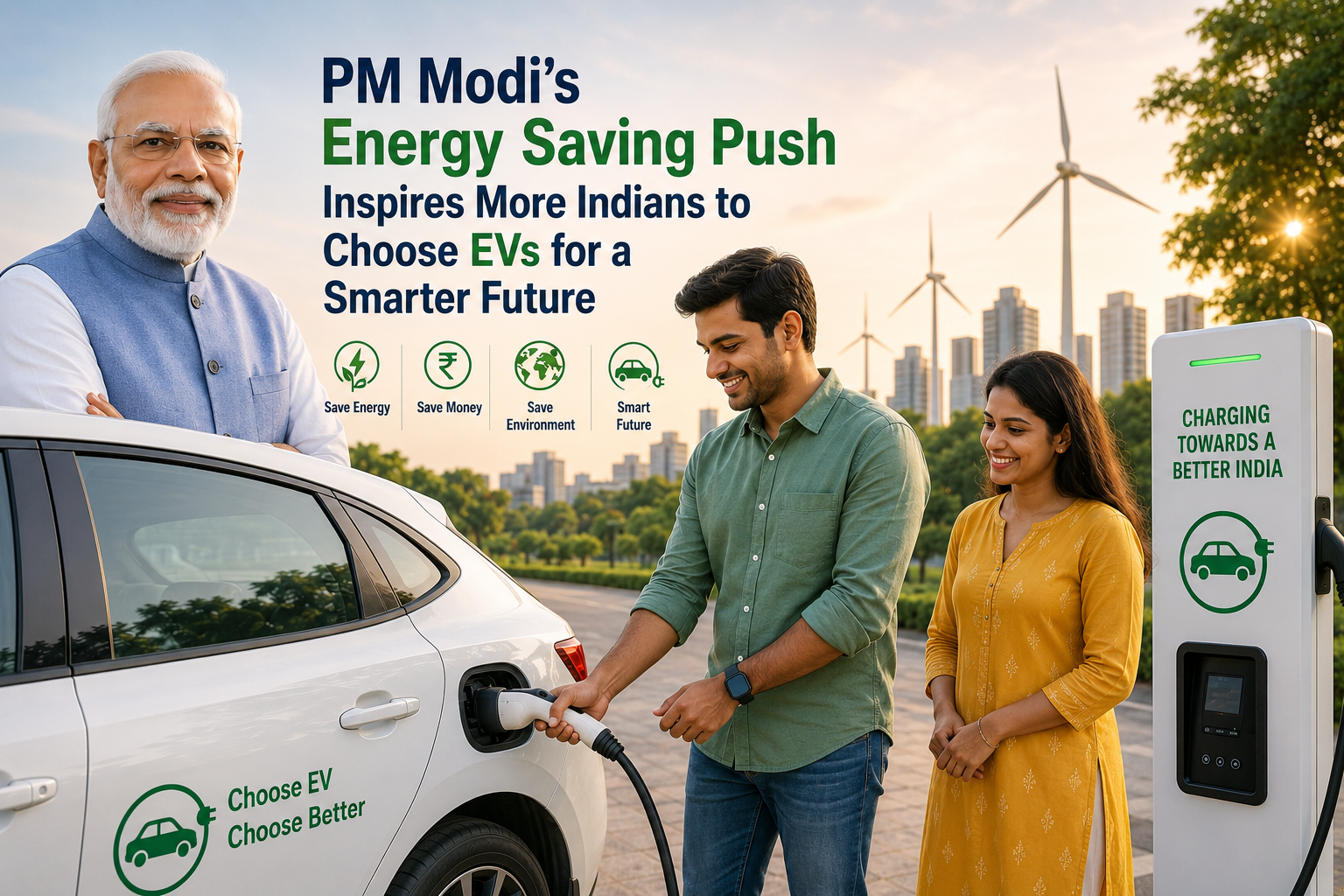
India’s electric vehicle journey is no longer something people talk about only as the future. It is slowly becoming part of everyday life. From electric scooters on city roads to charging stations appearing in apartments, malls, and office spaces, EV adoption across India is growing faster than many expected.
Prime Minister Narendra Modi recently spoke about the importance of saving energy, reducing fuel consumption, and choosing smarter transportation options. His message connected with a reality that many Indians are already experiencing — rising fuel prices are making daily commuting more expensive than ever before.
Over the last few years, people have started looking at EVs differently. Earlier, electric vehicles were often seen as expensive, limited, or difficult to maintain. Today, they are becoming practical for regular families, working professionals, and city commuters who want to reduce long-term expenses.
India’s EV market growth clearly reflects this shift. In 2020, annual EV sales in India were below 2 lakh units. By 2025, the country crossed nearly 20 lakh EV sales annually across electric cars, scooters, and commercial vehicles. Experts now estimate that India could cross 1 crore EV sales every year by 2030 if the current growth continues.
One of the biggest reasons behind this rapid change is simple — EV ownership is starting to make financial sense.
Rising Fuel Costs Are Changing Buyer Decisions
Fuel expenses have become one of the biggest monthly concerns for Indian families. Petrol prices crossing ₹100 per litre in several cities have forced many people to rethink their daily travel costs.
A person travelling around 40 to 50 kilometres every day can easily spend more than ₹10,000 monthly on petrol alone. Over a year, that becomes a major expense.
Electric vehicles are helping reduce that burden significantly.
Charging an EV at home usually costs around ₹1 to ₹1.5 per kilometre, while petrol vehicles often cost ₹7 to ₹10 per kilometre depending on traffic conditions and fuel prices. Many EV users are now saving close to ₹80,000 to ₹1 lakh every year compared to traditional fuel-powered vehicles.
Maintenance expenses are also lower. EVs do not require regular engine oil changes and generally have fewer moving parts than petrol cars. For many urban buyers, this combination of lower fuel and maintenance costs is becoming one of the strongest reasons to switch to electric mobility.
India’s Charging Infrastructure Is Growing Rapidly
A few years ago, charging availability was one of the biggest worries surrounding EV adoption. Many people feared getting stranded without nearby charging stations.
That situation has changed considerably.
India had fewer than 2,000 public charging stations in 2021. Today, the number has crossed 26,000 charging points across highways, airports, malls, office complexes, and residential communities.
Battery technology has also improved rapidly. Earlier electric vehicles struggled to provide more than 100 to 120 kilometres of practical range. Today, many EV models comfortably offer between 300 and 600 kilometres on a single charge.
Fast charging technology is improving too. Several modern EVs can now charge from 20% to 80% in under 45 minutes, making longer travel much easier than before.
Because of these improvements, more people now feel confident about switching to EVs without worrying constantly about charging limitations.
Sell EV Cars in Bangalore Through EV-Focused Platforms
As EV ownership grows, the resale market is also becoming stronger across India.
Earlier, many buyers were uncertain about the resale value of electric vehicles. Today, that hesitation is gradually reducing as more people become familiar with battery life, charging infrastructure, and EV ownership.
Cities like Bangalore are leading this transition because of faster EV adoption, better charging networks, and stronger awareness about sustainable transportation.
This growth has naturally increased the demand to Sell EV Cars in Bangalore through dedicated EV marketplaces instead of traditional classified platforms.
Many vehicle owners now prefer platforms like ev.sale because buyers visiting EV-focused websites already understand electric vehicle ownership, charging needs, and battery performance. That makes the resale process smoother and more reliable.
The demand to Sell EV Cars in Bangalore has especially increased among users upgrading to newer EV models with improved range and updated technology. Industry reports also suggest that India’s used EV market could grow by nearly 40% annually over the next five years.
Sell EV Cars in Bangalore
India’s automobile industry is currently going through one of its biggest transitions in decades. Global manufacturers are investing heavily in electric mobility, battery production, and charging ecosystems.
India itself is aiming for nearly 30% EV penetration by 2030 as part of its larger sustainability and energy-saving goals.
The rise of the Best EV marketplace in Bangalore reflects how quickly consumer behaviour is changing alongside this shift. Buyers today want transparency, verified EV listings, and platforms that properly understand electric mobility.
Prime Minister Modi’s focus on energy conservation and smarter transportation choices is also encouraging more Indians to think differently about the future of mobility. For many people, EVs are no longer just about sustainability. They are becoming a practical way to reduce monthly expenses and depend less on rising fuel prices.
The Best EV marketplace in Bangalore is now playing an important role in helping buyers and sellers connect more confidently in the growing EV ecosystem.
And for people planning to upgrade or sell EV Cars in Bangalore, the market today looks far stronger than it did even three or four years ago. India’s electric mobility journey is still growing, but it is becoming increasingly clear that EVs are steadily moving towards becoming a normal part of everyday life.
1. Is buying an electric vehicle worth it in India right now?
Yes, EVs are becoming more practical and cost-effective for Indian buyers. With rising petrol prices, lower running costs, and improving charging infrastructure, many users are saving a significant amount every year. Modern EVs also offer better range and faster charging compared to earlier models.
2. How much does it cost to charge an electric car in India?
Charging an electric car at home usually costs around ₹1 to ₹1.5 per kilometre depending on electricity tariffs and battery size. Compared to petrol vehicles, EV owners can save between ₹70,000 and ₹1 lakh annually on fuel and maintenance expenses.
3. Is it easy to sell EV Cars in Bangalore today?
Yes, the demand to Sell EV Cars in Bangalore has increased rapidly because Bangalore has become one of India’s biggest EV markets. Buyers are actively searching for used EVs with good battery health and verified ownership details through dedicated EV platforms.
4. Which is the Best EV marketplace in Bangalore for buying or selling EVs?
Platforms like ev.sale are becoming popular because they focus specifically on electric vehicles. Buyers and sellers get access to EV-focused listings, battery-related information, and a marketplace designed around electric mobility instead of general automobile sales.
5. What is the future of electric vehicles in India?
India’s EV market is expected to grow rapidly over the next decade. Industry experts predict that EV penetration could reach nearly 30% by 2030 due to stronger government support, expanding charging infrastructure, and increasing consumer awareness about energy-efficient transportation.
Leave a Reply